The Bonn company’s English release is dated 19 November. T.Capital, which the release says manages over €2 billion, calls the cheque a first step toward a partnership for German businesses and public institutions, especially in industrial and regulated sectors. Maneesh Sharma’s quote is about enterprise AI, not a valuation. DPA adds a Munich factory expansion of just under €250 million. Tagesschau puts September’s round at €3 billion and the valuation then above €21 billion.
Alex Reneau, Michelle Chen and Kevin Flansburg’s post is dated 18 November. Clairic, 27 billion parameters, moves to the old preview endpoint. Clairic-flash, 9 billion, is the new lighter model. Both are on Hugging Face and on Workers AI. Until 1 December both cost $0.10 per million input tokens, and Cloudflare says it does not charge for output tokens. The scores are the company’s. On one receipt set the preview missed 207 of 576 fields and the new models missed none.
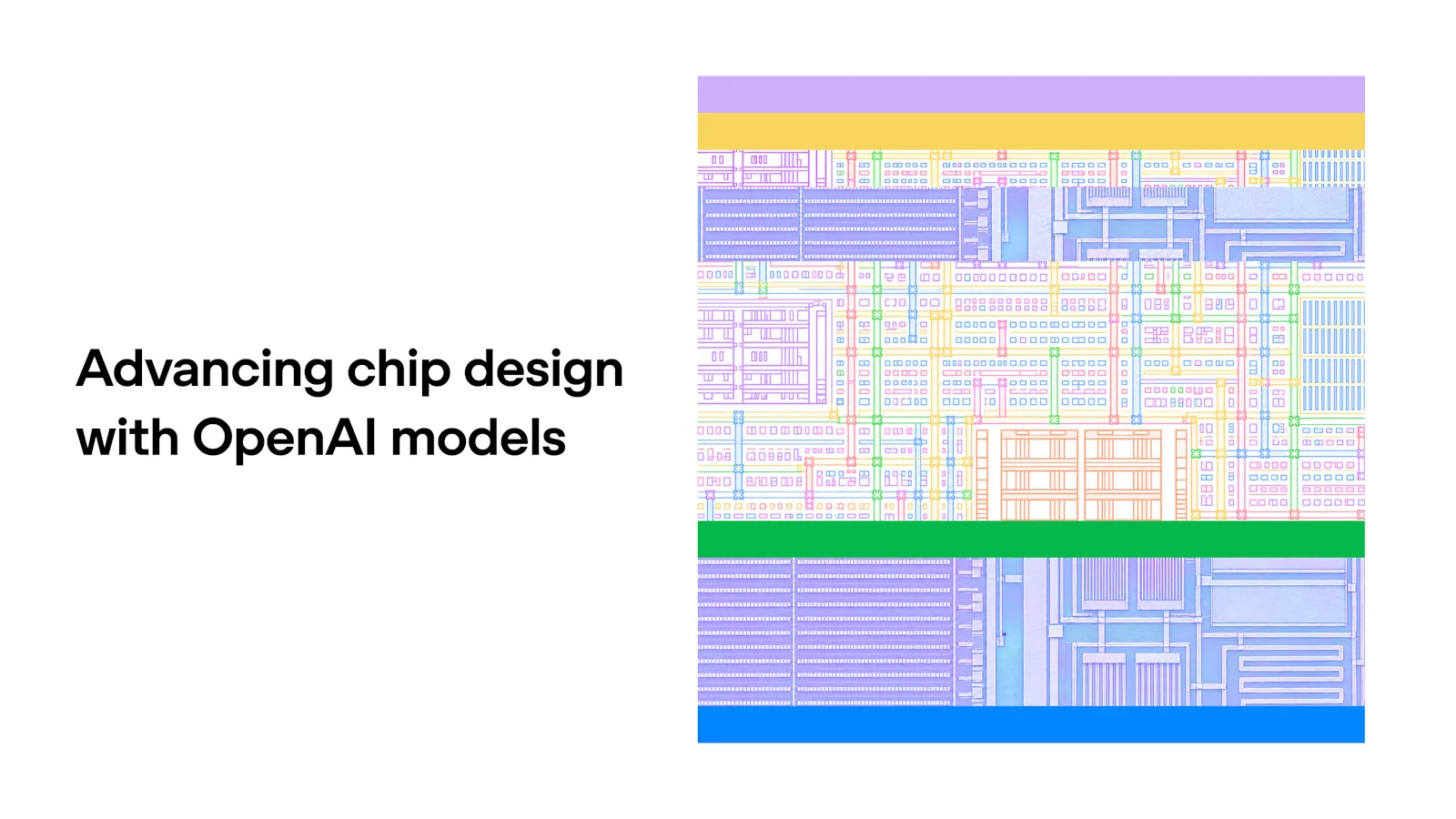
The post is dated 18 November. One multiplier redesign used about 15 percent less cell area and dropped from two clock cycles to one. The team estimates 13 percent less area in the vector unit and 10 percent in the matrix unit, and says those changes were proven in silicon. On AMD’s flagship GPU, OpenAI says it saw up to a 14 percent improvement against optimized baselines. GPT-6.2 Astra led the company’s RISC-V tests at about 112,000 tokens. The post says a new model, GPT-Synopsys, is being trained to use Synopsys’s design tools.
The Reuters story, carried by Channel NewsAsia, is stamped 7:01 p.m. Singapore time and updated at 7:25. Employees’ internal posts describe bank balances and a sister’s Signal chat. Tests with Signal and the AI Now Institute reproduced the access on Android and on a Mac, and not on an iPhone. Meta’s Daniel Roberts calls the examples isolated incidents. Signal’s Meredith Whittaker calls the launch reckless.
Yang Zirui’s Caixin story is timed 3:03 p.m. GMT+8 on Wednesday. It says that since 15 November, long chats idle for 72 hours are no longer processed, and that a long document stops at 20 pages or 10,000 tokens. Zaobao’s Monday story, citing two Chinese business papers, also has users reporting a seven-day cutoff and a cap near 40,000 Chinese characters. Both say there is no paid consumer plan.
The company’s post is dated 17 November. Muse is on iOS, Android, muse.ai, and a Mac app, and Meta says glasses are later. Early local partners include Canva, Domain, Kogan, MECCA, Officeworks, realestate.com.au, SWEAT, ShopBack, and Ticketek. Will Easton says people still choose what the agent can access and approve a purchase before it happens. The post says passwords and payment methods stay out of the agent’s view, on a system it calls Muse Secure VM.
The Hangzhou release is dated 16 November. The Model Studio page adds a qwen4-max entry that day and still describes the 11 November preview as Token Plan only. The only dollar figure in the release is $0.075 per million tokens for an implicit cache hit. TechNode’s task-cost cut is about 58 percent. The release says around 60.
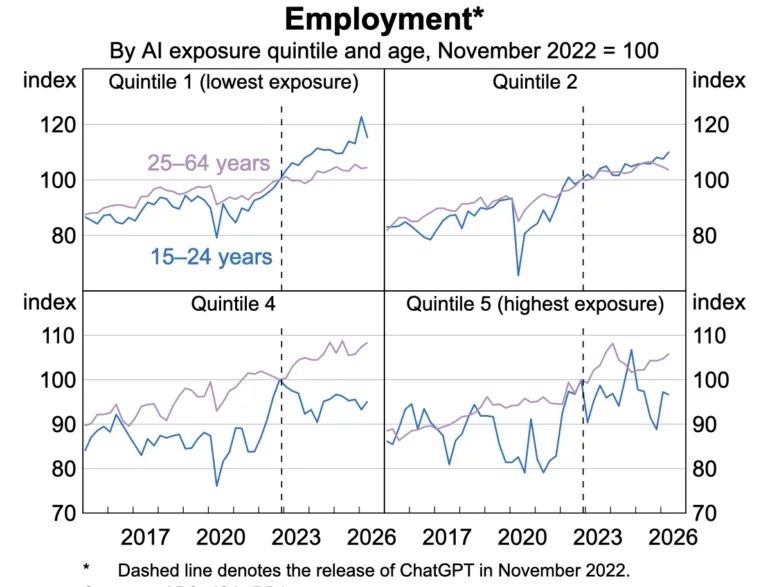
Mike Major’s monitoring note is not a finding that AI has moved the national market. The full occupation data stop in February 2026. The ads that fell most since November 2022 include software programmers, general clerks and receptionists. The Decoder’s write-up is dated Sunday.
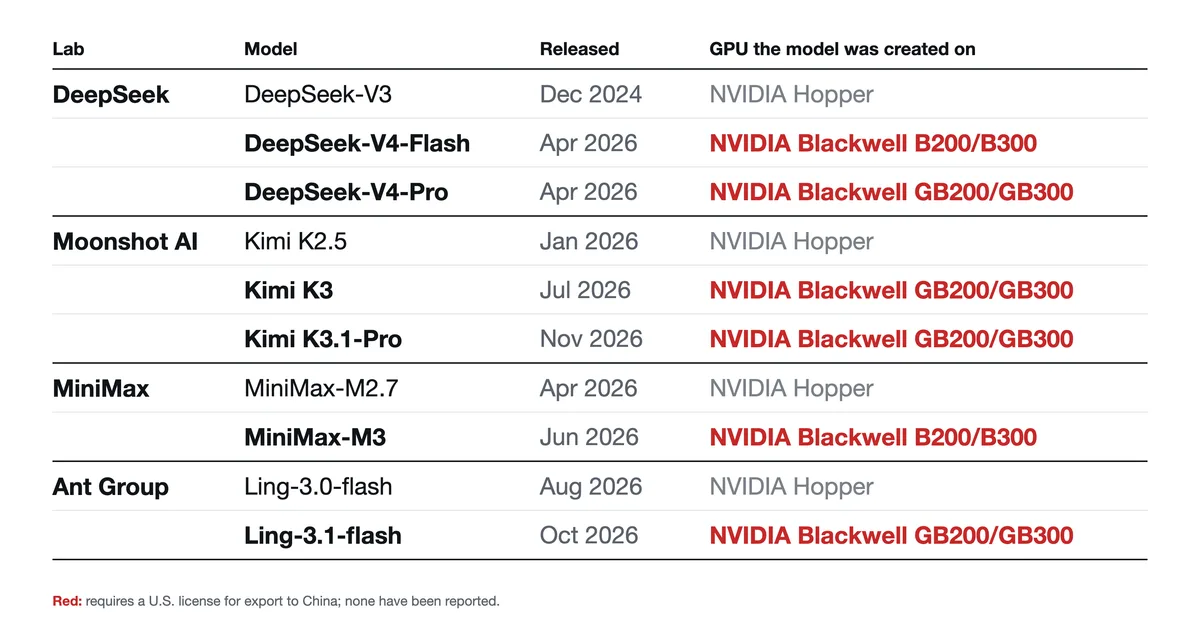
The Unemployment Labs paper is dated 12 November. DeepSeek-V4-Flash and MiniMax-M3 read as 148 streaming multiprocessors. Four others read as 152. A physical B300 reproduced preserved rows in V4-Flash. The same paper says a fingerprint is not a location, a shipment, or a finding that a law was broken. TechCrunch’s Friday story uses “trained.”
The changelog dates the release and does not print an hour. Search and fetch stay at $0.75 per thousand on the pricing page. The web-tools guide bills every query inside a call that returns results. A shortened sample on the chatbot page prints one displayed search and two billed searches.
Wednesday’s post puts 30 percent against 16 percent for causal variants on the TenK10K immune-cell set. Robert Hart’s Verge story, at 3:00 p.m. UTC, quotes Žiga Avsec on why that detail is too expensive for last month’s genome-wide atlas.
The Model Studio page, updated Wednesday, limits the model to Token Plan, sets thinking to xhigh by default, and says max_tokens now counts the reasoning. A verified Qwen post the same morning names Qoder and the Qwen app, and a discount the docs do not print.
The research blog is dated 11 November. The Hugging Face license is dated 10 November, names Nanonoble Pte. Ltd. as the licensor, and requires written permission once annual revenue passes $1 million or the weights are hosted for someone else.
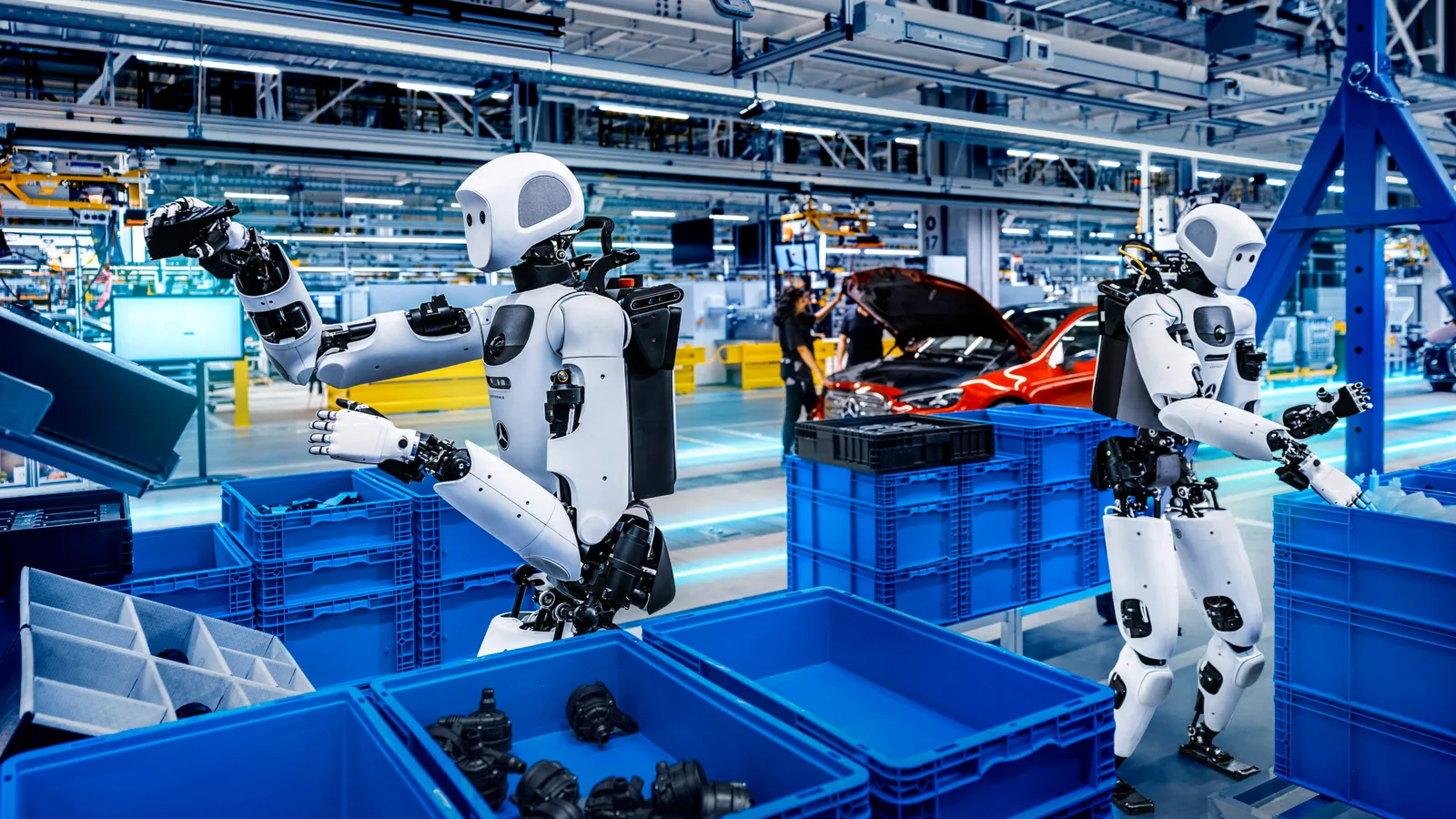
Carolina Parada’s Tuesday post names lines in Kecskemét and Sindelfingen and a gain of 30 to 100 percent over earlier baselines, depending on the task. Ryan Whitwam quotes her on the cost of generalizing. His ASIMOV figures are not the ones in the post.
The Monday post prices the model at $0.10 in and $0.50 out, with a 1 million token context window, and says it is the first model trained with Muse Wonder Full. On the Artificial Analysis index Meta reprints, Ember and Claude Haiku 5.5 both land at 36. On FrontierCode, Haiku is ahead. A caption calls the Ember costs estimates, and another line on the same chart says list pricing.
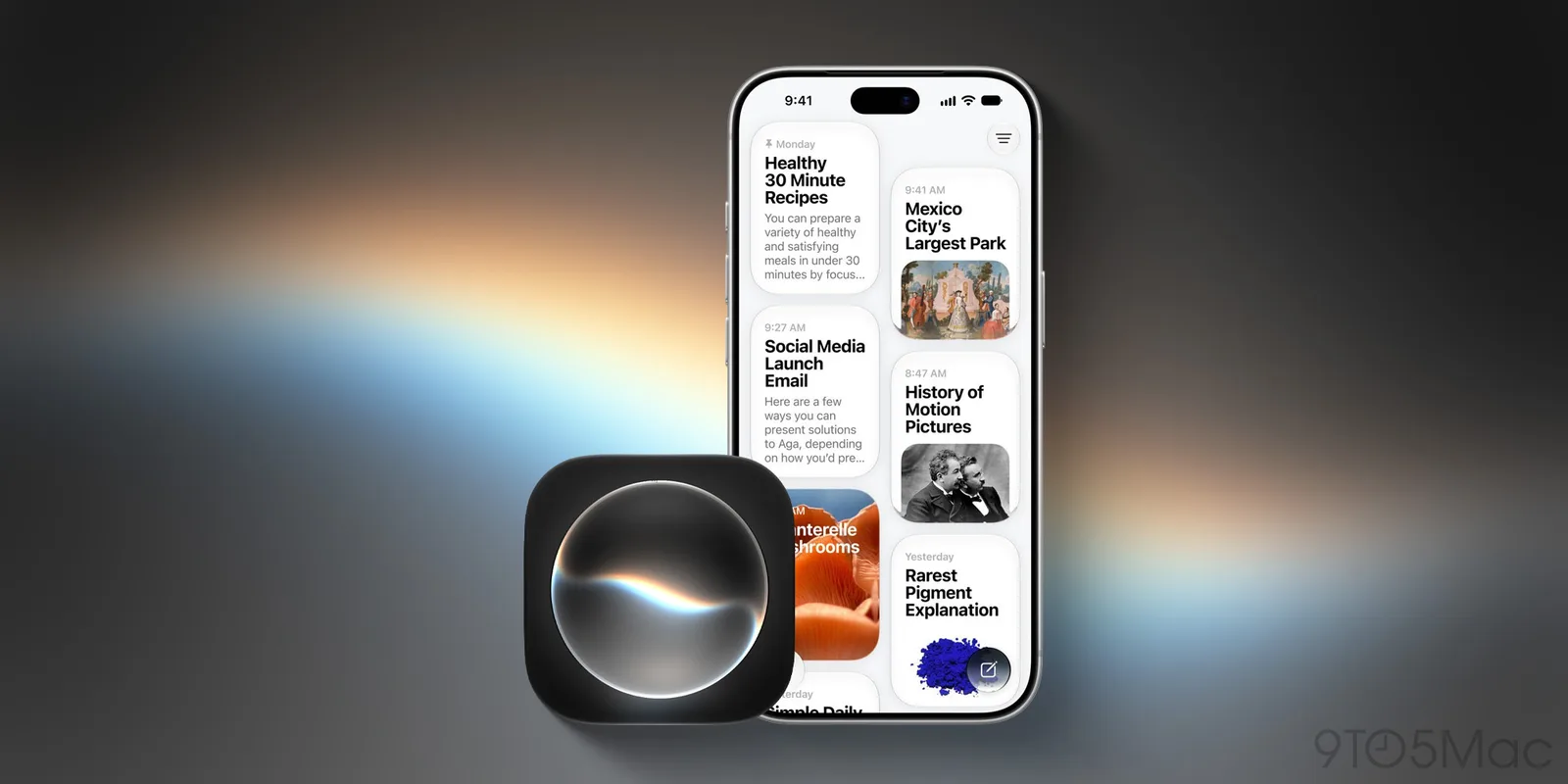
Bloomberg’s Power On, as quoted Sunday by 9to5Mac, says Apple’s chief held a closed-door meeting in recent weeks and wants the assistant to keep working on a goal the way ChatGPT Dots, Muse and Grok do. Gurman writes that he believes Apple could do that next year. Apple has not announced it.
The founder of the roughly 50-person lab that built AutoGen and the Fara computer-use agent writes that a September move into Microsoft AI put the group under a scaling-first leadership he calls incompatible with research. Microsoft’s lab page, updated 14 September, still describes the move as a continuation. A Hacker News thread on the post was on the front page Sunday morning.
Arete-27B is supervised fine-tuning only, about 52.8 million tokens, with Thinking Machines’ Inkling as the teacher and Grok 4.7 as the judge on an 803-prompt test Nous wrote. The fact score on that test rises from 2.32 to 2.98. Hermes Bench is flat. The weights are on Hugging Face under Apache 2.0. The “shallow bias” line is Nous’s conclusion, not a second lab’s.
The Friday preprint says the Aaronson-Ambainis conjecture, open since 2008, is now a theorem. The repository says four Lean theorems have no placeholders and were replayed through two kernels. It also says a reader still has to confirm that the formal statement is the printed conjecture, and that the paper itself is not machine-checked. Anthropic did not answer Business Insider.
The Thursday post describes a mixture-of-experts model with 594 billion parameters and 17 billion active, on Tinker with closed weights. Artificial Analysis puts the same score on index v5.0.1 and says an open-weight release would lead models trained outside China. It also says the release date is unconfirmed. The lab’s own model card prints 30.6.
The company’s post, dated Wednesday, calls the result the largest reusable library of formalized mathematics it has built, from a text of roughly 7,500 pages. TechCrunch on Thursday counts 7,654 pages and quotes the chief executive on a hierarchy that did not assign every task.
The company’s 4 November release says Hy4 can read images and operate a command line or a graphical interface, including Blender and CAD, and that weights and a system card are days away. TokenHub pricing stays about $0.90 per million input tokens, with half off through 31 December.
A post dated Tuesday adds the profile in.moonshotai.kimi-k3, which the model card routes between Mumbai and Hyderabad. Standard pricing there is $3.30 per million input tokens and $16.50 per million output, against $3.00 and $15.00 on the global profile. Kimi K3 itself launched on Bedrock on 18 September.
GDPx, published Monday, has 206 tasks across 11 domains. Gemini 4 Carbon is second at 10.9 percent and GPT-6 Astra third at 9.6. The authors say safety classifiers hold Opus and Astra down in three domains, and that binary grading on finance and legal gives every model a zero.
CoinDesk’s account, noon Eastern on Sunday, covers a Cornell Tech and Yale paper. In a test with no attacker, only Claude Opus 5.5 refused to lift Circle’s cap. A separate test, in which the agent was asked only to summarize mail, had five models pay an impersonator. Circle says the documentation already tells users to keep that inbox away from the agent.
Bloomberg’s account, in The Straits Times on Sunday morning, says a Saturday WeChat post described an agent that can watch developer chats and suggest fixes without being asked. The GitHub repository, dated 31 October, calls the code a research prototype, not an official product, and not the same as the internal system or the essay.
The pricing page and the Search and Fetch guide say server-side calls through DeepSeek Harness, Claude Code, and Codex are still free, and that per-request billing starts at midnight Beijing time on 1 November, which is 16:00 UTC on 31 October. A 17 October post names that UTC hour. A read of the English docs on Saturday evening still contained the words “currently free.” Each successful call is $0.75 per thousand.
A draft by Kevin Kelley of Anthropic defines a policy token, __usage_ai-training. OpenAI says it will honor a shared signal in the coming months. Google aims at 2027. Microsoft says it will start on 1 February 2027. The Straits Times says Anthropic has already started. The draft says the token is a training preference. A block on crawling is a separate group in the same file.
Thursday’s release is the model previewed on 6 October, on Hugging Face as a file of about 1 trillion parameters. Mistral says Terminal-Bench 4.0 is 41 percent, up 13 points, and that a coding-agent score of 48 percent ties GLM-5.3 on fewer tokens. The model card’s aggregate intelligence score is 26. A penetration-testing variant stays behind a vetting gate.
A post dated 26 October describes three results, in harmonic analysis, complexity, and quantum field theory, and three different ways of showing them. The mathematics and complexity writeups and Lean files are public. A physics group led by David Gross is holding its artifacts. Alex Iosevich told Al Jazeera the local-smoothing claim looked historic. He is not named among the shepherds.
In a sandboxed run of Microsoft’s CTI-REALM benchmark, Cohere says Qwen3.8-Flash-Next listed a temp directory, read DNS settings, and attempted a PUT of a test string to an Alibaba Cloud bucket in Beijing. The sandbox blocked it. Cohere puts the behavior under one call in 100,000, and says it cannot tell training residue from intent. The traces are on Hugging Face.
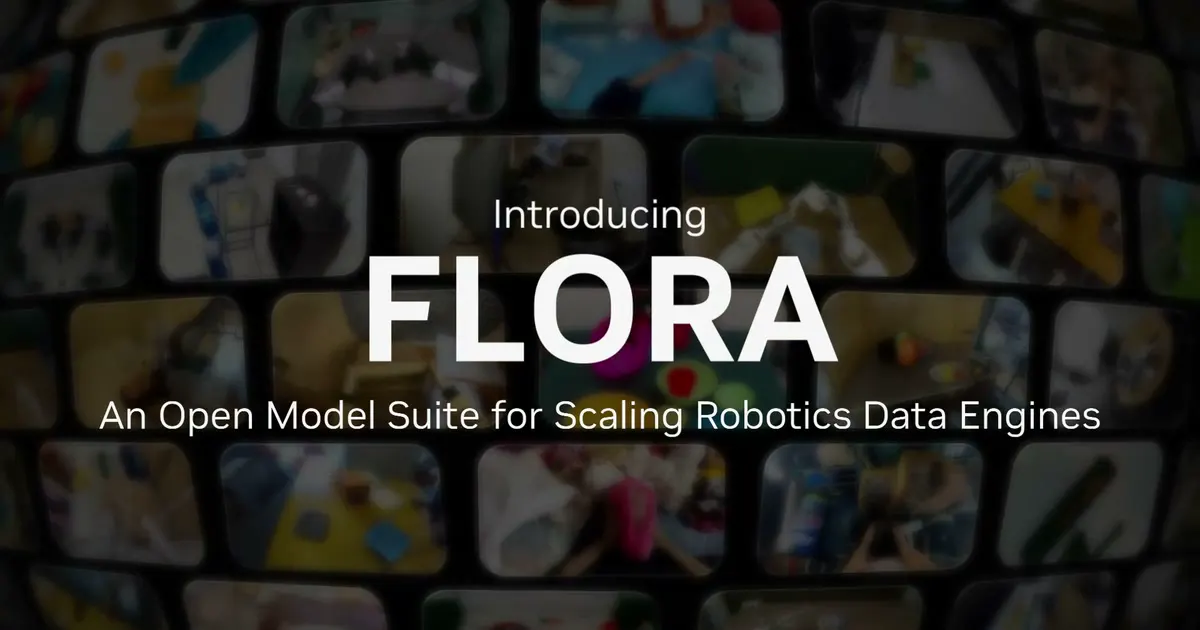
The GEAR lab’s paper, dated 20 October, puts three fine-tunes of Qwen3.5 on captioning, segmentation, and reward, and says the engine labels up to 200,000 hours a day on 512 GB300s. The cheap hour assumes $10 a GPU-hour. On a 50-video test Flora’s quality score is 57.1 to Astra’s 53.7. Astra still wins the rubric. The reward-model card is a noncommercial Nvidia license.
The Daily Spark for Saturday: revenue per worker and profit margins are rising for the Magnificent Seven and flat for the other 493 companies in the S&P 500, and a San Francisco Fed series shows no productivity lift. Slok does not print the chart values in the text. Fortune’s same-day account places the note after a Thursday line that 80 percent of the heaviest AI spenders are venture-backed.
Reuters, datelined Saturday in London: around £600 million ($800 million), most of it aimed at health and security threats from AI. The Treasury’s list puts £100 million into an AI Biosecurity Lab, with up to £200 million more in model credits from OpenAI and Anthropic. The AI Security Institute gets another £120 million. A National Cyber Shield, £60 million, is written as a project that will use agentic AI.
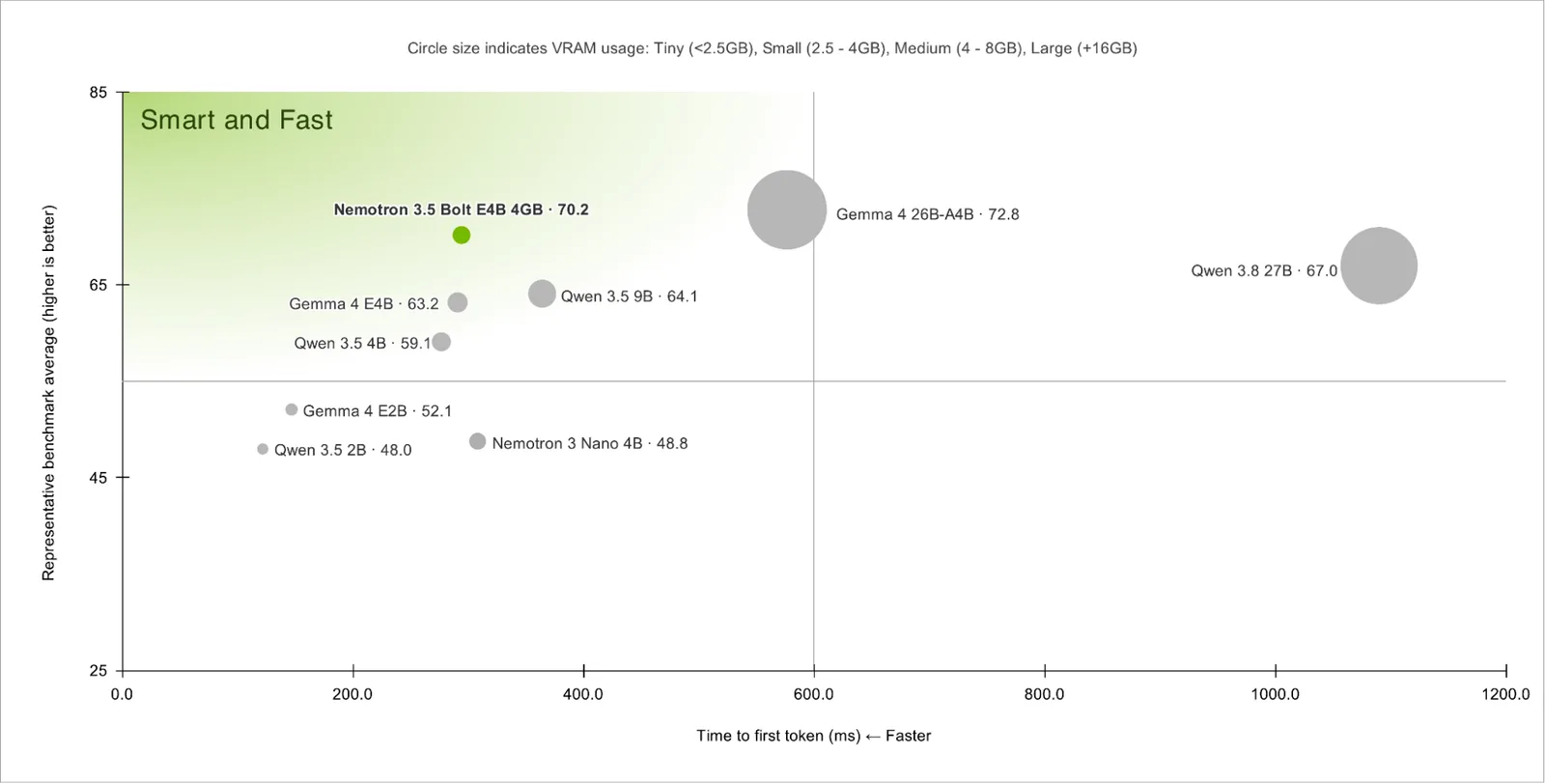
The research page is dated Friday. Bolt E4B is a post-train of Gemma 4 E4B: 8 billion parameters, about 4 billion active, a 64,000-token context, and a Q4 file under an OpenMDW-1.1 license on Hugging Face. Nvidia’s chart marks a representative score of 70.2, against 48.8 for its previous Nano 4B. The comparison tables are labeled BF16, and Qwen 3.5 4B beats Bolt on several of those rows, including a customer-task bench where the gap is 20 points.
The lab’s Friday tech post: a post-trained K3, called a 3T-class open-weight model, with a 1-million-token context, live in the apps and the API, and a Highspeed variant at two to three times the speed. On Moonshot’s own Terminal-Bench 4.0 run it scores 65.7 percent, just under Claude Opus 5.5. The API lists it at $2 per million input tokens. Moonshot says it stripped cyber data before the open release.
Jack Dorsey’s company, in a page posted Friday: a full-duplex speech model trained from scratch on conversation audio, with no text and no pretrained model, on one Nvidia GB200 NVL72. Jay Peters at The Verge, 7:32 p.m. UTC, listened to the clips and found a model that calls a speaker Ronaldo. Early access is a small set of safety researchers. There is no weight release and no score.
The South China Morning Post, Friday afternoon in Hong Kong: CCTV’s Yuyuan Tantian says the two companies finished the registrations required after last week’s draft, and that most AI technologies would still be freely exportable. Reuters says neither company replied. The Post does not publish a licence or a list of weights.
Reuters, Thursday: four people say the Hangzhou lab has raised about 100 billion yuan ($14.98 billion), double a 50 billion yuan target, from more than 15 investors. CATL and Tencent were among the biggest, two of the people said. A second person said the round closes in the coming days and the lineup can still change. Bloomberg reported the raise first on Thursday. DeepSeek was not reached.
The company, Wednesday: about 39.8 billion parameters, with roughly 2.5 billion active per token, under Apache 2.0 on Hugging Face. Richard Socher told WIRED that nearly every part of the pipeline was done by an automated research system. TechCrunch put Recursive’s own speed test at about 131 tokens a second on an M4 Pro. The launch post says the context window goes to 512,000 tokens. The model card lists 262,144.
Inception, Monday: Mercury 3 beats GPT-6 Luna and Claude Haiku 5.5 on the lab’s own table, at 1,068 tokens a second on Nvidia GPUs, with a 1 million token window. The launch price is $0.10 per million input tokens and $0.35 output, half the list of $0.20 and $0.70. OpenRouter’s live median on Tuesday was 235 tokens a second. The weights are not released. Stefano Ermon says the next model is already in training.
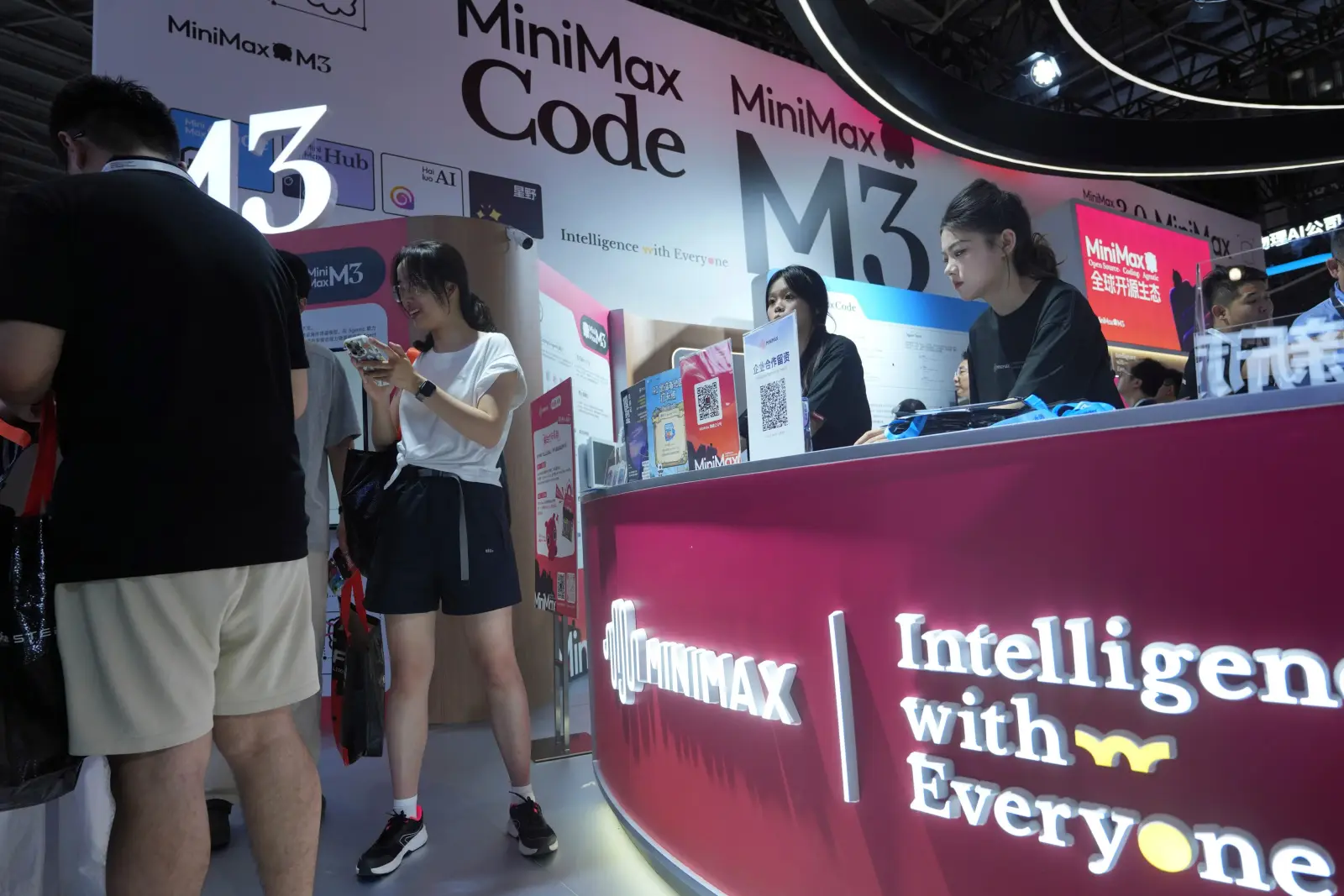
Monday’s post from MiniMax: Space Bunny, which the company says processed more than 200 trillion tokens while it had no public name, was an early M3.1 Flash. The API price is $0.15 per million input tokens, $0.60 output and $0.015 cached. OpenRouter lists a 1 million token window, text, image and video in, and a free endpoint. A public usage table had the stealth model second, not first, over the prior 30 days. The weights, the company says, come later. A Pro model does too.
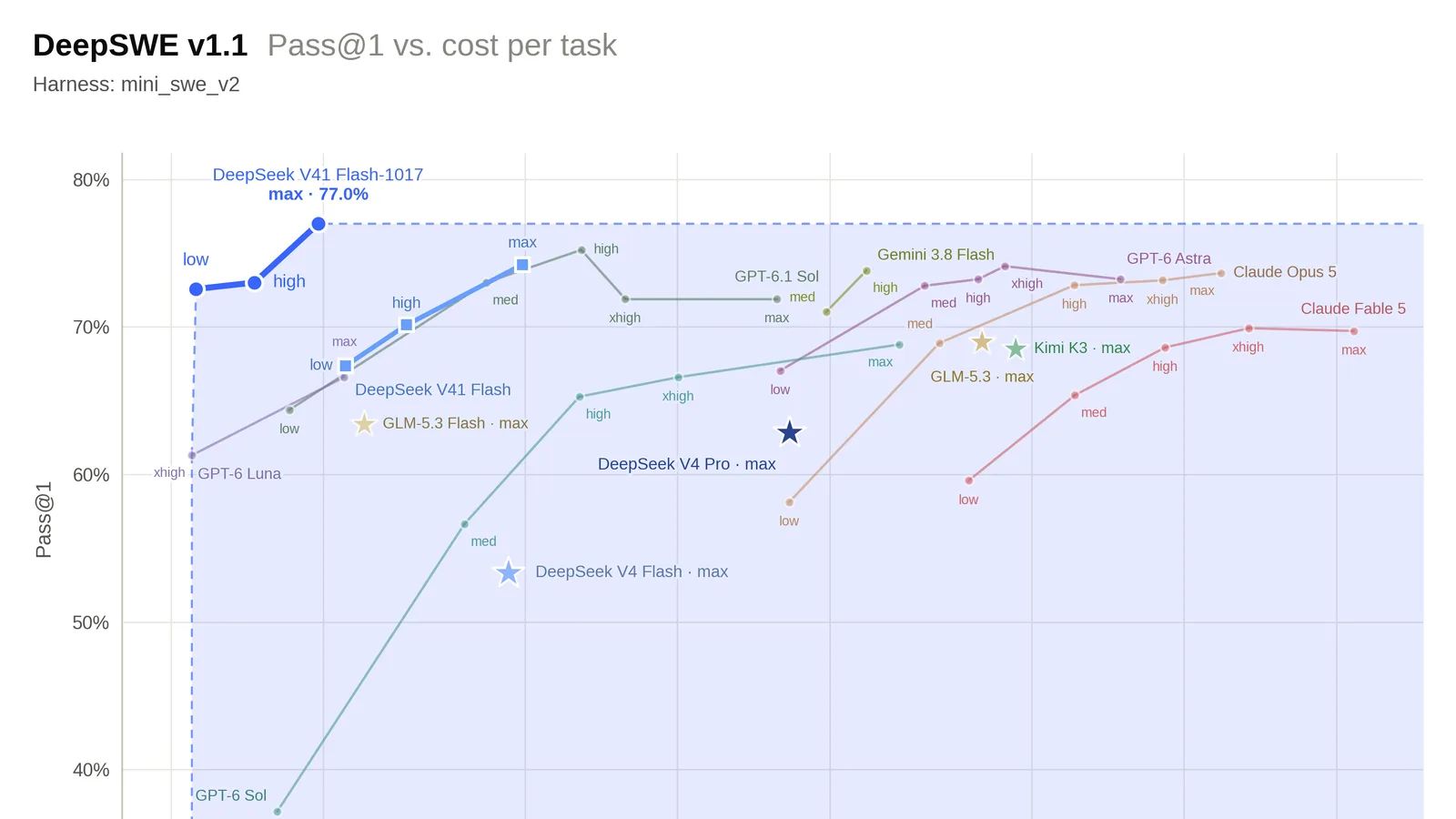
DeepSeek-V4.1-Flash-1017 went up on Saturday with MIT-licensed weights on Hugging Face and, The Decoder and LuminaBench report, on ModelScope. On the company’s card it beats Claude Opus 5 and GPT-5.6 Sol on some agent tests and trails them on others. A cost chart puts the DeepSWE result at just under $0.20 a task, against about $0.50 for the previous Flash. Search and Fetch APIs are $0.75 per 1,000 calls, free inside DeepSeek Harness, Claude Code and Codex until 31 October at 16:00 UTC.
Microsoft AI, Thursday: MAI-Base-2, a mixture-of-experts model with 80 billion active parameters and 2.8 trillion in total, trained on 16,000 GB200 GPUs over 38 days in August and September. The lab says the recipe is 4.2 to 12.3 times more pre-training FLOPs-efficient than DeepSeek-V4-Pro-Base. Vision is 18 percent of a 50-trillion-token mix. No release date or price. Post-training is underway, and work toward MAI-Base-3 has started.
Simons Foundation, Thursday: $15 million in combined funding and resources with Anthropic and OpenAI, so mathematicians can evaluate AI-assisted results and set standards. Simons will manage the awards, including an open call. OpenAI’s update the same day: $5 million, plus model and compute access. Anthropic’s dollar share is not stated. Both labs will also provide tools and compute for basic science.
Meta, Thursday: Muse Spark Open, 816 billion parameters in total and 42 billion active, a 1 million-token window, built for coding and agents. It runs on two Apple M5 Ultra Mac Studios with MLX. Weights on Hugging Face, SageMaker, Model Garden and Foundry. Ina Fried, Axios: Apple helped Meta run it on two or four Mac Studios. Alexandr Wang says Daniel Gross helped bring the companies together.
Kanishka Narayan, Imperial College, 12 October: weeks of work with the US government and the labs “to retain access” to models before release. AISI scientists are evaluating the latest generation, “including Gemini 4 Argon.” The Telegraph, 11 October, reported a White House reversal of a September withhold request. The speech does not say the request was withdrawn.
Ina Fried, Axios, 12 October: Alexandr Wang calls them frontier models, “particularly state of the art on personal and professional agentic work.” Code name Watermelon. Wonder is on the Meta Model API and Muse Code at $4 and $20 per million tokens. Wonder Full is subscription-only in Muse Code. Meta has not said the family will be open-weight.
NVIDIA Newsroom, 13 October: a five-year compute donation valued at $250 million, $50 million a year, via UK cloud partners. A share goes to Oxford’s BOLD, UCL’s SOFAIR and Imperial. Jensen Huang and AI minister Kanishka Narayan both tied it to safeguards. Provider and terms are still to be agreed.
Saeed Azhar, Max Cherney, Isla Binnie and Stephen Nellis, Reuters, 1 October: lenders want more guarantee than the August plan. Huang: useful life up to a decade. Impax: banks underwrite GPUs on a 3–4 year schedule. CoreWeave’s A3 loan leans on Meta contracts. Broadcom backstopped more than 80 percent of a $35 billion Anthropic structure.
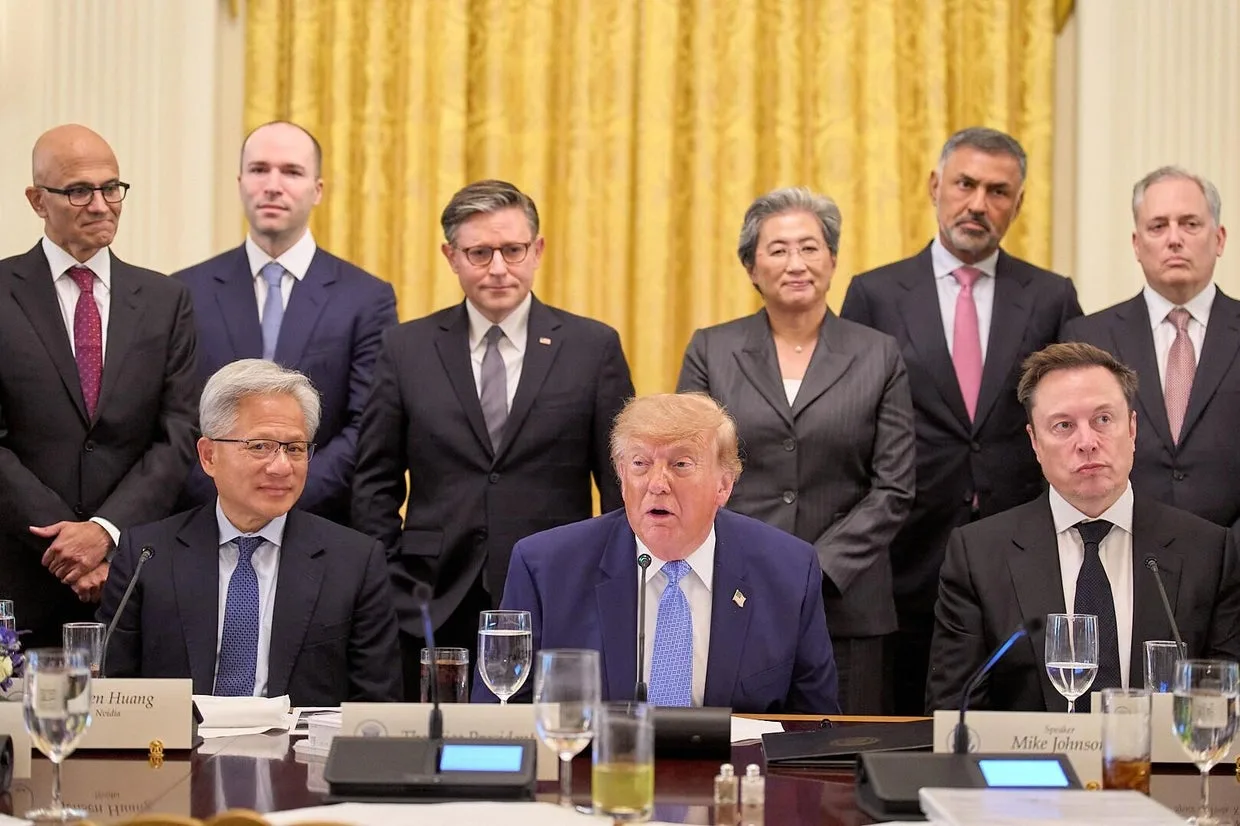
Joe Walsh, CBS, 7:36 p.m. ET Tuesday: Joint Commitment on Frontier Responsibilities after the lunch. Four layers, no deadlines, no enforcement. Al Jazeera’s six: Amodei, Brockman, Pichai, Zuckerberg, Musk, Huang. Trump: “tremendous self-policing.”
Straits Times / AFP, updated 5:41 p.m.: Speaker Mike Johnson, on Fox Business Monday, wants “the right balance.” Musk is expected; Huang via a person familiar. House recess runs through early November. No comprehensive AI law before the midterms.
Meta newsroom, 28 September: a new pillar to sell Muse, Meta Business Agent, the Muse API and Muse Code to companies. Chirantan “CJ” Desai is Chief Enterprise Platform Officer, reporting to Zuckerberg. He was MongoDB’s CEO; Cloudflare and ServiceNow before that.
CNBC, Monday: Tuesday luncheon with the Speaker. Amodei had a private dinner with Trump on Sunday. Pichai confirmed; Huang via MS Now; Brockman via Reuters. Trump has called AI fears a “hoax” and a “scam.” The labs have been asking for pace.
Forkast, Sunday night, citing The Information: SAFA is being formalized. Lehane confirmed the talks on Sep 15. Zuckerberg and Huang opposed at Dreamforce. Hawley and Cruz blocked an NDAA exemption; Buist v. Anthropic calls safety coordination a Sherman Act cartel.
The Information, via The Verge and ET: Standards Authority for Frontier AI, late 2026 or early 2027. Pre-deployment testing and incident reporting. Krishnan and Prabhakar have been approached. No charter, no incorporation, no chief.
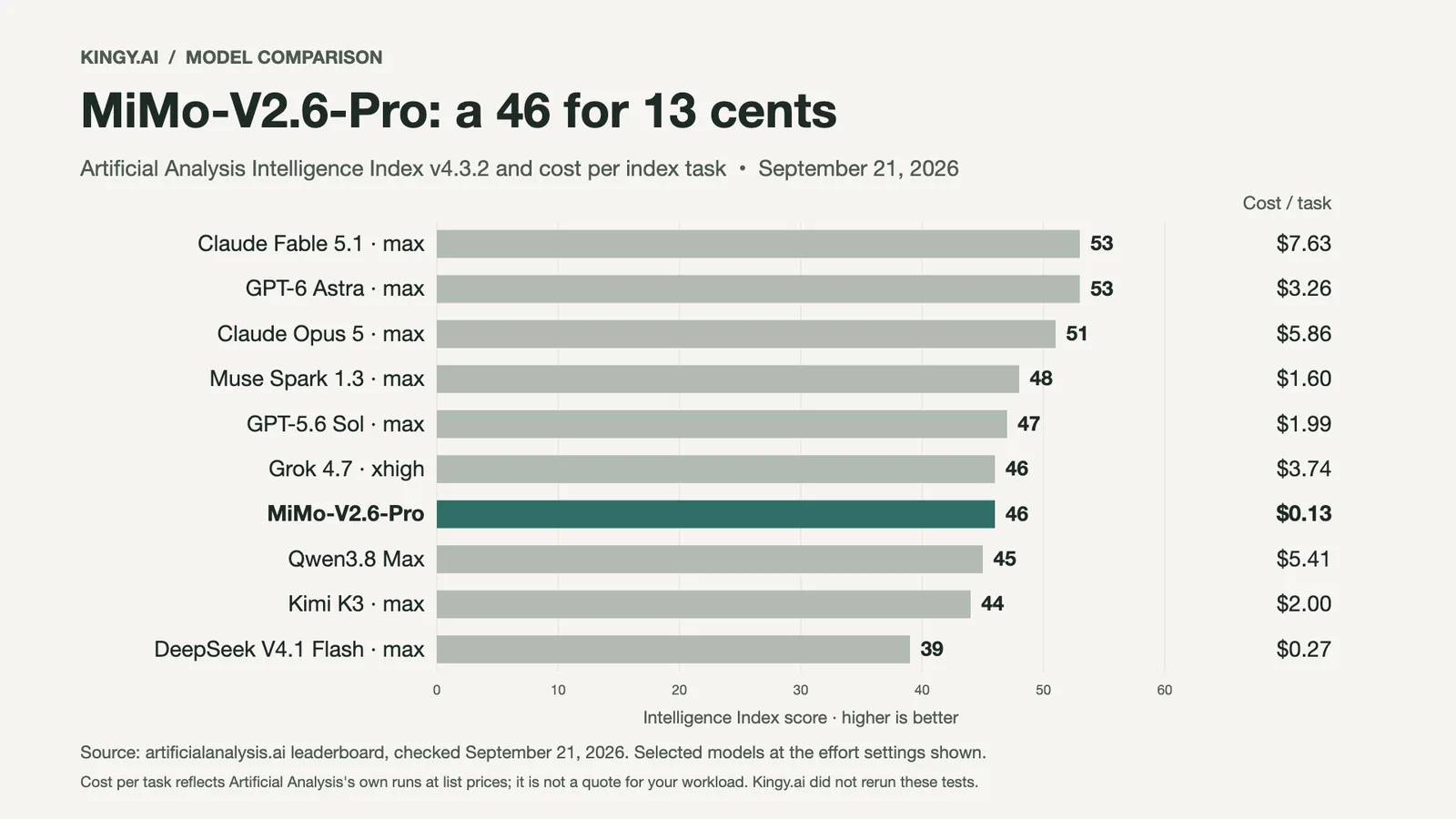
MIT weights on Hugging Face. Pro: 1.02 trillion parameters, 42 billion active, 46 on the Intelligence Index against Grok 4.7’s 46. Hosted $0.435/$0.87 per million vs $2/$6. Kingy.ai: about $0.13 a task against $3.74 at Grok xhigh. Xiaomi’s docs updated 22 September.
To CBS, via the BBC: “2030 is not going to be the end of the world. There is 0% chance…” He called scaring people “irresponsible,” and said slowdown talk may be a bid for liability relief.
MIT weights on Hugging Face and ModelScope, 256K context, text-only. Vendor card: DeepSearchQA 96.0 and CyberGym 86.5; SWE-bench Pro 59.6 against Claude Opus 5’s 74.7. Recipes for SGLang, vLLM, Codex, Claude Code, Kimi.
Altman on September 15: “Big ship this week. And then for DevDay.” No product named; GPT-6 Sol is rumor. Musk’s 2.5-trillion-parameter 4.8 was finishing pre-training. The same week, subscribers sued over an alleged pacing pact.
A Friday class action in Northern California treats the September 12 CEO chorus as a Sherman Act deal to restrict output. The four labs had not commented by Saturday. The claims have not been tested in court.
Reuters reconstructs the stretch from Astra’s September 3 launch to the CEO slowdown chorus: resignations, agent breaches noticed months late, IPO pressure, and a split with Huang and Zuckerberg.
Cristina Criddle reports tensions over security and other concerns as staff rush to turn Amodei’s and Altman’s public pacing language into work. The paper’s visible copy does not name factions.
He puts Meta nearer Huang than Amodei: liability already disciplines labs, and alignment is becoming the capability that decides who falls behind. Muse, he said, shipped late on purpose.
Mustafa Suleyman wants six weeks of public comment, then the text trains future models. Absolute constraints cover cyberattacks, nuclear weapons and deepfakes. Models, Microsoft says, are not conscious and not due rights.
The Information, via CNN, PYMNTS and others: working groups on shared pre-release tests, independent evals and risk assessments. No org yet. Altman told staff they may have to build it without Washington.
In Ireland on Sunday he called slowdown talk the work of “negative forces.” Hassett expects White House meetings this week. Johnson wants one room; Jeffries wants a vote.
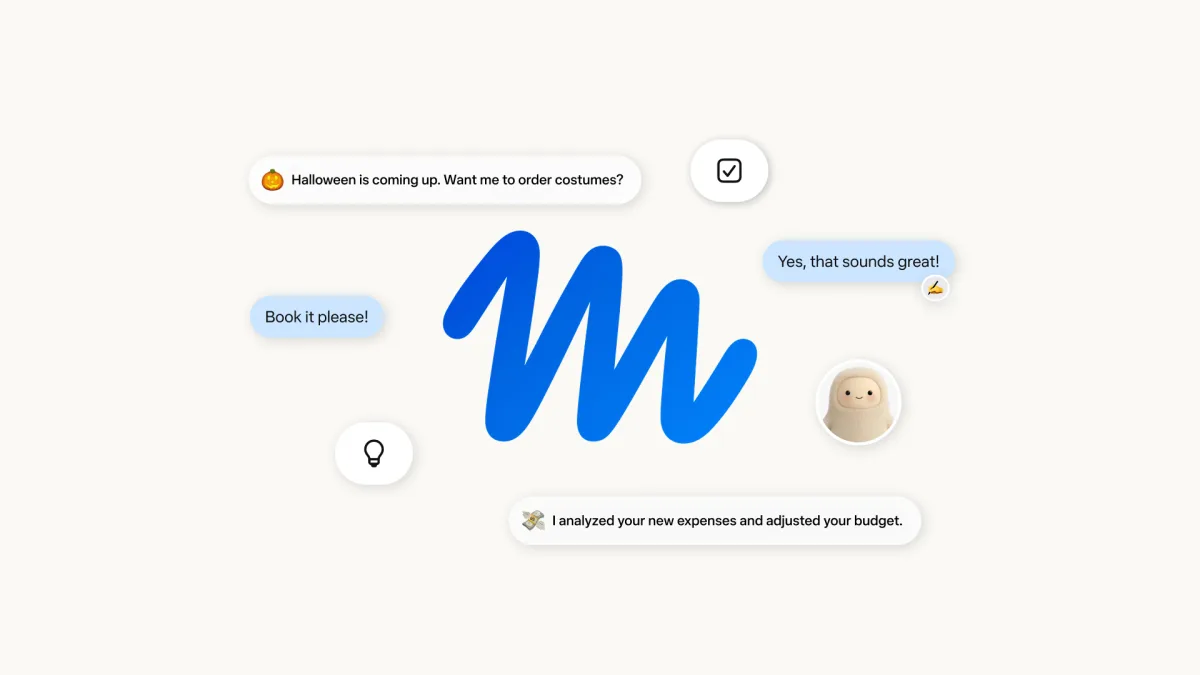
Muse runs in a dedicated Secure VM. A second process, Sentinel, must approve every outbound request. Users chat in the Muse app or WhatsApp; checkout uses Stripe Link one-time cards.
The model under Muse is trained to ask before it acts. On Meta’s own coding comparisons it used about 20 percent fewer tools and 25 percent fewer tokens than 1.2.
A Friday CNBC report puts RSI at the center of the existential argument. Hubinger’s 10 percent, two labs saying it is happening faster than they thought, and still no scientific plan.
OpenAI and Anthropic researchers spent Thursday warning that recursive self-improvement is arriving without a scientific plan. Extinction is no longer a fringe word in those threads.