Nvidia’s Flora labels robot video at about $0.72 an hour, against $88.49 for GPT-6 Astra
The GEAR lab’s paper, dated 20 October, puts three fine-tunes of Qwen3.5 on captioning, segmentation, and reward, and says the engine labels up to 200,000 hours a day on 512 GB300s. The cheap hour assumes $10 a GPU-hour. On a 50-video test Flora’s quality score is 57.1 to Astra’s 53.7. Astra still wins the rubric. The reward-model card is a noncommercial Nvidia license.
Feature2 minIn-depth
Priya Shah2 min read
- Nvidia
- Flora
- GPT-6 Astra
- Robotics
- Qwen
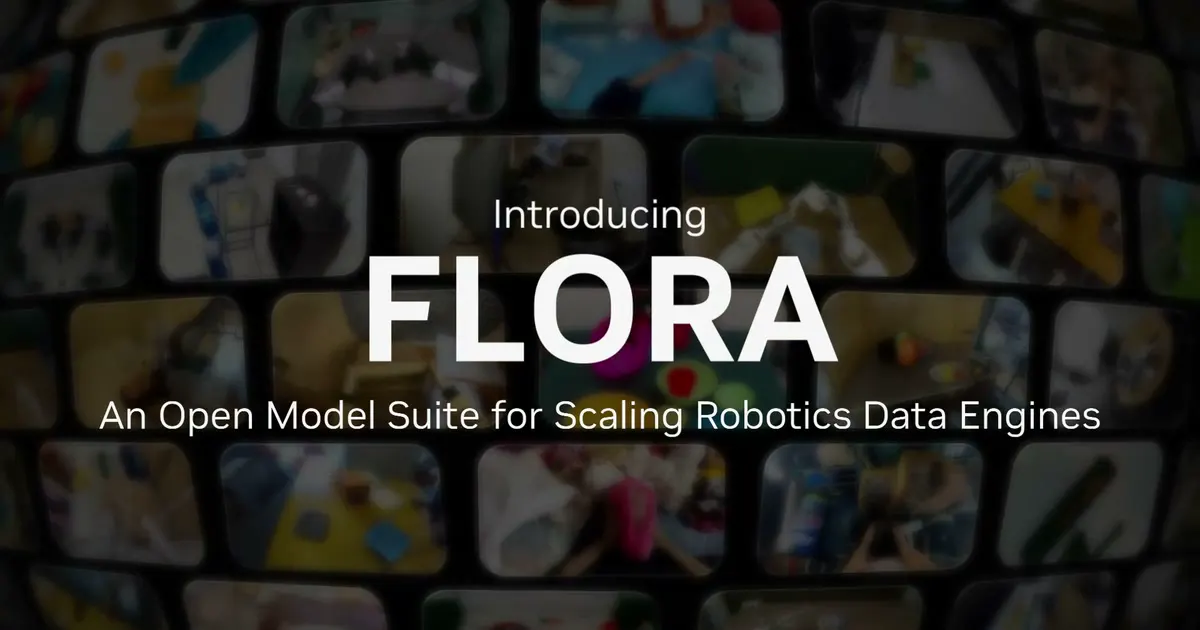
Photo: NvidiaSource page
Nvidia’s GEAR lab has published Flora, a set of three models that label robot and human video for the data its GR00T robotics models train on. The paper, dated 20 October, says the engine produces timestamped captions, process rewards, and outcome rewards, and that it is already labeling up to 200,000 hours of data a day across 512 GB300 GPUs. The segmentation model starts from Qwen3.5-9B. The captioning model and the reward model start from Qwen3.5-27B. The Decoder wrote the release up on Sunday.
The price in the paper is an estimate, and the paper says so. On a fixed set of 50 videos, Flora scores 57.1 percent quality at an estimated $0.72 per hour of source video, using eight GB300s at an assumed $10 per GPU-hour. GPT-6 Astra, at maximum reasoning effort, scores 53.7 percent at an API cost of $88.49 per hour. The paper divides those costs and gets 122.49, which it summarizes as approximately 125 times lower, and it says the dollar gap is an engineering scenario, not a confidence interval. Storage, billing granularity, and deployment overhead are excluded. Claude Opus 5, on the same comparison table, scores 30.4 percent quality at $41.70 an hour. Gemini 3.8 Flash scores 38.3 percent at $8.48.
Where the labels help, and where Astra is still ahead
The paper’s failure test is the part that is not a price. On DenseRewardBench, 40 held-out episodes and 4,861 labeled time steps, Flora-Rewarder recalls 53.3 percent of failure steps. No baseline in that table exceeds 11.7 percent, and Astra detects none. The cost of that recall, the paper says, is that Flora-Rewarder also marks about 11 percent of normal steps as failures. On a rubric bench of 40 episodes, the ranking runs the other way: Flora-Rewarder’s pooled L1 distance from human scores is 6.5, and Astra’s is 3.6, so Astra is closer to the human grades. In one episode the paper walks through, Flora matches 34 of 37 reference intervals and Astra matches four.
The word the paper uses for the release is open-sourcing. The model card for Flora-Rewarder on Hugging Face is more specific about the terms. It says use of that model is governed by Nvidia’s OneWay Noncommercial License of 22 March 2022, and that the Qwen3.5-27B checkpoint it was post-trained on is under the Apache 2.0 license. A noncommercial license on the reward model is a different offer from weights a lab can drop into a paid labeling line. The $0.72 figure is Nvidia’s estimate under a $10 GPU-hour, not an invoice, and the 57.1 to 53.7 quality gap is one 50-video test in which Astra was allowed its maximum reasoning effort. On the rubric, Astra still grades closer to the people.