MiniMax names M3.1 Flash, and says the stealth model Space Bunny was an early version
Monday’s post from MiniMax: Space Bunny, which the company says processed more than 200 trillion tokens while it had no public name, was an early M3.1 Flash. The API price is $0.15 per million input tokens, $0.60 output and $0.015 cached. OpenRouter lists a 1 million token window, text, image and video in, and a free endpoint. A public usage table had the stealth model second, not first, over the prior 30 days. The weights, the company says, come later. A Pro model does too.
Deep dive4 minIn-depth
James Okonkwo4 min read
- MiniMax
- OpenRouter
- Space Bunny
- Agents
- Open weights
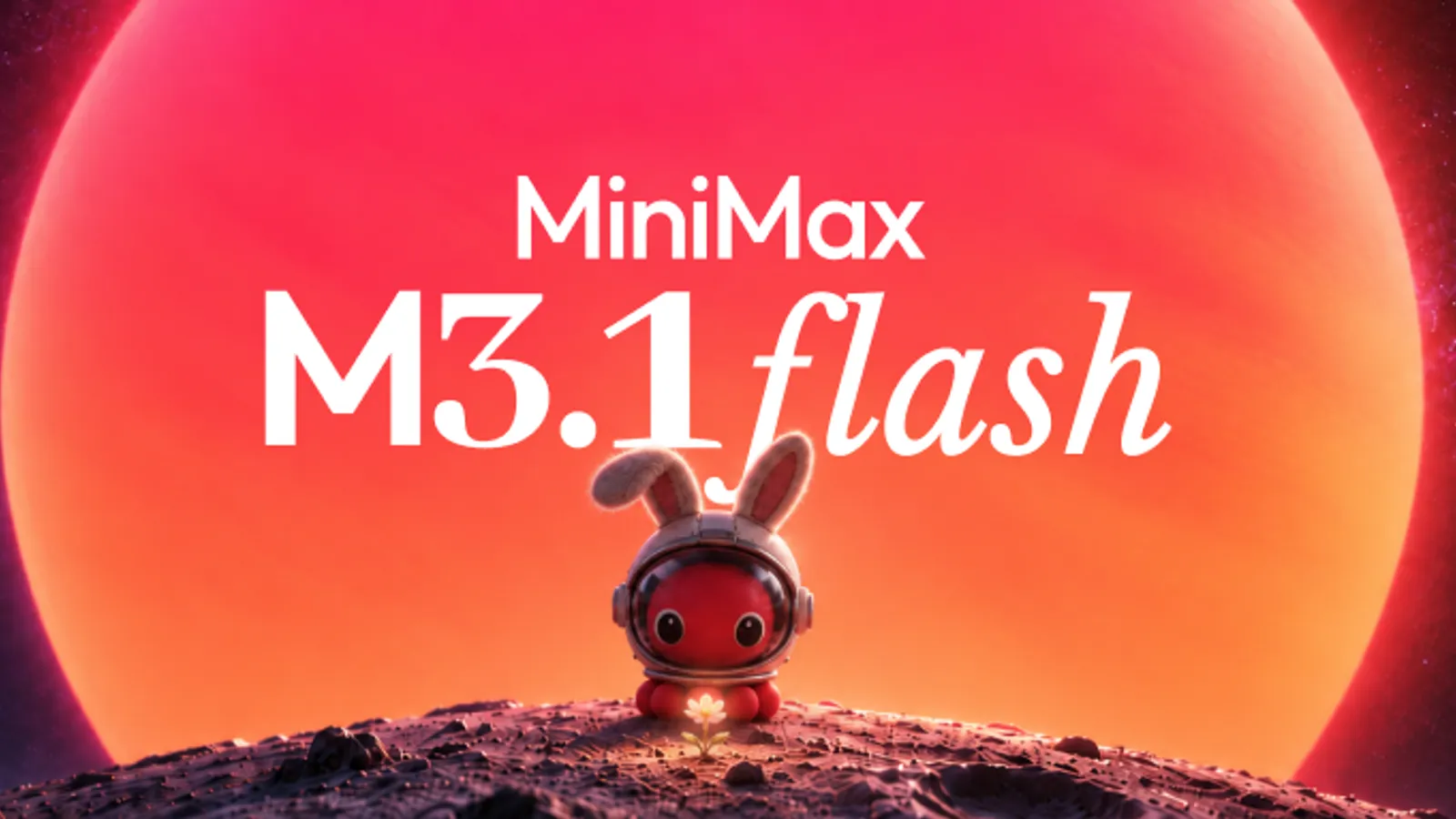
Photo: MiniMaxSource page
MiniMax put a name on the model that had been running on OpenRouter as Space Bunny. In a post dated 19 October, the company said it was rolling out MiniMax M3.1 Flash, and that Space Bunny, “which processed more than 200 trillion tokens while operating anonymously, was an early version of MiniMax M3.1 Flash.” The listed API price is flat: $0.15 per million input tokens, $0.60 per million output tokens, and $0.015 per million cached input tokens. MiniMax says the model is available through its API, the M Plan subscription, and MiniMax Code, a desktop app. It also says online inference is nearly three times faster than the predecessor, and that the cost of agentic tasks is 70 percent lower.
OpenRouter’s page for the stealth model says Space Bunny Alpha was developed and operated by MiniMax, and that it has been revealed as M3.1 Flash. The page is explicit that OpenRouter routed the requests and was not the developer, owner or provider. It dates the stealth release to 23 September 2026, and describes a 1 million token context, adjustable reasoning effort, and native multimodal input. Prompts and completions “may have been retained by the provider but are not used for training.” The free stealth period, that page says, has ended. A separate OpenRouter listing, M3.1 Flash on a free endpoint, is dated 19 October. It gives the same 1 million token context and a maximum output of 524,288 tokens. The model accepts text, images and video, and returns text. It accepts tools and tool_choice for function calling, and response_format for JSON output, without JSON-schema enforcement. The listing’s own line on the weights is “Open weights are planned.”
Second over the prior 30 days
A compilation of OpenRouter’s public token counts, current as of 17 October at cheapestllmapi.com, puts Space Bunny Alpha second over the window from 17 September to 16 October, at 56.72 trillion tokens. First in that table is a DeepSeek V4.1 Flash checkpoint, deepseek/deepseek-v4.1-flash-20260910, at 122.72 trillion. The site says the figures combine prompt and completion tokens, use each provider’s own tokenizer, and leave out private models, private endpoints, zero-data-retention traffic and hidden apps. MiniMax’s “more than 200 trillion” is the company’s number for the anonymous run. It is not the same quantity as that 30-day OpenRouter window, and the post does not say where the rest of the tokens were counted.
The stealth listing did not stay up the whole time. A catalog diff published by variables.md, comparing OpenRouter snapshots from 5 October to 6 October, lists Space Bunny Alpha among models removed from the catalog on 6 October. OpenRouter’s named listing is dated 19 October. The company has not, in the launch post, said what happens to prompts retained from the anonymous weeks.
The scores on the post are MiniMax’s
The launch post does not cite an outside run. The numbers below are the ones MiniMax published. On AutomationBench-AA, it says M3.1 Flash “ranks among the top performers” and can finish enterprise workflows across sales, marketing, operations, customer service, finance and HR. It does not print a score for that benchmark in the post. It does print 76.2 on BankerToolBench, which it describes as multi-step planning, consistency across documents and files, financial compliance and chained tool calls. On DeepSWE v1.1, a coding set in which the model has to understand a codebase, add a feature, fix a bug and check its own work with tests, MiniMax reports 73.7 percent.
On computer use, the post gives 61.7 on OSWorld V2 and 29.6 on Agents’ Last Exam, and says the model ranks first among Chinese models on both. On CyberGym it reports 82 percent, which it calls a leading score on finding and checking vulnerabilities. A separate sentence says internal security experts found the model strong at code auditing, vulnerability patching, penetration testing, malware analysis and reverse engineering. That is MiniMax describing its own evaluation. It is not a published method, and it is not a third-party result.
The speed claim is also the company’s. MiniMax says it pushed inference with more aggressive sparsity, that everyday output can pass 200 tokens a second, and that the median, the P50, stays above 170. The 70 percent cost cut is specifically “for agentic tasks,” against the predecessor, not a claim that every token is 70 percent cheaper than every rival. The per-token list is the table: $0.15, $0.60, $0.015.
Weights later, and a Pro model with no date
The launch post says “Model weights will be released later.” It does not give a day. MiniMax’s model notes, in an entry dated 19 October, already call M3.1 Flash “an ultra-efficient open-weight model for everyday work.” The local-deploy guide, which walks through self-hosting MiniMax-M3, M2.7, Music 3 and H3, does not list M3.1 Flash in its model table. OpenRouter’s listing says the weights are planned. Those three sentences are not the same status. A model can be described as open-weight before a file, a license and a repository exist.
The other date the post does not give is for a larger model. The last paragraph says Flash is MiniMax’s exploration of efficiency against capability, and that “Pro, which pushes the boundaries of intelligence, will also arrive later.” What shipped on Monday is the priced API, the subscription, and MiniMax Code. The desktop app is the product around the model: the post links a download at agent.minimax.io and points API access at platform.minimax.io. The weights, and Pro, are the two things the same post puts after the launch.