The Reserve Bank of Australia’s 9 November note says younger workers in the most AI-exposed jobs have had the weaker outcomes
Mike Major’s monitoring note is not a finding that AI has moved the national market. The full occupation data stop in February 2026. The ads that fell most since November 2022 include software programmers, general clerks and receptionists. The Decoder’s write-up is dated Sunday.
Feature3 minEasy
Priya Shah3 min read
- Labour
- Australia
- RBA
- Hiring
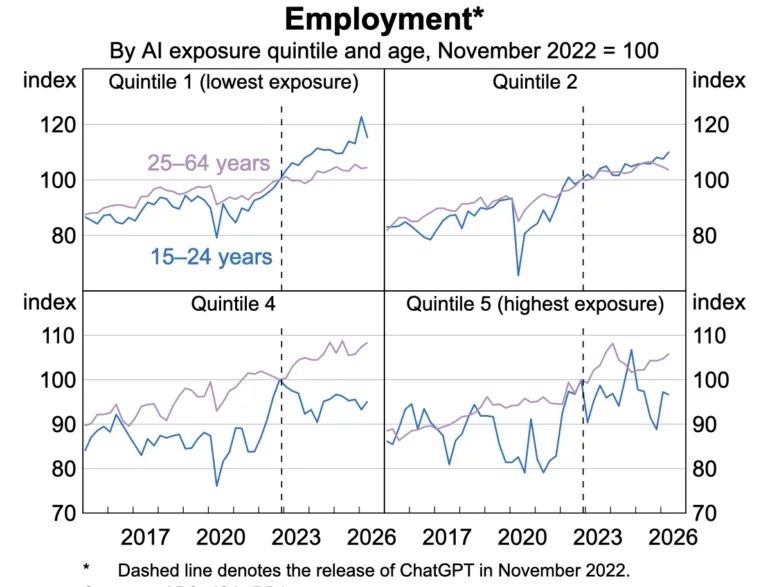
Photo: Reserve Bank of Australia, via The DecoderSource page
Manuel Uth’s story at The Decoder is dated 15 November. The document it is writing about is older. Mike Major’s note for the Reserve Bank of Australia, Insight 2026-09, is dated 9 November, and the bank’s own disclaimer says insights are staff analysis that can align with, extend, or challenge other work at the bank. Major’s first takeaway is that there is little evidence to date that AI has materially disrupted the Australian labour market. The second is that there are tentative signs of weaker outcomes in more AI-exposed occupations, particularly for younger workers, and that the evidence remains limited. The third is that those signs have to be read next to the business cycle, other structural changes, and the chance that AI creates demand for some work.
The screen he is using is Jobs and Skills Australia’s automation-exposure map, based on Gmyrek, Berg and Bescond’s 2023 paper for the International Labour Organization. Occupations are grouped by employment weight. The most exposed, he writes, include software developers, clerical workers and administrative workers, because their tasks resemble what current AI can do. He uses November 2022, when ChatGPT became public, as the line on the graphs. Exposure here is a task score, not a count of firms that have bought a tool. He writes that high exposure does not imply displacement, because the same occupations tend to score high for augmentation as well as automation, and that the scores can move with other changes, including working from home. The latest complete occupation data are for February 2026. Partial data are shown for May 2026. A change in the labour-force survey and a new occupation classification mean later figures will need a revised map.
Five jobs in the ad decline, and little difference in who finds work
On job advertisements, Major writes that there is some suggestive evidence, in Jobs and Skills Australia and SEEK data, that the flow of ads in the most exposed occupations has slowed a little more than in other occupations. The occupations in that top fifth that contribute most to the decrease in new Jobs and Skills Australia ads since November 2022 are general clerks, software and applications programmers, ICT business and systems analysts, call or contact centre workers, and receptionists. SEEK and Indeed measures of ads that contain AI-related keywords have increased rapidly. He says those measures suggest rising demand for AI-related skills, and that some of the increase may be terminology in the ad rather than a change in the job. On flows, he finds little evidence of differences in job-finding rates, or in moves from employment into unemployment, across occupations with different exposure. Employment growth and total hours have been a little weaker in more exposed occupations than in less exposed ones. The pattern holds when he keeps only market-sector jobs.
The age split is where he says an effect would show first, if firms were cutting junior roles or slowing graduate hiring. Graphs of youth and graduate outcomes look softer than the aggregate in recent years, and still stronger than before the pandemic. He warns that youth series are volatile and more cyclical, that 2022 was an unusually tight market, and that some of the weakness since then may be the market easing rather than AI. Combining age with exposure, the data are volatile, but within the most exposed occupations younger workers appear to have had weaker employment outcomes and larger increases in unemployment than older workers. That is not the case, he writes, in less exposed occupations. The result is similar in market-sector jobs only. Uth’s caption on the chart The Decoder reprints is harder than that sentence. It says that in the highest-exposure group, employment among young people has declined since late 2022, while employment among older workers has risen. That reading is The Decoder’s, of a chart whose source line is the Reserve Bank. Major’s own conclusion is the more limited one: early signs of weaker demand and employment in more exposed jobs, particularly among younger workers, which should not be read straight away as displacement.