DePue’s report matches six Chinese models to a Blackwell starting layout, and says the weights do not show where the chips were
The Unemployment Labs paper is dated 12 November. DeepSeek-V4-Flash and MiniMax-M3 read as 148 streaming multiprocessors. Four others read as 152. A physical B300 reproduced preserved rows in V4-Flash. The same paper says a fingerprint is not a location, a shipment, or a finding that a law was broken. TechCrunch’s Friday story uses “trained.”
Feature6 minIn-depth
Priya Shah6 min read
- DeepSeek
- Moonshot
- MiniMax
- Nvidia
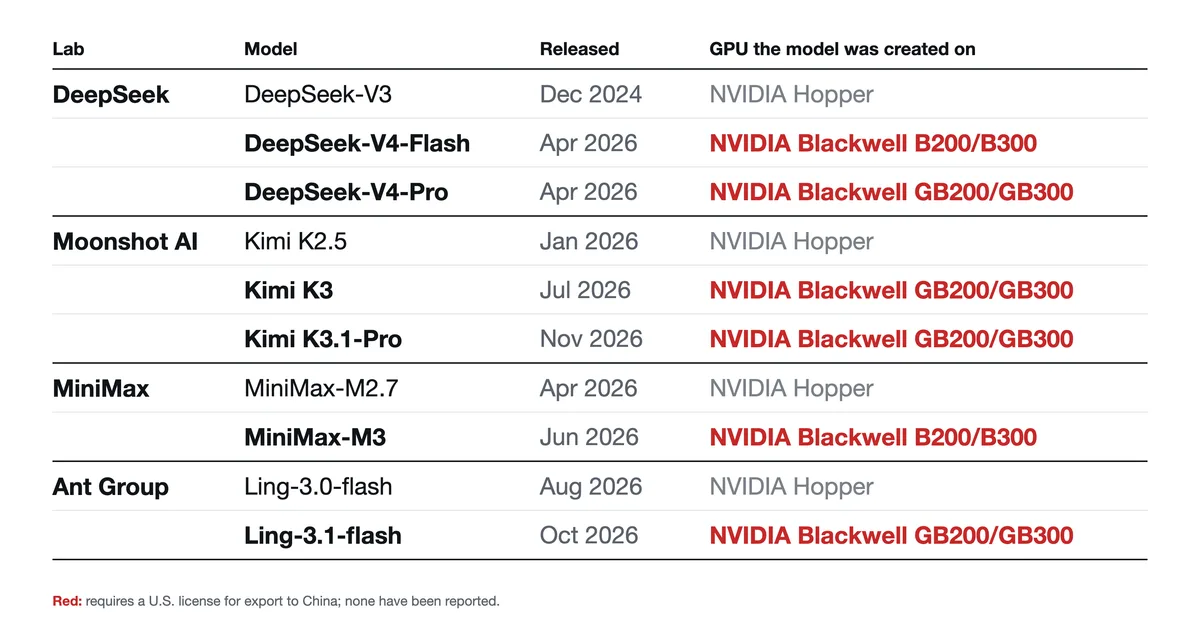
Photo: Unemployment LabsSource page
Will DePue, at the nonprofit Unemployment Labs, published a forensic read of open model weights on 12 November and revised the scale estimates the same day. The report says six models from DeepSeek, Moonshot AI, MiniMax and Ant Group contain numerical patterns matching Nvidia’s Blackwell chips, and that earlier models from the same labs match the older Hopper generation. It also says, in the executive summary, that the findings are technical evidence of access to the hardware and do not establish where the chips were, how access was obtained, or whether export controls were violated. The fingerprint, the paper says, identifies how the starting weights were created and supports, without proving, the inference that Blackwell also did the training. Tim Fernholz at TechCrunch, at 10:40 a.m. Pacific on Friday, leads with a plainer verb. The models “were trained on” restricted Nvidia chips, he writes, and DePue “was able to find compelling evidence” that Kimi’s K3 releases and DeepSeek’s V4 models bear fingerprints from training on Blackwell. Further down, Fernholz writes that this does not mean the models were trained entirely on Nvidia chips, or that export-control laws were necessarily broken, because the chips could have sat in a data centre outside China. That second qualification is the limit the paper puts first.
148 cores, 152 cores, and a seed a B300 could replay
The split inside Blackwell is a count of streaming multiprocessors, the processor cores on the chip. DePue writes that DeepSeek-V4-Flash, released in April 2026, and MiniMax-M3, released in June, match the B200 or B300, which have 148 of those cores and, in the configurations he examined, 303,104 threads. DeepSeek-V4-Pro, also April, Kimi K3 from July, Kimi K3.1-Pro from November, and Ant Group’s Ling-3.1-flash from October match the GB200 or GB300, which have 152 cores and 311,296 threads. Hopper chips in the same comparison, the H100 SXM, the H200 and the H800, have 132 cores and 270,336 threads, and the method cannot tell those three apart. A footnote says a bullet in his table means a US licence is required for export to China and that none has been reported. Kimi K3.1-Pro, he writes, starts from the same seed as K3 and may be a further-trained checkpoint of it. The appendix says MiniMax-M3.1-Flash, from October, shares M3’s initialization.
The check he could run on a machine, rather than only in statistics, uses seeds he says he recovered. DeepSeek’s seed, 953049583, appears in both DeepSeek-V3 and DeepSeek-V4-Flash. On a Blackwell B300, unmodified PyTorch reproduced 461 of 469 selected rows in V4-Flash with correlations above 0.99, including 445 rows that matched bit for bit. Eight of the selected rows had been partly changed by training. An H100 reproduced all 57,344 preserved values he selected in V3, bit for bit, and neither chip reproduced the other model. Changing the seed by one reproduced no matching rows. On a rented GB200, the same unmodified software reproduced all 13 of Kimi K3’s preserved rows from Moonshot’s seed, 20256586. Changing that seed by one reproduced none. He says the code and the preserved weights are public, and that the comparison also runs without a GPU.
What still reads as Hopper, and an AMD layout he tried
The paper’s own negative results are part of the claim. The newest models he could read from Alibaba’s Qwen, Zhipu’s GLM, Tencent, Xiaomi and StepFun still read as Hopper. Meituan’s LongCat-2.0, which the company says was trained entirely on “AI ASIC superpods,” showed no Nvidia fingerprint. DeepSeek-V4.1-Flash also showed none, after what he calls an exhaustive search. Baidu’s ERNIE-5.5 was trained with PaddlePaddle, which he says does not leave this chip layout. He recovered a seed, 2760, and could not name the hardware. Several Qwen3 models were initialized on an ordinary processor, which leaves no GPU trace. A June 2025 GitHub comment he cites, from a DeepSeek engineer, says “we don’t have SM100 GPUs,” using Nvidia’s name for the Blackwell generation. Ant Group’s public cuLA repository, he writes, includes benchmark results generated on a GB300 on 31 March 2026.
AMD is the alternative he says he could not dismiss from the layout alone. An MI300X normally has 304 processing units, and it can be split into groups of 152 or limited to 148. On a physical MI300X, those limits reproduced the layouts he associates with Blackwell. For DeepSeek-V4-Flash he then compared the values. In the 377 places where Nvidia’s and AMD’s results differ, the published weight matched Nvidia in 363 and AMD in none. He says the same test could not settle the other five models, and that he considers the AMD explanation very unlikely for them, because a lab would have had to configure a cluster to use the same number of units as a Blackwell chip. The method, he writes, needs published weights, so a closed model cannot be checked. It also identifies the chip that generated the starting values, not every chip that later trained the model. A lab could initialize on one system and move the weights. In Kimi K3, he writes, at least 64 separately seeded processes each left the same 152-core layout.
A GPU count he marked down, then raised
The cluster sizes are estimates he says he is not confident in. Training compute is divided by what one Blackwell GPU delivers over a guessed run length, assuming the chips ran at about 20 percent of peak, or 25 percent for DeepSeek. His best estimates, rounded to the nearest 500, are 1,500 Blackwell GPUs for V4-Flash, 3,000 for V4-Pro, 4,500 for Kimi K3, 1,500 for MiniMax-M3 and 1,500 for Ling-3.1-flash, about 12,000 across the five runs, inside a range of 7,000 to 22,000. The ranges on the individual runs are wide: Kimi K3 is 1,000 to 9,500. Halving the run length doubles the count, he notes, and no lab has stated these run lengths. A first version of the report, he writes, put the largest runs at 2,000 to 3,000 GPUs and the largest cluster at $150 million to $200 million, assuming the chips ran as efficiently as Nvidia’s own benchmarks. The revised figures replace those. At about $70,000 a GPU, a price he takes from a Wall Street Journal report that about 36,000 Blackwell chips being installed in Malaysia for ByteDance would cost more than $2.5 billion, the largest of these clusters would be roughly $200 million to $300 million, and the five together more than half a billion. The figures, he says, cover the final training run, not experiments or serving.
The statistical claim is a margin over a search he sizes at roughly six trillion seed-and-layout combinations. A chance match across that search, he writes, would be expected to reach about 8 sigma. The strongest held-out result for each of the six models runs from 49 sigma, on V4-Pro, to 1,385 sigma, on V4-Flash, and the weakest individual test he reports still reaches 20. On 24 models where a developer has publicly named the hardware, he says the method agrees every time, and he flags that eleven of those are step-zero checkpoints and that related models are not independent, so the check is consistency rather than a measured accuracy rate. Fernholz adds two figures the paper’s executive summary does not print as its own estimates. Epoch AI, he writes, estimates that about two million advanced chips entered China in 2024 and 2025 through schemes meant to hide the destination, and that 275,000 Nvidia AI accelerators were imported to Malaysia in those years. He also writes that White House technology adviser Michael Kratsios said earlier this year, citing US intelligence, that Moonshot had used export-banned Nvidia chips. Those are Fernholz’s citations. They are not rows in DePue’s table.