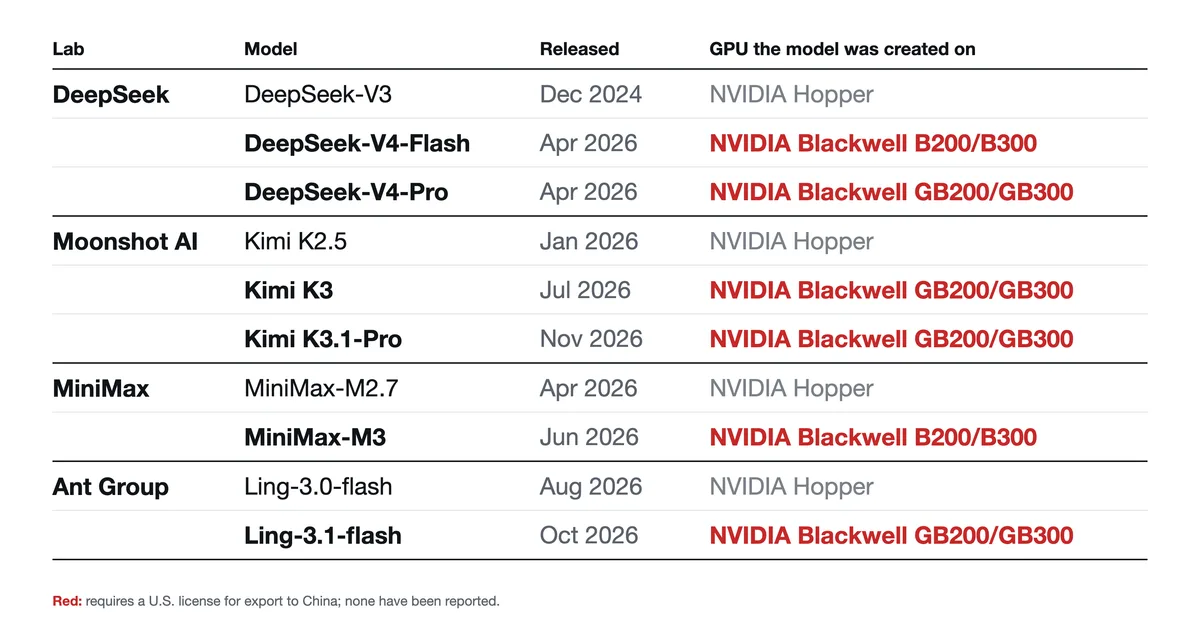
Nvidia releases Nemotron 3.5 Bolt E4B, a local model it says fits in about 4GB
The research page is dated Friday. Bolt E4B is a post-train of Gemma 4 E4B: 8 billion parameters, about 4 billion active, a 64,000-token context, and a Q4 file under an OpenMDW-1.1 license on Hugging Face. Nvidia’s chart marks a representative score of 70.2, against 48.8 for its previous Nano 4B. The comparison tables are labeled BF16, and Qwen 3.5 4B beats Bolt on several of those rows, including a customer-task bench where the gap is 20 points.
Feature4 minIn-depth
Eli Navarro4 min read
- Nvidia
- Nemotron
- Gemma 4
- Local models
- Jetson
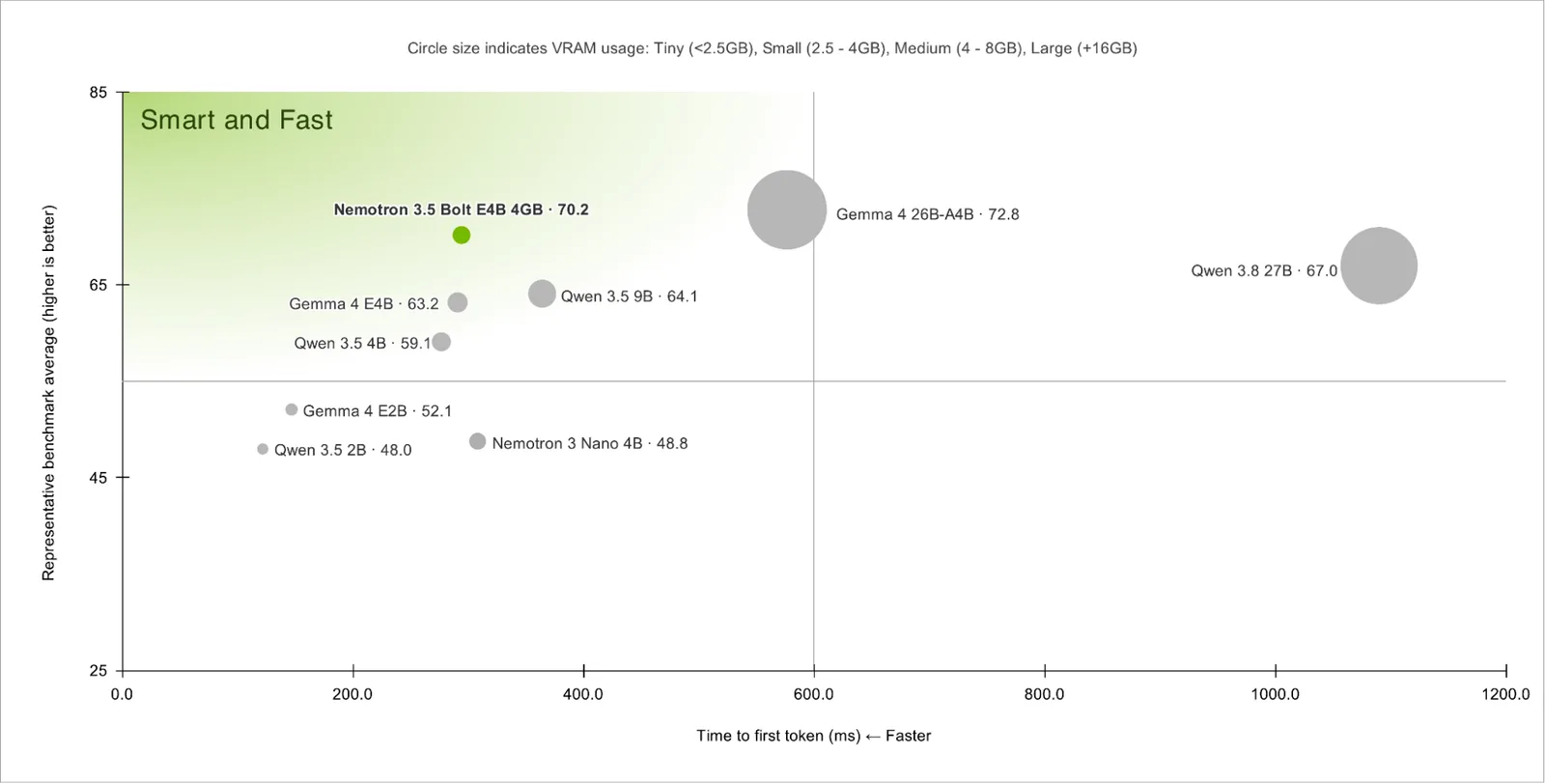
Photo: NvidiaSource page
Nvidia on Friday released Nemotron 3.5 Bolt E4B 4GB, an open small model it describes as a further post-train of Google’s Gemma 4 E4B, aimed at local voice assistants, game characters, and robots. The research page is dated 23 October. The Hugging Face card, which Nvidia dates the same day along with a listing on build.nvidia.com, puts the model at 8 billion parameters in total and about 4 billion effective, on a Gemma-4-E4B architecture, with a context of up to 64,000 tokens in and out. The download Nvidia points at for the small footprint is a Q4_K_M file, Nemotron-3.5-Bolt-E4B-Q4_K_M.gguf. The license on the card is OpenMDW-1.1. Nvidia says the weights are ready for commercial or non-commercial use. A separate BF16 checkpoint is published for people who want to fine-tune rather than serve the quantized file.
The product claim is speed and quality per gigabyte, not a new frontier score. Nvidia says Bolt offers roughly 40 percent higher average quality than its prior Nano 4B on the conversational-agent benchmarks it chose, and up to about 80 percent fewer output tokens than peers in comparisons with reasoning turned on. A scatter plot on the page marks “Nemotron 3.5 Bolt E4B 4GB” at 70.2 on a representative benchmark average, in a region labeled “Smart and Fast,” against 48.8 for Nemotron 3 Nano 4B. The same plot marks Gemma 4 26B-A4B at 72.8, at a slower time to first token, and Qwen 3.8 27B at 67.0, slower still. A caption elsewhere on the page gives cloud reference points for a different average — a Q4_K_M score across MultiChallenge, RoleMRC, BFCL-v3, IHEval, SysBench, and RelyToolBench, measured on an RTX 5090 at about 3,000 input tokens and 50 output tokens. Those references are Gemini 3.8 Flash at 77.1, with a time to first token of 2,449.5 milliseconds, and Claude Sonnet 5.5 at 76.2, at 3,002.2 milliseconds. The caption does not print Bolt’s score on that line.
The score tables are BF16. The speed tables are the 4GB file
The comparison tables underneath are labeled “All results BF16,” and they say every benchmark used the same reasoning mode across models, while the mode itself changes by benchmark. On those rows Bolt is not uniformly ahead of the other 4-billion-class models Nvidia includes. On Tau2-Bench, a multi-turn customer-task test, Bolt scores 55.1, against 75.1 for Qwen 3.5 4B, 38.5 for Gemma 4 E4B, and 29.2 for Nano 4B. On BFCL-v3, correct tools and arguments, Bolt is at 68.5, just under Qwen’s 70.9 and above Gemma’s 66.4. On RULER at 64,000 tokens, Bolt is at 87.0, behind Qwen at 95.1 and Nano at 91.5. The rows that move the other way include When2Call-MT, a test of when to call a tool, clarify, or abstain, where Bolt scores 63.4 against Qwen’s 37.8, and RoleBench, a speaking-style comparison, where Bolt is at 67.0 and Nano at 12.0. Nvidia’s “roughly 10 percent higher than other peers” line is an average across the set. It is the company’s arithmetic. Two of the benches it uses to get there, Brevity Bench and When2Call-MT, are marked as Nvidia’s own and “to be released at a later date.”
The latency numbers are measured on the Q4 file, at batch size one, in llama.cpp, with a tool Nvidia calls AIPerf. On an RTX 5070 with 12GB, at 3,000 new input tokens and 50 output tokens and no cached prefix, Nvidia reports 3.5GB of VRAM, 548 milliseconds to the first token, and 133.4 tokens a second. On a Jetson Orin Nano with 8GB, the same short setting uses 4.2GB, takes 5,785 milliseconds to the first token, and generates 15.5 tokens a second. The 4GB in the model’s name is the target footprint Nvidia describes for the workloads it has in mind. On that Jetson row the measured footprint is already above it. The card’s recommended sampling is a temperature of 1.0 and a top-p of 0.95, in both thinking modes. Thinking and a “conversational mode,” meant to push shorter speech-ready replies, are switches in the chat template.
A length penalty, and a drafter that is not the model
The training note is short and specific. Bolt starts from Gemma 4 E4B’s instruction model. Nvidia says it post-trained with reinforcement learning from verifiable rewards and from human feedback, using NeMo-RL and NeMo-Gym, on tool use, instruction following, instruction hierarchy, and structured output. To keep non-reasoning answers from being an afterthought, it says every sample in the blend was used in both reasoning and non-reasoning modes, and that each training batch kept a two-to-one ratio of non-reasoning samples to reasoning samples. As answers got longer, it increased a group-relative length penalty on reasoning and on the final answer inside its GenRM environment, and turned off overlong filtering in the other environments. The Q4 file was quantized with llama.cpp and an importance matrix, calibrated on about a million tokens of rollouts from the same training step as the checkpoint that was selected.
A second release, DFlash, is a drafter rather than another copy of Bolt. Nvidia says it proposes draft tokens in one forward pass, the target model checks them in parallel, and the target’s output distribution is preserved. Against the MTP drafter that shipped with Gemma 4 E4B, Nvidia says DFlash raises throughput by up to 21 percent. The page’s demonstrations are a Reachy Mini robot on a Jetson Orin Nano, with Cosmos 3 Edge supplying vision and Bolt calling animation scripts, and a game character that checks a payment and then calls tools to craft an item. Those are Nvidia’s scenes. The card says a llama.cpp recipe is still pending. The languages Nvidia claims are 35, on a base model it says was pre-trained on more than 140. Nothing on the page is an independent rerun of the 70.2.