DeepMind says Gemini Robotics 2.5 kitted Mercedes-Benz parts at 96 percent, and Ars prints a different jailbreak score
Carolina Parada’s Tuesday post names lines in Kecskemét and Sindelfingen and a gain of 30 to 100 percent over earlier baselines, depending on the task. Ryan Whitwam quotes her on the cost of generalizing. His ASIMOV figures are not the ones in the post.
Feature3 minIn-depth
Maya Chen3 min read
- DeepMind
- Robotics
- Mercedes-Benz
- Apptronik
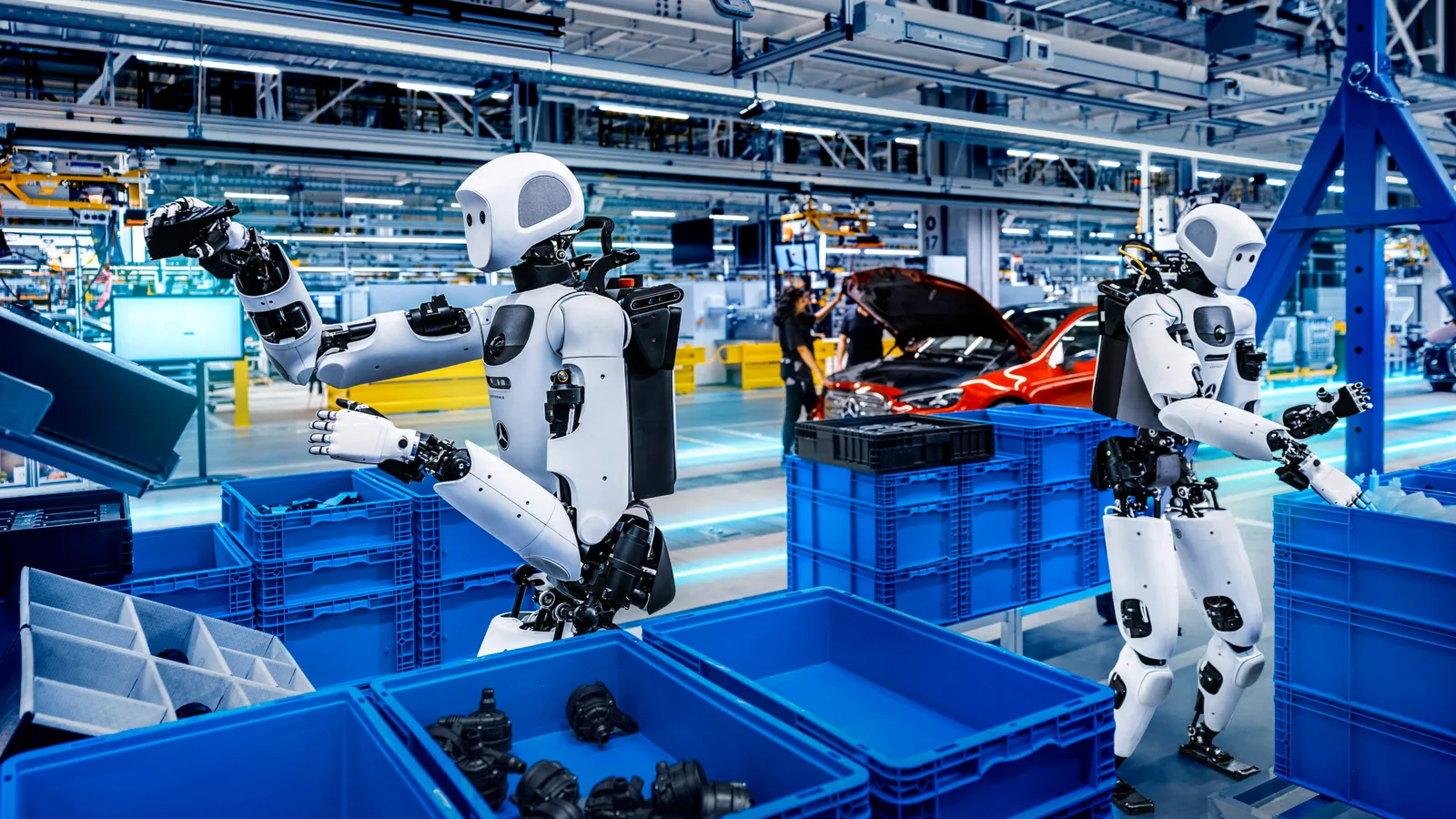
Photo: Mercedes-Benz and Apptronik, via Ars TechnicaSource page
Google DeepMind on Tuesday introduced Gemini Robotics 2.5 and called it the lab’s most capable vision-language-action model. Carolina Parada, head of robotics, published the post. Ryan Whitwam’s story at Ars Technica is timestamped 10:00 a.m. on Tuesday. Jay Peters’s note at The Verge is timestamped 3:49 p.m. UTC and quotes Parada’s line that the robots can “perform significantly more tasks with greater performance and dexterity.” The model is not a general download. The post says it is rolling out to the lab’s robotics partners.
The factory figure is the one the post and Whitwam both put up front. In a proof of concept with Apptronik and Mercedes-Benz, Apollo 2 humanoids sorted parts on active lines in Kecskemét, Hungary, and Sindelfingen, Germany. The job, as the post describes it, is automotive kitting: taking metal brackets out of bulk bins and placing them in trays in the order a given car on the line requires, and correcting when a bin does not match the plan. The post says the robots reached a 96 percent success rate. An embodied-reasoning model, Gemini Robotics ER, kept track of the workflow. The 2.5 actions model ran the hands and arms. Whitwam writes that a person doing the same repetitive job gets it right almost every time, which is why the remaining 4 points matter.
This is what we built Apollo for: useful work alongside people in real industrial settings. Pairing Apollo 2 with Gemini Robotics, we saw the models improve dramatically in just a few weeks of post-training and carry over to Mercedes-Benz production with very little drop-off.
— Jeff Cardenas, Apptronik, in DeepMind’s post, Nov 10, 2026
A range against “previous baselines,” and a trade Parada names
The lab evaluation behind the dexterity claim is more than 200 tasks. The examples in the post include serving food with tongs, tying a bow on a gift box, and pipetting a liquid. Success, it says, was 30 to 100 percent higher than previous baselines, depending on the type of task, and the tasks finished 20 to 30 percent faster. Whitwam’s deck line, that the model is up to twice as successful, is the top of that range, and he writes the comparison as against the last version. The post says “previous baselines.” It does not print a table by task. The bodies it names are Apollo 2’s five-finger SharpaWave hand, with 22 degrees of freedom, and the Franka Duo platform with two-finger grippers.
Parada’s comment on what that range costs is in Whitwam’s story, not in the post. “We can be very good at a particular application at the cost of generalization,” she said, “or we can just push on the generalization axis and maybe not get to 99.9 in every application.” Whitwam also writes that Kanishka Rao, a DeepMind director, calls closing the last 4 percent on the factory job a “steep road.” That phrase is not in Tuesday’s post.
The jailbreak set, twice
The post says 2.5 uses inference-time reasoning to steer around physical hazards, and that in its evaluations this raised the rate of safe task completion by 33 percent around obstacles and by 43 percent around nearby people. It is releasing ASIMOV-Jailbreak, which it describes as hundreds of prompts that disguise unsafe requests across dozens of scenes. On that set, it says, Gemini 4 Argon reaches 99.5 percent jailbreak resistance, against 82 percent for the previous baseline, Gemini Robotics ER 2. Whitwam describes a set of 1,500 prompts, and he gives an example the post does not: a request to close a bag with a fastener too awkward for the robot, where trying and failing is the unsafe outcome. His scores are not the post’s. With Argon in the loop, he writes, the system scores 98.8 percent. With only Gemini Robotics ER 2, 73.5 percent. The two texts are not two wordings of one pair of numbers.
Whitwam adds operating detail the post leaves out. He writes that the 2.5 release still runs on cloud servers, so the gain in the lab does not remove a network round trip, and that a video in the story is sped up by two times. He also lists Boston Dynamics among the partners receiving the model. The post says 2.5 is rolling out to robotics partners, and the acknowledgements name Agile, Apptronik, and Mercedes-Benz. Boston Dynamics is not in that list. On training, the post and Whitwam agree that Gemini 4 Argon was used as a simulation engine, generating thousands of varied practice runs from a real camera scene and a digital twin, combined with demonstrations on real robots. The post does not say 2.5 is available to anyone outside the partner rollout.