Axiom says its agents formalized the Stacks Project in about 16 million lines of Lean
The company’s post, dated Wednesday, calls the result the largest reusable library of formalized mathematics it has built, from a text of roughly 7,500 pages. TechCrunch on Thursday counts 7,654 pages and quotes the chief executive on a hierarchy that did not assign every task.
Deep dive4 minIn-depth
James Okonkwo4 min read
- Agents
- Mathematics
- Lean
- Axiom
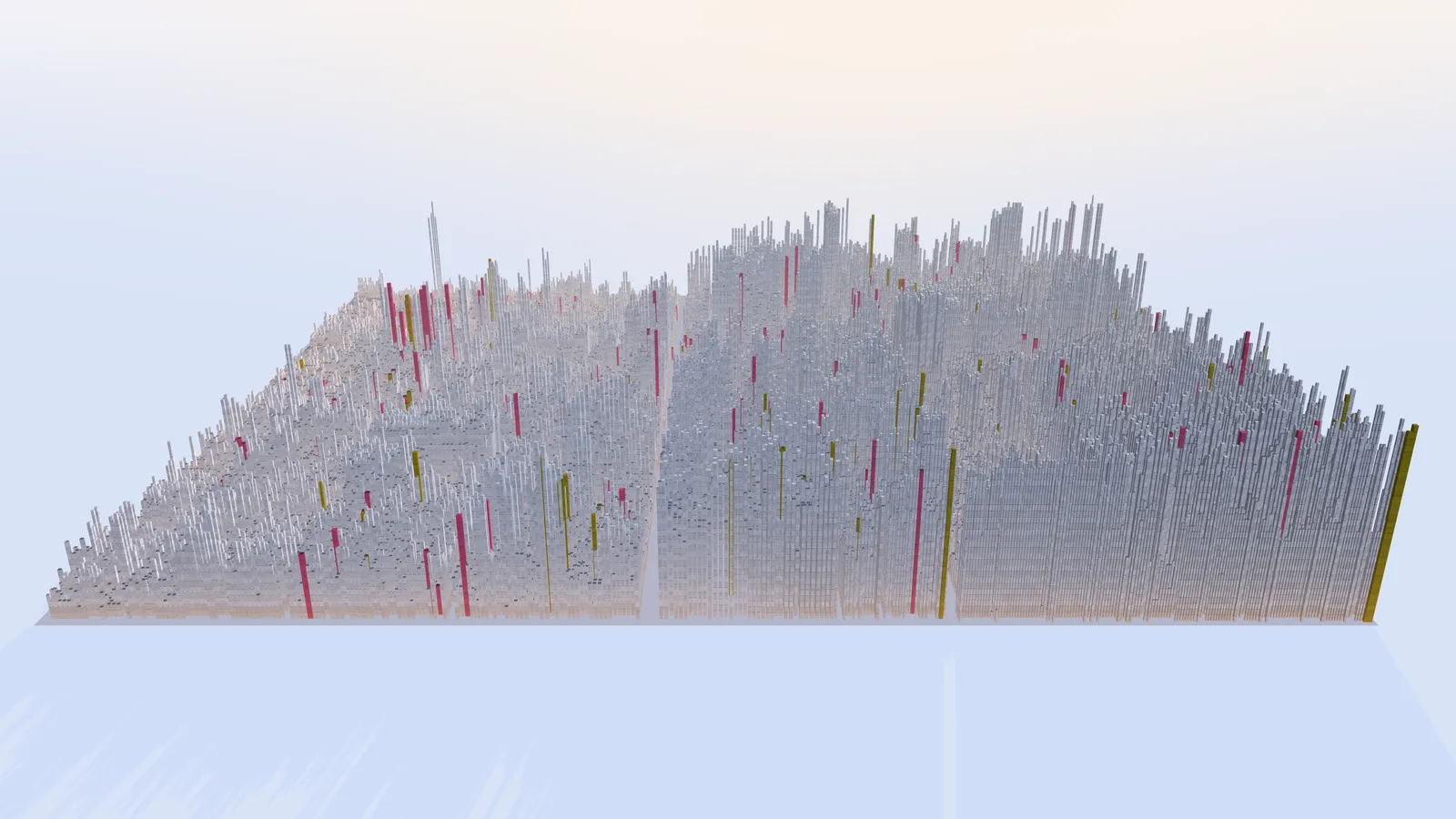
Photo: AxiomSource page
Axiom on Wednesday published a Lean formalization of the Stacks Project, the algebraic-geometry reference Johan de Jong started at Columbia University in 2005. The company’s post, dated 4 November, says the library runs to some 16 million lines of code, covers a text of roughly 7,500 pages, and is the largest integrated, reusable library of formalized mathematics ever built. That last clause is Axiom’s claim about its own release. TechCrunch, in a story timestamped 8:16 a.m. Pacific on Thursday, puts the same text at about 7,654 pages and the code at about 16 million lines.
Formalizing, as Aditya Mehta explains it in that story, means rewriting a proof in Lean so a proof assistant can check it line by line. Axiom’s post says the release keeps the Stacks Project’s permanent tags, so a Lean declaration can be read against the page mathematicians already cite, and that the side-by-side text and the dependency graph are at stacks.axiommath.ai. The post also says the formalization is an independent open-source project. On 21 October, it says, de Jong asked that AI-generated comments and pull requests not be submitted to the upstream Stacks repository for the time being. Axiom says it is keeping its code, counterexamples, and revisions in its own repository.
What the company says the agents did
The post describes the work as coordinated swarms of agents translating, proving, and integrating theorems in parallel, inside a hierarchy with specialized roles. The point of the hierarchy, in Axiom’s account, is to stop two agents from proving correct theorems about the same object with definitions that will not compose, and to stop them from rebuilding pieces Mathlib already has. Lean’s kernel will accept either file alone. The post says a usable library is a different problem. It also says statement faithfulness was checked by multi-agent auditing, by comparisons with the source text, and by the requirement that each definition still fit the theorems downstream of it, plus targeted audits of foundational definitions and landmark theorems. The post does not name an outside referee for the library as a whole.
TechCrunch’s interviews on Thursday describe a looser machine than that summary. Ashvin Swaminathan, a member of the technical staff, told Mehta the team imposed a hierarchy, but not one that dictated every agent’s task. The agents, he said, found work they could do in parallel. Carina Hong, the chief executive, told TechCrunch she had not been sure the project would hold together.
Things that are big and things that are delicate in life just don’t go together.
— Carina Hong, chief executive of Axiom, to TechCrunch
In the same interview she said the Stacks Project is a body of results in which theorems have to stay consistent and definitions must not fight. She also said the team was not sure “vibe coding” could preserve what she called the beauty of Stacks. Mehta writes that Hong is 25, that she left a Stanford mathematics Ph.D. program, that she founded the company in March 2025, and that Axiom raised a $200 million Series A led by Menlo Ventures in March. He describes Axiom as a $1.6 billion startup. The company’s own post does not state a valuation or the size of that round. On 27 October, the post says, Axiom released a separate Lean formalization of the classification of finite simple groups. It treats that as one theorem. It treats Stacks as a library of definitions meant to be imported into later proofs.
Statements the agents say they repaired
Axiom says that over the course of the project its system found dozens of statements in the Stacks Project that needed a local fix: missing hypotheses, edge cases in positive characteristic, and claims that did not hold in the generality in which they were written. The post says the agents built explicit counterexamples, wrote corrected theorems next to them, and, where a false lemma blocked a deeper result, looked for another route in the literature so the main theorem could still be had under its original hypotheses. Those repairs, it says, stay in Axiom’s repository rather than going upstream. Mehta quotes Swaminathan on the practical consequence he draws for algebraic geometry: until now, someone who wanted to check new work in Lean had little of that field to build on. “Well, now they do.”
Hong told TechCrunch she is willing to dare other coding companies to attempt a formalization at this scale. Swaminathan told him the formalization is a substrate later agents can read and extend, and that mathematics is where he thinks that kind of library starts, because the skill transfers. Both sentences are the company’s view of what the code is for. They are not a count of mathematicians who have checked the statements against de Jong’s text.