DeepSeek’s Flash update scores 77% on DeepSWE at under 20 cents a task
DeepSeek-V4.1-Flash-1017 went up on Saturday with MIT-licensed weights on Hugging Face and, The Decoder and LuminaBench report, on ModelScope. On the company’s card it beats Claude Opus 5 and GPT-5.6 Sol on some agent tests and trails them on others. A cost chart puts the DeepSWE result at just under $0.20 a task, against about $0.50 for the previous Flash. Search and Fetch APIs are $0.75 per 1,000 calls, free inside DeepSeek Harness, Claude Code and Codex until 31 October at 16:00 UTC.
Deep dive3 minIn-depth
James Okonkwo3 min read
- DeepSeek
- Open weights
- Agents
- Coding
- API
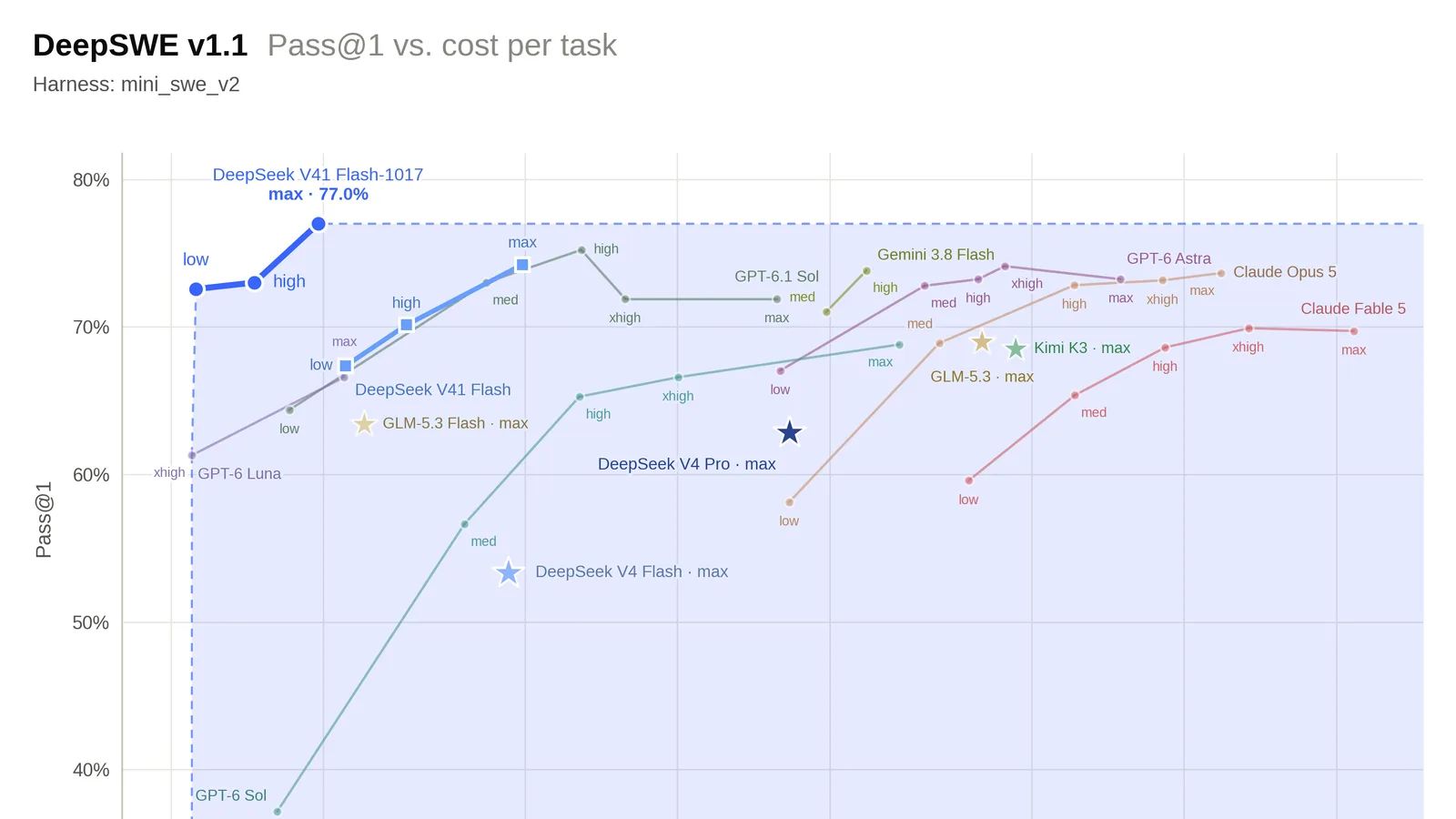
Photo: DeepSeek via LuminaBenchSource page
DeepSeek on Saturday released DeepSeek-V4.1-Flash-1017, a revision of its Flash model, and published the weights under the MIT license. The model card on Hugging Face lists a context window of 1 million tokens and a parameter count of 763 billion. Matthias Bastian at The Decoder, in a story dated 17 October, wrote that the checkpoint is on the company’s website, app and API, and that the weights are also on ModelScope. LuminaBench’s account the same day says the same. The card calls the release a minor update. Every benchmark it lists is higher than the previous Flash model’s.
The comparisons with Claude Opus 5 and GPT-5.6 Sol are the company’s. On DeepSWE v1.1 the card shows 77.0 for the new model and 74.2 for the previous Flash, against 74.0 for Opus 5 and 73.0 for Sol. The new model is also ahead of both on Automation-Bench v1.0.6, 60.5 against 50.3 and 45.8, on Agents’ Last Exam, 35.4 against 28.6 and 26.7, and on Apex Bench v1.1, 72.1 against 65.8 and 54.3. Opus 5 is ahead on HLE without tools, 56.3 to 42.6, on Terminal-Bench 4.0, 51.8 to 42.3, on ProgramBench, 37.0 to 29.1, and on NL2Repo-Bench, 75.3 to 68.2. Sol is ahead of the new Flash on HLE, 44.5 to 42.6, and on ZeroBench-main with tools, 53.0 to 51.0. A footnote says Terminal-Bench 4.0 used the Claude Code harness and DeepSWE used Mini-SWE-V2. LuminaBench, republishing the table, wrote that it had not reproduced the results. Bastian wrote that independent benchmarks were not out yet.
The bill for a finished task
The largest moves against the previous Flash are not the ones where the new model leads the bigger names. Terminal-Bench 4.0 goes from 31.2 to 42.3, and ProgramBench from 20.3 to 29.1. LuminaBench called those gains 11.1 and 8.8 points. HLE without tools goes from 36.8 to 42.6, and the text-only subset the card marks with a dagger goes from 39.1 to 44.0. The card’s sampling note recommends temperature 1.0, top_p 1.0, and a maximum generation length of at least 256,000 tokens. There is no Jinja chat template. The repository ships a Python reference encoder and, separately, deepseek-recipe, a set of Rust libraries with Python bindings that turn chat requests into the V4 prompt format and parse the output back.
What the company is selling, alongside the scores, is a shorter run. Bastian described a DeepSWE cost chart in which the new model’s top result, 77.0 percent, lands at an average of just under $0.20 a task, and the previous Flash’s 74.2 percent at around $0.50. In the low setting, he wrote, the new model still cleared 72 percent at about $0.10. On that chart, he wrote, GPT-6 Astra, Gemini 3.8 Flash and Claude Opus 5 sit between $2 and more than $10 a task, and none matches the new model’s accuracy there. LuminaBench’s reading of the same chart is “roughly $0.20” against “roughly $0.50,” and it labels the figures as DeepSeek’s. Neither outlet has an outside measurement of the bill.
Harnesses, and a search tool with a free window
Bastian wrote that the post-training method is reinforcement learning with self-feedback: the model uses its own confidence scores, or critiques it writes itself, as the reward, so the run does not depend on human graders or a separate reward model. DeepSeek, in his account and LuminaBench’s, says that is aimed at building a project through, from a game to a 3D scene. The release is tuned for DeepSeek Harness, with version v0.2.1-rc.1 or later recommended, and for Tencent CodeBuddy and WorkBuddy. Vercel’s changelog the same day, by Zachary Chen and Jerilyn Zheng, put the model on AI Gateway as deepseek/deepseek-v4.1-flash-1017. The note says it can be selected in Claude Code, Codex and Cursor after a gateway setup, and that the gateway charges the provider’s price with no markup.
The same release opens two web tools. Search returns results from an engine DeepSeek says it built and already runs at hundreds of millions of queries a day, Bastian wrote. Fetch returns a page as Markdown. Each endpoint is priced at $0.75 per 1,000 calls. LuminaBench, citing the documentation, says that is per 1,000 successful requests, and that failed requests, empty search results and timeouts are not billed. Calls made as server-side tools inside DeepSeek Harness, Claude Code and Codex stay free for DeepSeek API users until billing starts on 31 October 2026 at 16:00 UTC. The exemption is those tool calls. A developer hitting the Search or Fetch endpoints directly pays the listed rate now.