Xiaomi’s MiMo-V2.6-Pro ties Grok 4.7 on Artificial Analysis — top open weights, a fifth the token price
MIT weights on Hugging Face. Pro: 1.02 trillion parameters, 42 billion active, 46 on the Intelligence Index against Grok 4.7’s 46. Hosted $0.435/$0.87 per million vs $2/$6. Kingy.ai: about $0.13 a task against $3.74 at Grok xhigh. Xiaomi’s docs updated 22 September.
Deep dive3 minIn-depth
Priya Shah3 min read
- Xiaomi
- MiMo
- Grok 4.7
- Open weights
- Artificial Analysis
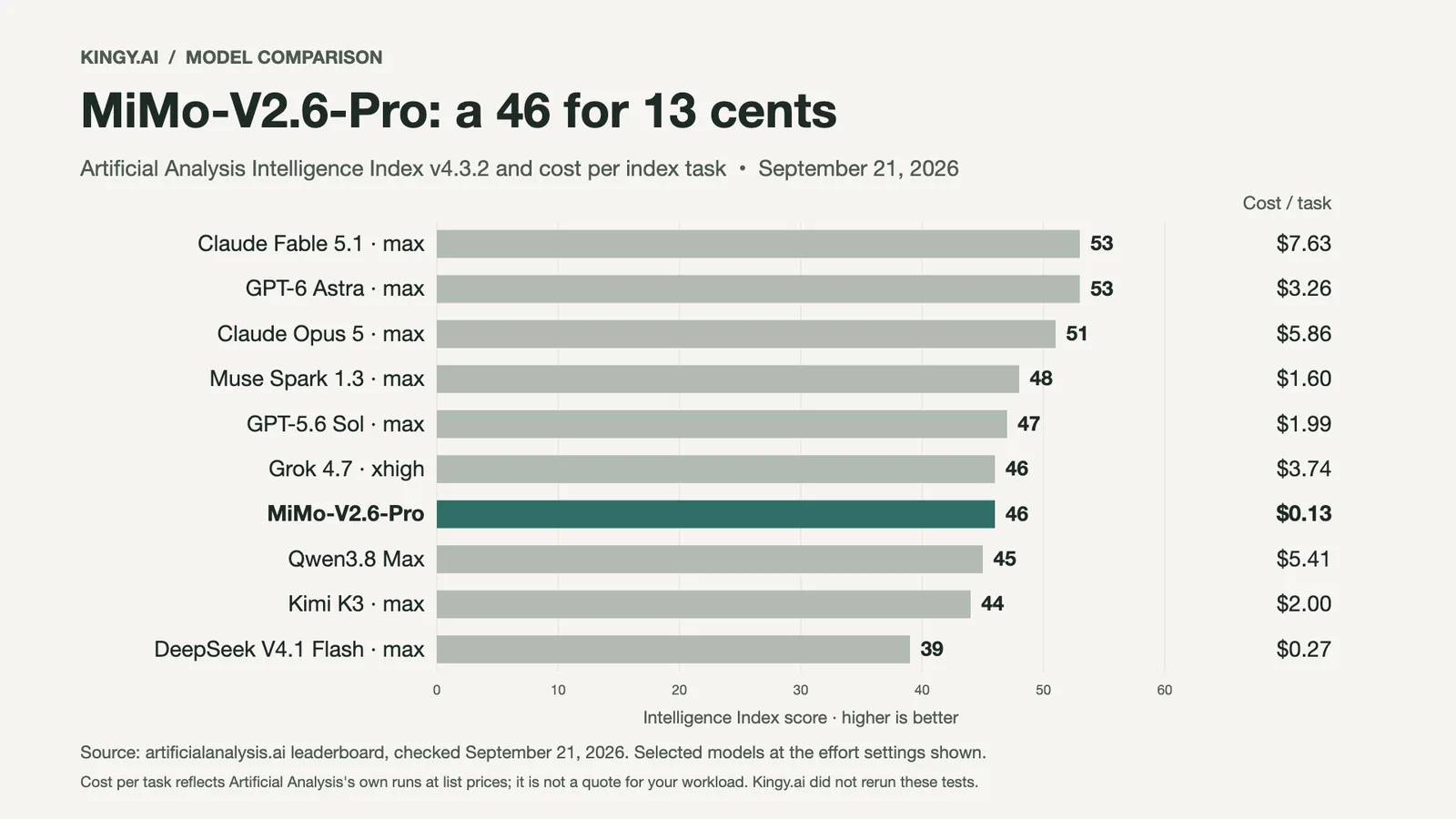
Photo: Kingy.aiSource page
Xiaomi put MiMo-V2.6-Pro and MiMo-V2.6-Flash on Hugging Face under an MIT licence on 21 September. The English docs on mimo.mi.com were updated on the 22nd. Diederik Knol at DataNorth dated the weights to the 21st. The flagship, Pro, is a sparse mixture of experts: 1.02 trillion parameters in total, about 42 billion active per token, and a 1,048,576-token context window. Flash is 309 billion total and about 15 billion active. Both, Xiaomi says, are native multimodal models. The number the company wants next to Grok 4.7 is the Artificial Analysis Intelligence Index. Xiaomi printed 46. DataNorth and Kingy.ai print 46.32 on index v4.3. Grok 4.7, which SpaceXAI shipped the same day, sits at 46. That is the top open-weights row. Claude Fable 5.1 and GPT-6 Astra are still at 53 on the same board.
The hosted tariff is the sharper fact. Pro is $0.435 per million input tokens and $0.87 per million output on Xiaomi’s API, unchanged from V2.5. Grok 4.7 is $2 and $6. Flash is $0.14 and $0.28. Cached input on Pro drops to $0.004, DataNorth wrote. Kingy.ai, reading Artificial Analysis’s own spend, puts Pro at about $0.13 per Intelligence Index task against $3.74 for Grok 4.7 at xhigh — and $5.86 for Claude Opus 5 at max. Xiaomi’s own line is that, at the same intelligence level, the price is one-twentieth to one-sixtieth of “overseas models.” Alexis Dufresne at AI Weekly cited OfficeChai for the same $0.13 figure. A third SKU, Pro-UltraSpeed, runs about twenty times Pro’s output speed at ten times the price, Knol wrote.
MiMo-V2.6-Pro scores 46 points in the Artificial Analysis Intelligence Index, surpassing Kimi K3 and Qwen3.8 Max to become the most powerful open-source model available. However, there is still a gap when compared with the strongest closed-source models Claude Fable 5.1 and GPT-6 Astra.
— Xiaomi MiMo, MiMo-V2.6 announcement, updated Sep 22, 2026
A $2.62 million RL bill, and a vendor table that still loses to Opus
Xiaomi livestreamed the last reinforcement-learning stage. In under six days the two models each ran 30 steps and about 750,000 trajectories. Training cost, the company says, was about $2.62 million for Pro and $850,000 for Flash. Average pass rates on the training tasks rose 25 percent and 12 percent; DeepSWE v1.1, out of sample, rose from 48.8 to 65.7 on Flash and from 58.4 to 72.6 on Pro. Dufresne, citing VentureBeat, added that Fuli Luo — formerly of DeepSeek, now running MiMo — assigned “several dozen people” and ran coding, general agents, visual and cyber work in one pass, a method Xiaomi calls “You Only RL Once.” Those are Xiaomi’s costs and Xiaomi’s yards. Whether $2.62 million is a fully loaded cloud bill or an internal rate is not in the post.
The agent card is mixed once you leave the composite. DataNorth and Kingy.ai both print Xiaomi’s DeepSWE v1.1 at 71.9 for Pro — next to Grok 4.7’s 71.0 in DataNorth’s table, and next to Claude Opus 5’s 74.0 and GPT-5.6 Sol’s 73.0 in Dufresne’s. Terminal Bench 2.1 is 89.9. ExploitBench is 47.9 against Sol’s 78.5. Kingy.ai, reading Xiaomi’s appendix, says Pro trails Opus 5 on 10 of 14 shared rows; the wide gaps are ExploitBench, Terminal-Bench 4.0 and ProgramBench. Those vendor rows do not name the harness. Treat them as Xiaomi’s until someone else reruns them. Kingy.ai did run a smaller check: Pro and Opus 5 both passed 23 of 23 hidden OpenCode tests; Pro cost about $0.03, Opus about $1.03.
Weights, a 9B distill, and no hardware sheet
Alongside the two large models Xiaomi released MiMo-V2.6-Distill-Qwen-9B, more than 7,000 RL task environments, and the training code built on verl, uni-agent and mini-swe-agent. Starting that 9B from an SFT baseline, Xiaomi says SWE-bench Verified moved from 61.1 to 66.2. Hosted access is Xiaomi AI Studio, MiMo Code, MiMo Desktop, the MiMo API and OpenRouter. The invitation-only desktop beta ends in a week. What the announcement does not give is a self-hosting bill. Knol’s point is the obvious one: you still have to hold 1.02 trillion parameters in memory even if only 42 billion fire. There is no published rack list. Flash, at 15 billion active, is the model a small team can actually serve. Pro is the leaderboard row — and, as of Tuesday, the cheapest way to buy a 46 on the same index SpaceXAI is selling at $2/$6.