Cisco Talos: CLOSEDQUORUM is the first reported autonomous AI command-and-control implant
Ryan Fetterman: no human operator; a panel of commercial models votes the next move. CAIRN, the metadata-first hunter that found it, was open-sourced 22 September. The public sample is inert. Talos has no confirmation it was deployed.
Feature3 minIn-depth
James Okonkwo3 min read
- Cisco Talos
- CLOSEDQUORUM
- CAIRN
- Malware
- AI agents
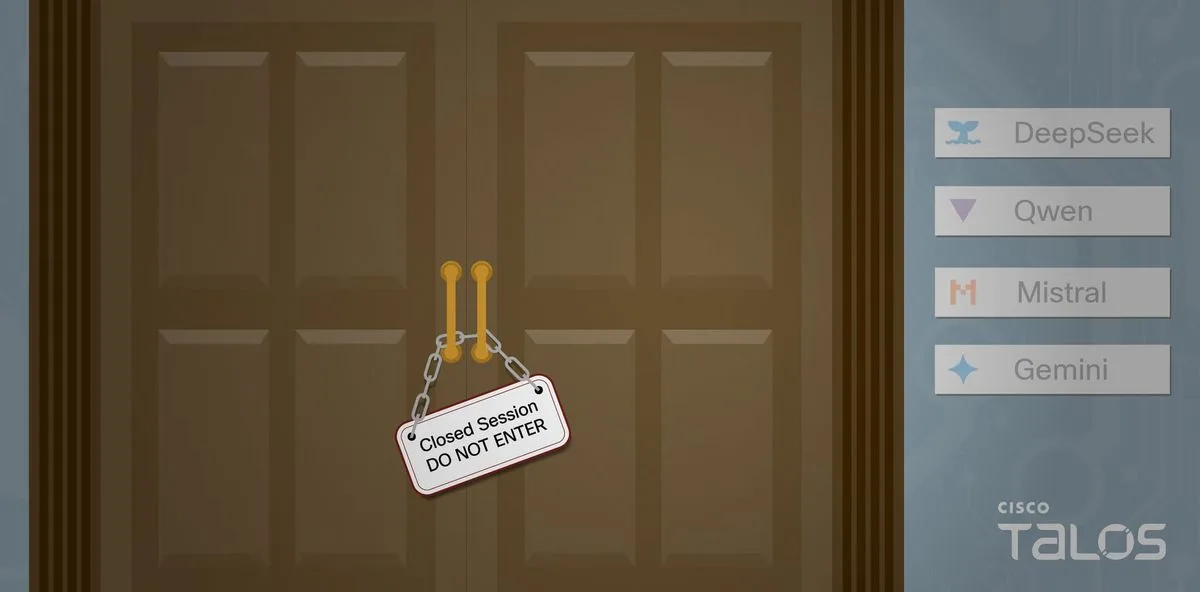
Photo: Cisco TalosSource page
Cisco Talos’s Ryan Fetterman says CLOSEDQUORUM is the first reported fully autonomous multi-model AI command-and-control implant: after it lands, no human operator has to stay on the line. The binary, a 16.4MB 64-bit Windows program written in Go, asks a panel of commercial models — DeepSeek, Qwen, Mistral and Google Gemini — to pick the next action, tallies the votes, and runs the winner. Fetterman calls the shift “effort displacement”: expanding parts of the attack chain can run when the operator is asleep. The Closed Quorum post is dated 22 September on the article page; Talos’s blog index still lists a 17 September item. CAIRN, the toolkit that found the sample, was published the same day, after this site’s Tuesday and Wednesday-morning editions. Talos has no confirmation the implant was used in the wild. The public build ships with placeholder API keys and a dummy webhook. Fetterman writes that the team “did not observe a complete end-to-end execution of the architecture.”
The design, as Talos describes it, treats the model providers as the command channel. There is no dedicated attacker server to sinkhole. Four vendors are queried in sequence; a plurality vote selects among a short, fixed list of next moves aimed at credentials and cryptocurrency wallets. A Discord webhook is the operator’s report line. If every model fails, the loop sleeps and retries rather than taking a default action. Ties break in a fixed order that favors DeepSeek. Fetterman assesses the public file as an inert template and the business as credentials-as-a-service: a developer injects an operator’s keys at build time, the operator handles delivery, stolen material arrives in that operator’s channel. Artifacts in the binary, Talos says, tie the developer to carding-forum posts going back to 2025.
This is not merely augmenting what an operator can accomplish in a session, but transferring an entire phase of the attack from the operator to the system.
— Ryan Fetterman, Cisco Talos, The Closed Quorum, Sep 22, 2026
CAIRN hunts the leftovers, not the binary
CAIRN — Cognitive Artifact Intelligence Research Network — is Talos’s open-source, metadata-first hunter for malware that talks to models. It looks for prompt templates, provider endpoints, API-key prefixes and jailbreak language without downloading the file. Fetterman lists 24 acquisition filters, a three-tier YARA ontology (T1 artifacts, T2 behavioral context, T3 named families), and an explorer graph that ties samples by submitter, import hash, domain or provider. Initial hunts run from July 2025, when LAMEHUG appeared in CERT-UA reporting. In that window, Talos says, the autonomy arc from “LLM as optional feature” to a fully autonomous multi-model consensus orchestrator with no human operator filled in within one calendar year.
A second finding is about teaching. An evasion trick — natural-language suppression text addressed to LLM sandboxes — was traced to a named red-team instructor and showed up in independent samples within 12 months, including compiled malware. Fetterman’s own caveat matters as much as the headline. T1 and T2 hits without genuine AI integration are common: PyInstaller bundles spill a developer’s virtual environment into searchable strings; Tauri apps and some Go PE layouts trip structural signatures. CAIRN is a research toolkit, not a live-threat feed. Final verdicts still need reverse engineering. The Closed Quorum write-up is a reference architecture, not a confirmed campaign. It is a different story from this morning’s Unit 42 harness and from the Muse Mac local-privilege report.