Apple opens a US study of health questions for up to 200,000 adults, on an iPhone 15 Pro or later, and says the data will not train models
The newsroom note is dated 15 November. Ivan Mehta’s TechCrunch story is stamped 5:30 p.m. Pacific. OpenEvidence supplies the clinical answers. Apple’s eligibility line is iPhone 15 Pro or later on iOS 26. TechCrunch says iPhone 15 or later. A footnote says the app does not diagnose.
Short1 minEasy
Priya Shah1 min read
- Apple
- OpenEvidence
- Health
- iPhone
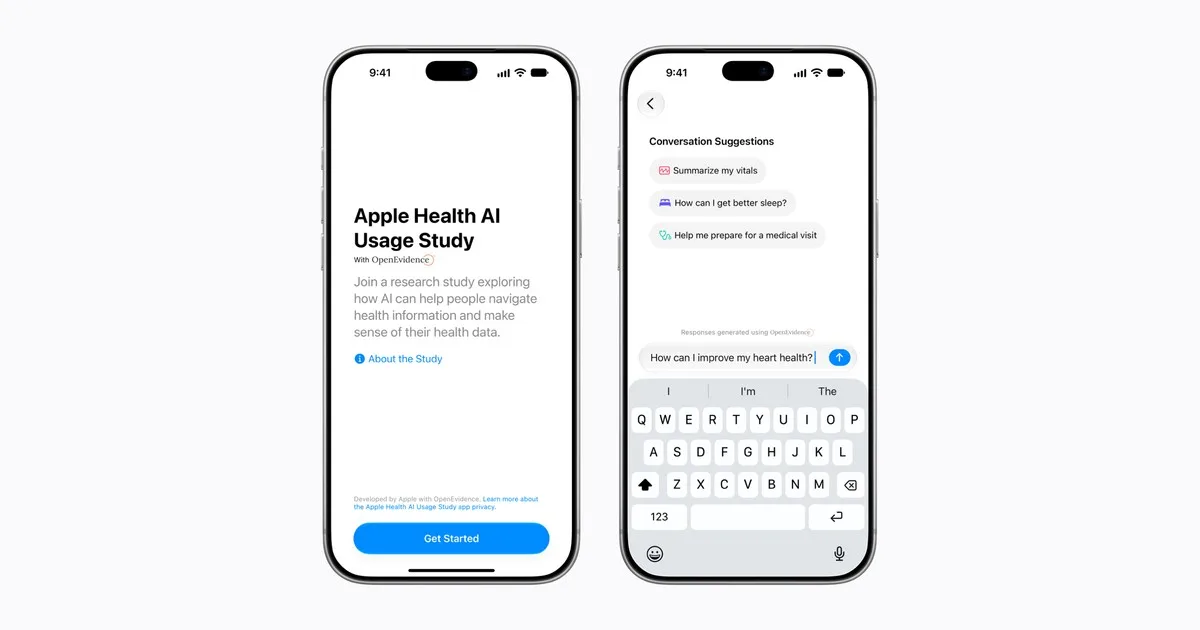
Photo: AppleSource page
Apple’s newsroom posted the Health AI Usage Study on 15 November. Ivan Mehta’s TechCrunch story is stamped 5:30 p.m. Pacific the same day. The study runs in the United States, with OpenEvidence, and Apple caps it at 200,000 people age 21 and older. Enrollment requires an Apple Intelligence-enabled iPhone, which the newsroom defines as an iPhone 15 Pro or later, on iOS 26 or later. Mehta’s story says iPhone 15 or later. The newsroom’s list is the narrower one.
The app takes everyday health questions. Apple says the answers draw on medical sources including The New England Journal of Medicine, the Journal of the American Medical Association and Nature, and that each response carries linked, peer-reviewed citations. A participant can choose to share HealthKit data, among them resting heart rate, activity, sleep or lab results, so the study can look at whether that context changes how relevant an answer seems. Sumbul Desai, Apple’s vice president of Health, says in the release that a dedicated study is the way the company wants to see how people engage with, understand and judge health AI. Robert Wachter, chair of medicine at the University of California, San Francisco, says patients and clinicians are turning to tools “built and tested in separate worlds.”
Apple says study data will not be used to train AI models, that people control whether they share HealthKit metrics or survey answers, and that the app is built to catch certain concerning questions and suggest a provider or other resources. A footnote says the app is not meant to diagnose or treat any condition, or to replace a clinician. Mehta writes that Apple said the data are anonymized before they are sent to a secure third-party cloud provider, and that OpenEvidence deletes the query and the response after 24 hours. That deletion line is in his story. It is not in the newsroom text.