Elvis’s rightsholders and Eminem’s publisher sue Suno in separate federal cases
Variety reported the filings on Saturday. The Verge’s account landed Sunday evening. The Presley complaint, 51 pages in the Northern District of California, cites Tennessee’s ELVIS Act and songs that mirror his voice. Eight Mile Style says Suno generates tracks that mirror Eminem’s. Eminem is not a plaintiff. Suno says it blocks prompts that name artists. CourtListener lists Elvis Presley Enterprises, LLC v. Suno, Inc., filed 6 November.
Feature4 minIn-depth
Priya Shah4 min read
- Suno
- Copyright
- Music
- ELVIS Act
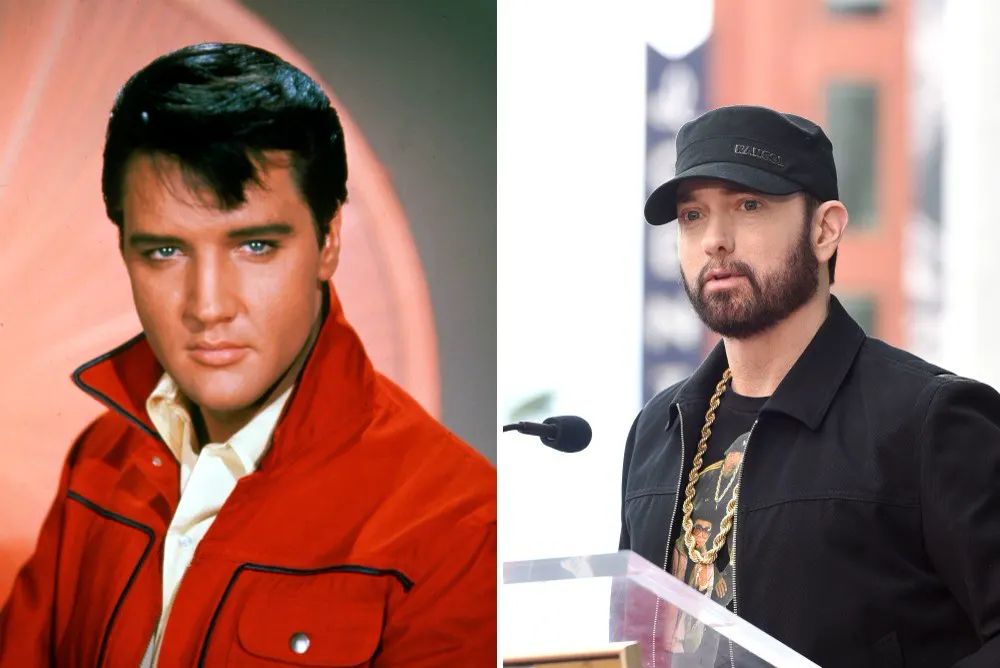
Photo: Getty Images, via VarietySource page
Rightsholders in Elvis Presley’s music, and the publisher of many of Eminem’s records, have filed separate federal lawsuits against the AI music generator Suno. Corbin Bolies reported the cases for Variety at 8:15 a.m. Pacific on Saturday. Terrence O’Brien’s account in The Verge is timestamped 5:23 p.m. UTC on Sunday. CourtListener lists one of them as Elvis Presley Enterprises, LLC v. Suno, Inc., No. 3:26-cv-13398, in the Northern District of California, filed 6 November and last updated on the docket the morning of 8 November. Variety describes the Presley plaintiffs as a group that includes Authentic Brands Group, Raleigh Music Publishing and others. The two complaints are not the same suit.
The Presley filing, which Variety says runs 51 pages, accuses Suno of copyright infringement and of exploiting Presley’s identity when users cite his name to generate songs. The plaintiffs say Suno violated Tennessee’s Ensuring Likeness Voice and Image Security Act, the 2024 law known as the ELVIS Act, which restricts AI cloning of a singer’s voice. They say the service lets users generate tracks that mirror Presley’s “rich vocal timbre” without permission. Eight Mile Style, which Variety describes as an LLC controlling hundreds of Eminem recordings, including “Lose Yourself,” “Without Me” and “The Real Slim Shady,” alleges in its own case that Suno infringed its copyright by letting users generate songs and lyrics that mirror the rapper’s tracks. Eminem is not a plaintiff. A representative for him did not respond to Variety’s request for comment.
What the complaints say the model is doing
Richard Busch, Mark Block, David Niemierzycki and Andrew Davis represent both sets of plaintiffs, Variety reports. Both complaints include examples of generated songs that, the lawyers say, either sound like Presley or reproduce Eminem’s lyrics. The attorneys argue that Suno has “mechanically encoded itself with artists’ identities, hard-work, creativity, and time, and harnessed them all for a consistent conveyor belt of cold hard cash.” In the Presley case they write: “The next Elvis won’t pick up a guitar.” The next sentence, which The Verge also quotes, says Suno’s “ravenous race to the bottom aims to make human creativity obsolete, coldly replicating without a license in seconds what takes years to learn, struggle with, maintain, and endlessly attempt to make better and perfect.”
Suno exists to help people create new, original music, not to trade on anyone’s name or likeness, and we prohibit any unauthorized use of an artist’s work. To protect against this, we do not allow prompts for specific artists’ names and songs and work with third-party providers to screen uploaded audio files and lyrics for potential misuse.
— Cat McCormack, a Suno spokesperson, to The Verge, 8 November 2026
Variety carries the same statement and does not name the spokesperson. O’Brien identifies her as Cat McCormack and adds her line that the company is “always working to strengthen our guardrails” and will “continue to add new safeguards that protect artists and our users.” The Verge says the new suits resemble a September case led by Jason Isbell and other musicians, which alleged that Suno’s platform lets users exploit their identities and which, Variety writes, Suno has denied. In that earlier case, Variety says, the plaintiffs argued that users got around name blocks by asking for tone and phrasing, by using a legal name instead of a stage name, or by putting spaces between the letters of a name. Suno’s position there, as Variety reports it, was that there was “nothing unlawful” about asking for a song in the vein of an artist.
Where these cases sit among the others
Variety places the new filings next to cases the same parties have already brought against other companies. Authentic Brands Group and other Presley publishers sued Anthropic last month over 274 of his songs. Variety says that complaint demanded $48.6 million and that Anthropic has denied the allegations. Eight Mile Style sued Meta in June for roughly $110 million over 243 recordings stored, the publisher alleged, in libraries on Facebook, WhatsApp and Instagram. Variety says Meta’s lawyers called that suit “fanciful” and that a federal judge in Michigan let it proceed to discovery. Those are different defendants. The news in the Sunday story is Suno.
Suno was already in court with other music plaintiffs. Variety names ongoing cases from the independent publisher Round Hill and from Universal Music Group and Sony Music Entertainment. Warner Music Group settled last year. Deals with Warner, BMG and Believe, Variety writes, fed a label-backed model, “v6,” released in September, and that model prompted a further suit from UMG and Sony, who called it “the fruit of the same poisoned tree.” Variety also writes that the litigation has not changed the company’s fundraising: Suno raised $400 million in a round in June at a $5.4 billion valuation. That figure is Variety’s account of the round. The complaints do not, in the reporting, include a ruling.