Google’s Willow chip cut magic-state error by about 40 times
Science, 15 October: on the Willow processor, Google Quantum AI’s magic-state cultivation reduced error fortyfold, with a T-state fidelity of at least 0.9999, keeping 8 percent of attempts. Distillation, the older method, can consume most of a machine. Cultivation filters one noisy state and grows it. The group says this is not yet a full fault-tolerant computer.
Short2 minEasy
Priya Shah2 min read
- Quantum
- Willow
- Science
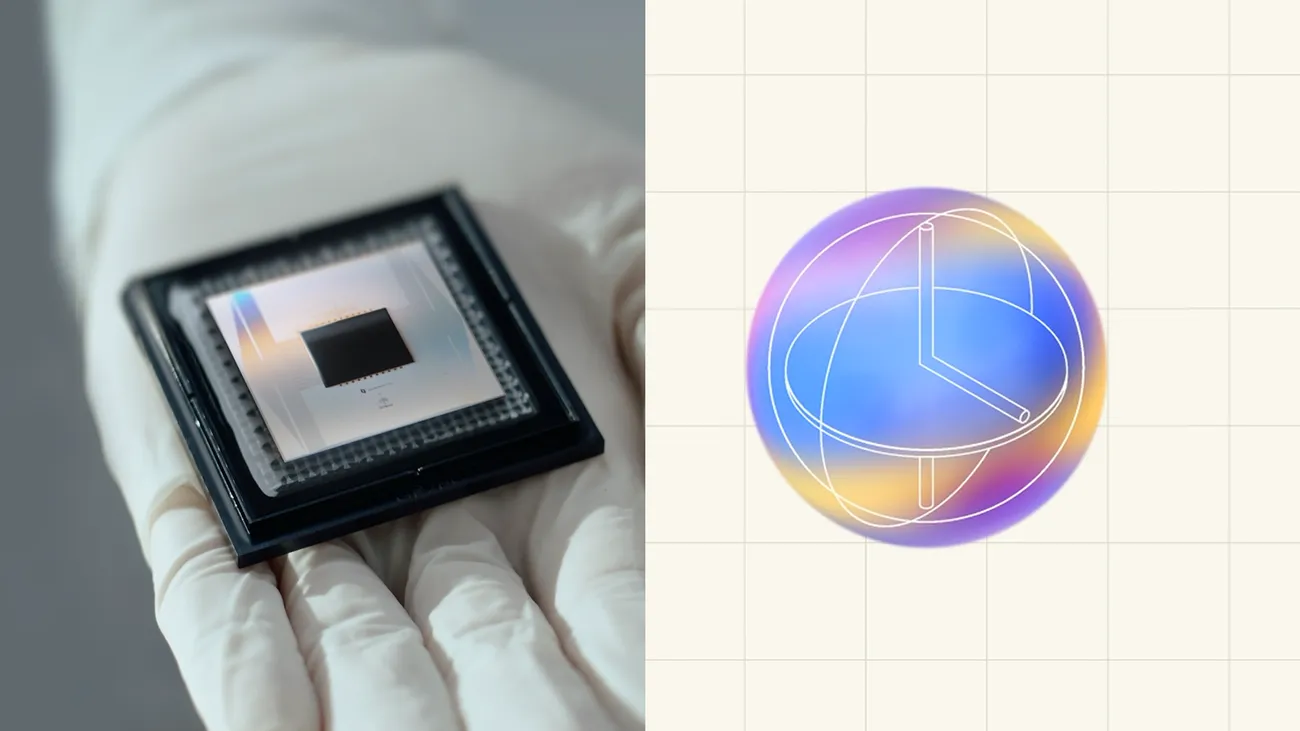
Photo: GoogleSource page
Google Quantum AI said on Thursday that a technique called magic-state cultivation works on its Willow processor. The paper, in Science the same day, reports that cultivation reduced the error by a factor of 40, with a state fidelity of at least 0.9999 — the last digit carrying the paper’s stated uncertainty — while retaining 8 percent of attempts. Emma Rosenfeld and Craig Gidney, on the Google blog, put the same result as an error reduction of about 40 times and a T-state fidelity of 99.99 percent. They call it a step toward a useful, error-corrected machine, and say the group still has to show the method at a larger scale before it is realistic for practical computing.
A quantum processor can already run a family of operations, the Clifford gates, that a normal computer can imitate. The gate that takes it past that imitation is usually a T gate, and a T gate is made by consuming a magic state: a qubit prepared in a very particular mixture of 0 and 1. The state is used up. Any error in it becomes an error in the gate. Rosenfeld told Scientific American that the standard recipe, distillation, can leave as much as 95 percent of the machine doing nothing but manufacturing these states. Some estimates Google cites are the same figure. Cultivation, proposed in a 2024 paper by Gidney, Noah Shutty and Cody Jones, tries to do the job on one state. A noisy version is injected into a small patch of the chip. A series of measurements asks, in effect, whether it is the right state, and throws it out if it is not. States that pass are spread onto more qubits so the protection is stronger. Jacek Krywko at Scientific American wrote that the experiment used 54 of Willow’s 105 physical qubits.
Keeping 8 percent of attempts is the other half of the result. Kenneth Brown, director of the Duke Quantum Center, who was not an author, told Scientific American that the quality check discards 92 percent of tries. The fidelity number is the quality of the states that remain. Scientific American put the current error at roughly one faulty state in 10,000 attempts. Breaking the RSA-2048 encryption used on the web, the magazine wrote, would need magic states that fail only once in 10 billion tries. Simulating molecules, which Rosenfeld called the nearer target, would need something like one error in a million, or one in 100 million. “We’re more galvanized than ever to get to these near-term scientific applications,” she told the magazine.
Circuit designers count Toffoli gates because each one spends a magic state. A preprint from Anthropic and Harvard, submitted the same day as the Science paper, estimates how many Toffoli gates a set of future circuits would need. Those counts were checked on an ordinary computer. Thursday’s experiment is the preparation step, on one cultivated state, short of an end-to-end fault-tolerant calculation.