Google adds TPU 8tx and TPU 8i Max, systems built around chips it already has
Amin Vahdat’s Monday post says 8tx uses the same silicon as TPU 8t, with AMD’s fifth-generation EPYC as the host, and that 8i Max puts two 8i chips in one package. Quartz, citing Bloomberg, says he put availability next year. The post does not.
Deep dive5 minIn-depth
Priya Shah5 min read
- TPU
- AMD
- Chips
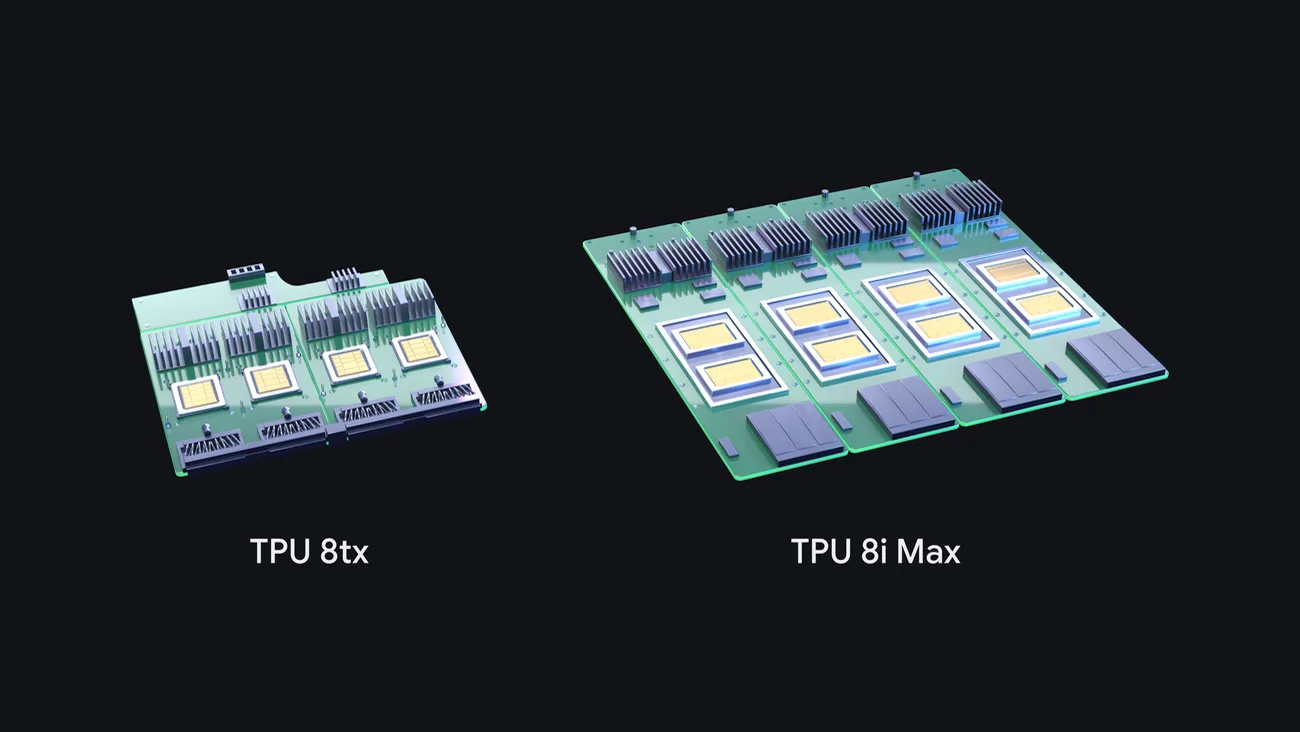
Photo: GoogleSource page
Google on Monday added two systems to its eighth-generation TPU line, TPU 8tx and TPU 8i Max. Amin Vahdat, senior vice president and chief technologist for AI and infrastructure, wrote that this is the first time the company has introduced four TPU systems in a single year. The other two, TPU 8t and TPU 8i, were announced at Google Cloud Next in April. He is explicit that a system is not a new chip. A new chip, he writes, means laying out billions of transistors in a process bound by manufacturing. A system is how compute, networking and storage are arranged around a chip that already exists.
On his account, 8tx is built on the same silicon as TPU 8t and is paired with fifth-generation AMD EPYC processors as the host CPUs. TPU 8i Max takes two of the low-latency TPU 8i chips and puts them on a single package. Cris Tolomia at Quartz, in a story updated Monday and written from Bloomberg, quotes Vahdat as saying the variations are reconfigured versions of existing silicon rather than new designs, changed to handle tasks customers had asked for. Tolomia also writes that Vahdat told Bloomberg availability is next year. Vahdat’s own post does not give a quarter.
8tx, and what “in use” is supposed to mean
Vahdat describes 8tx as optimized for secure and confidential inference, and as suitable for small-scale training. The customers he names as the point of it are regulated enterprises and governments running frontier or proprietary models, and autonomous agents, next to sensitive data. His account of the usual limit is concrete: data is encrypted when stored or sent, and has to be unlocked in memory while a computer processes it. 8tx, he writes, builds security into the hardware layer so that sensitive data and model weights stay protected and isolated while they are in active use.
The performance lines in that section are Google’s. By using what he calls the same low-latency Boardfly network built for real-time reasoning, 8tx delivers up to 2x lower latency than TPU 8t, with what he calls a near-zero performance penalty. He also writes that pairing training-grade compute with a fast inference network lets an organization fine-tune on private data, distill a large model into a smaller one, and train agents with reinforcement learning on one system, without moving sensitive data between separate clusters. The post does not show a latency trace, a workload, or a cluster size behind the “up to 2x.”
AMD’s release, timestamped 8:00 a.m. EST, calls 8tx the first cloud TPU system to deliver hardware-enforced confidential computing. It says fifth-generation EPYC processors in that system manage orchestration, data preparation and communication with the accelerators, and that AMD Secure Encrypted Virtualization, together with the TPU, extends confidential computing past the CPU to the connected accelerators. The mechanism AMD describes is a check of an accelerator’s identity and security configuration before it is given direct access to protected memory, so that prompts, model weights and intermediate data stay encrypted in CPU memory and in transit between the host and the accelerators, with hardware isolation while the accelerator runs. Mark Lohmeyer, vice president and general manager for AI and computing infrastructure at Google Cloud, is quoted in the AMD release.
By pairing 5th Gen AMD EPYC processors with our 8th-generation TPU architecture inside the AI Hypercomputer, we are bringing hardware-enforced confidential computing to cloud TPUs for the first time.
— Mark Lohmeyer, Google Cloud, in AMD’s release, Nov 9, 2026
8i Max, two chips in the rack the 8i already uses
Vahdat’s problem statement for 8i Max is memory bandwidth when many agents work across a codebase or hours of video at once. The package, he writes, doubles the compute, the SRAM and the high-bandwidth memory bandwidth of TPU 8i, and fits twice the silicon in the existing rack footprint, which he presents as more computing power per square foot and per watt. Tolomia, again from Bloomberg, says Vahdat described long context windows as mattering for drug discovery, mathematics and coding. Those are his examples of who would want the package. They are not benchmark scores.
The Monday post restates what 8t and 8i were supposed to do against the previous generation: up to 2.7 times better training performance for 8t, and 80 percent better inference price performance for 8i. Those figures are attached to the April chips, not to 8tx or 8i Max. The four-way split he prints at the end is a product map. TPU 8t for scale-up training, TPU 8i for low-latency reasoning, TPU 8tx for confidential computing, and TPU 8i Max for large context windows and the highest compute density per rack.
A software list, and the dates that are not in the post
The same post spends as much space on software as on the two systems. Vahdat writes that TorchTPU was open-sourced last month, so PyTorch and Hugging Face models run on TPUs, with backends for vLLM and SGLang. A TPU agent suite, in preview, plugs into Claude Code, Cursor and Google Antigravity to onboard a TPU, diagnose bottlenecks and tune kernels from plain language. He describes an Agent Compute Engine that suspends idle agent sessions and moves working memory off the chip in milliseconds, and an open-source layer called TPU Sync that, he writes, cuts key-value-cache transfer latency and time to first token by more than 90 percent. On InferenceX and AgentX, which he calls tests of agentic coding and long-context work, he says the vLLM-TorchTPU stack reached state-of-the-art price-performance. The post does not print the scores.
What the post does put a number on, for the business rather than for these two systems, is “nearly 100 customers,” including frontier labs, trading firms, retailers and universities. It does not say which of them have asked for 8tx or 8i Max, or what either system will cost. Tolomia writes that Bloomberg lists Apple, Meta and Oracle among TPU customers, and that Bloomberg’s reading of Google’s earnings report is that every TPU unit Google has is already committed to a customer. She also notes an October statement, from Google and Oracle, that TPUs would be available on Oracle Cloud Infrastructure in 2027, the first time on a hyperscale cloud other than Google’s. That October line is not a ship date for the systems announced on Monday. Vahdat’s post points readers to a broadcast at 9 a.m. PT the same day, and stops there.
We could build a single chip that tries to address the whole market, or by building specialized versions of the chips, we actually can deliver much more value.
— Amin Vahdat, as quoted by Cris Tolomia, Quartz, citing Bloomberg, Nov 9, 2026