Anthropic says Claude helped map a phage vault whose function is still unknown
A research post dated Wednesday describes a bacteriophage protein, L05, assembled into a shell of 96 chains, shorter and wider than the human particle and about 25 percent larger inside. The lab made it in E. coli. A preprint is on Anthropic’s site; the bioRxiv link was not live.
Feature4 minIn-depth
Maya Chen4 min read
- Anthropic
- Claude
- Biology
- Research
Photo: AnthropicSource page
Anthropic’s biology lab said on Wednesday that it has a three-dimensional structure for a vault particle from a bacteriophage, a virus that infects bacteria, and that Claude was in the workflow from the database search to the microscopy. The research post is dated 4 November. Vaults are large hollow protein shells. Leonard Rome and Nancy Kedersha described them in 1986, and the post says their function is still unknown. The new structure is of a phage protein the lab calls L05. Anthropic says related genes were already known in bacteria and in phages, and that, to its knowledge, no one had shown those proteins assemble into vaults. The company says it has submitted a preprint to bioRxiv and will add the link when the preprint is live. A PDF is already on Anthropic’s own site. The corresponding authors on that PDF are Nicholas T. Perry and Matthew G. Durrant, both listed at Anthropic.
In mammals, the post says, a vault is 78 copies of one protein, the major vault protein, in two matching halves. The phage particle is 96 copies of L05, 48 in each half, with a mass of about 9.5 megadaltons. It is shorter and wider than the mammalian vault: about 54 nanometers by 45, against about 67 by 40. Because it is rounder, Anthropic says, it encloses about 25 percent more volume. The wall is seven repeating segments stacked end to end, rather than the nine in mammalian vaults, and the caps are flatter. The post calls it one of the largest protein shells identified in prokaryotes, the group that includes bacteria. The lab has so far made the particles only in E. coli, the standard lab bacterium, and says it has not tested whether they form in the bacteria and phages where the genes occur.
A first model in 34 hours, and two weeks lost to a bad recipe
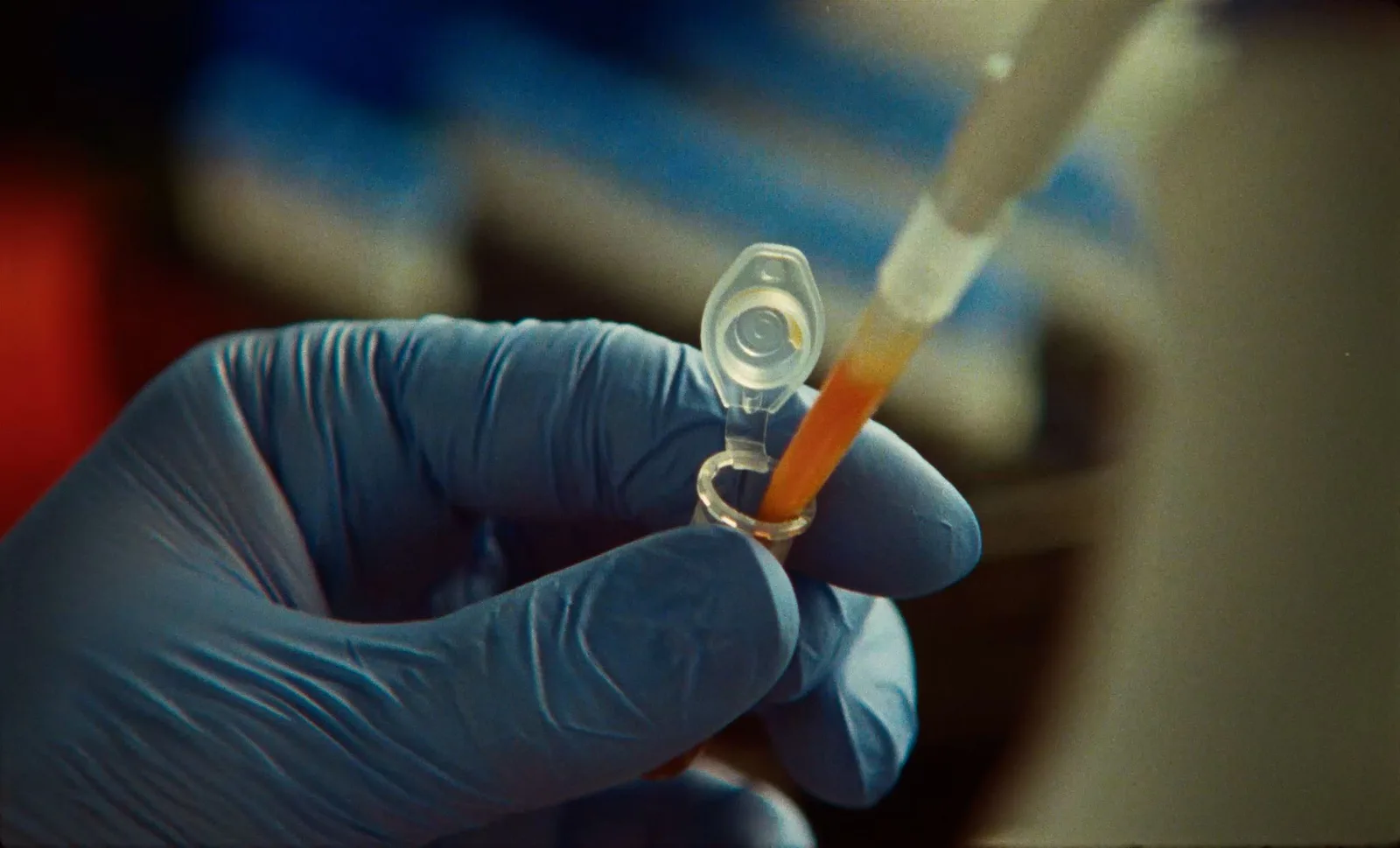
The post’s account of the method is a list of where Claude sat, under the scientists’ direction. Claude Science searched a database of about 15 billion predicted proteins. Homologs, the distant relatives of the vault protein, turned up in 29 bacterial phyla and four archaeal phyla, and in less than 1 percent of species with a sequenced genome. The lab chose candidates, had Claude turn the protein sequences into DNA designs for the host cell, and moved the best of them into E. coli. Isolating a vault the usual way, a spin through a tube of sugar, takes about three days, the post says. A chromatography method the team settled on, after Claude first argued against it, took about 90 minutes from cells to a microscopy grid. Seven of 15 proteins looked like vaults under an electron microscope. Cryo-electron microscopy, which freezes many copies and combines the images, confirmed four, two from phages and two from bacteria. L05 was picked because it closed into complete particles.
The structure work ran in what Anthropic calls an internal multi-agent harness, with access to the company’s own compute. Claude set up RELION, an open-source processing program, and ran the steps while the scientists made the analysis calls. A first full model was ready in 34 hours. The final maps took about a week from the start of processing. Anthropic estimates the first model would otherwise have taken weeks, and says the purification and the screening are the sort of work a typical lab could do with Claude products already on sale. The cryo-electron microscopy step used hundreds of GPUs in parallel, which the post says is more compute than an academic lab might have. The PDF’s title calls the particles engineerable nanocapsules. In the post, copying two of the seven wall segments, so the chain had nine, as in the human protein, produced a larger particle than the unmodified L05. Anthropic says the enclosed volume rose by about 20 percent. The preprint abstract makes a different comparison, and says the enlarged shell is 50 percent larger than the human vault.
The same section records where Claude was wrong. A protocol it wrote called for a growth medium with an additive that interferes with getting DNA into cells, and that mistake set the project back two weeks. Early in the microscopy processing it skipped a standard step and produced a map blended with its own mirror image. The scientists told it to stop improvising. Their line, printed in the post, was: “Please let’s do normal things unless they don’t work.” Anthropic says it passed the lab notes to the researchers who train Claude. A pocket in each of the 96 chains holds a small molecule the map shows clearly and the lab has not identified. Claude said the shape resembles coenzyme A, a common helper molecule. The post treats that as a resemblance, not an identification.
Figuring out the function of vaults is still enormously challenging. I am pleased that Anthropic has so much good data. Now, other people will be working on this problem.
— Leonard Rome, quoted in Anthropic’s research post, 4 November 2026
Rome discovered vaults with Kedersha. Anthropic says it brought him on to advise, and the preprint thanks him for comments on the manuscript. He is quoted again on the open question: whether these particles do the same thing as human vaults, or whether the function changed as the shells did. The post says the result deepens that question. It does not answer it. The structures and further data, Anthropic says, are still to be released.