Junior technical hires at Anthropic fall from 27% to 9% as agent hours hit six to one
A report dated 16 October, from the Anthropic Institute: junior employees in technical departments slip from 21% to 14% since early 2025, and junior technical hires from 27% to 9%. By August, interactive agent hours outnumber employee hours six to one. Figure 2 labels research organizations at 19 times. Meeting time is up 20% for the median employee and 16% for technical individual contributors. TechCrunch wrote it up Saturday. The Decoder filed Sunday.
Feature5 minIn-depth
Priya Shah5 min read
- Anthropic
- Hiring
- Agents
- Labor
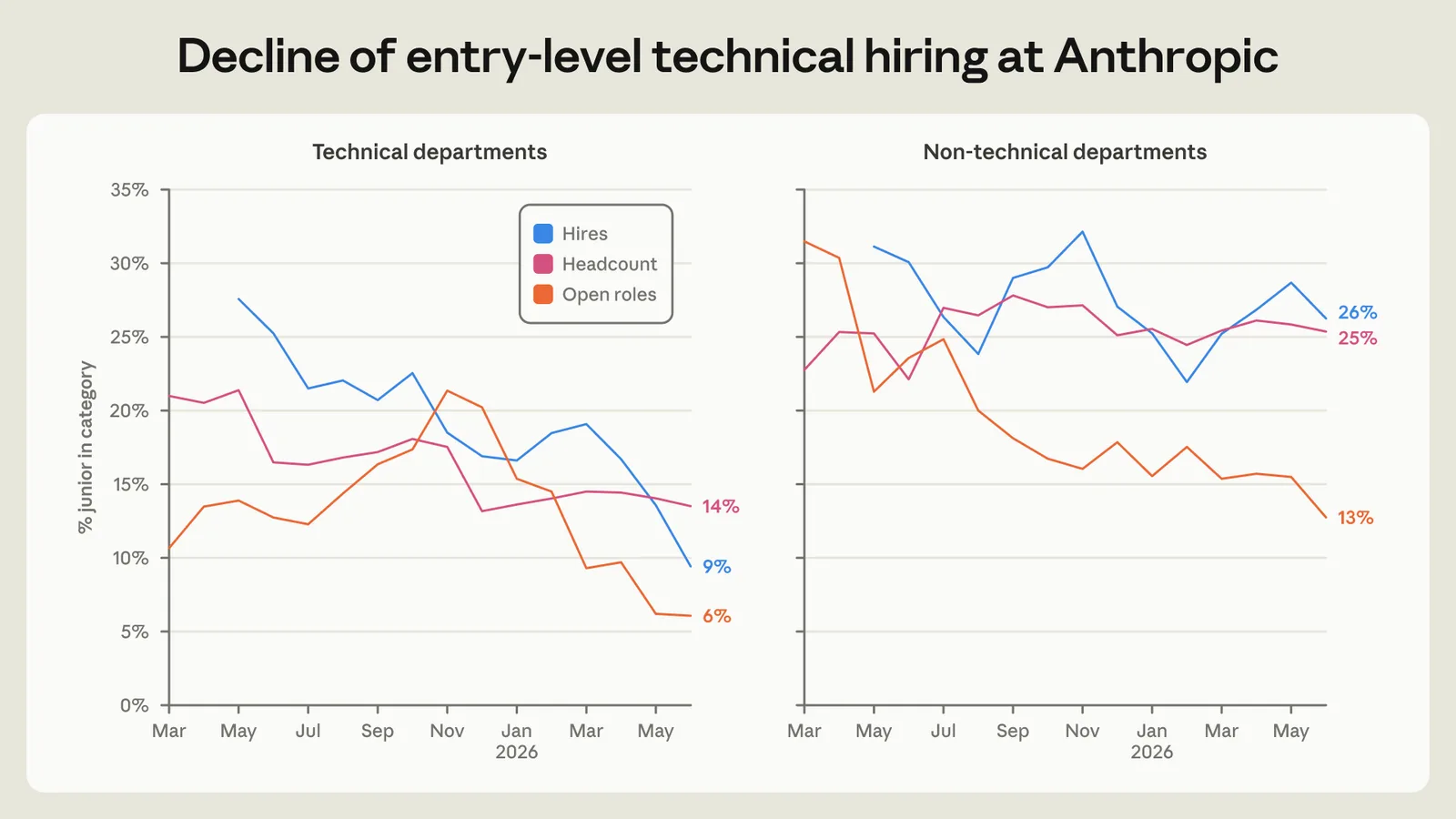
Photo: AnthropicSource page
Anthropic said on Friday that junior employees are a smaller share of its technical staff, and a much smaller share of its technical hiring, while hours logged by its own agents have pulled ahead of hours logged by people. The report, “How employment is changing at Anthropic,” is dated 16 October and credited to Nathan Wilmers, Regina Catipon, Maxim Massenkoff and Peter McCrory of the Anthropic Institute. It draws on internal employment records, agent telemetry, output metrics, surveys, calendars, hiring scorecards and 17 interviews. Figure 1 shows the share of junior-level employees in technical departments slipping from 21 percent to 14 percent since early 2025, and the proportion of junior technical hires falling from 27 percent to 9 percent. The chart’s latest label for open junior roles in those departments is 6 percent. Postings for juniors, the text says, have fallen particularly sharply since December 2025. Anthony Ha at TechCrunch wrote the hiring figures up on Saturday. Matthias Bastian at The Decoder filed them on Sunday.
The hours are in the same report. It says that in March 2026 the sum of autonomous and interactive agent work hours passed human work hours for the first time. Narrowing to interactive sessions that employees direct, and pooling subagents, it says that by August those agents worked six times as many hours as the people handling them. Figure 2 labels that company-wide ratio at 6× and a separate line, research organizations, at 19×. The note under the figure says agent time is runtime, including inference and active tool use, and that it excludes any wait longer than 30 minutes. Human hours are headcount times an assumed 40-hour week. In interactive sessions, the report says, about 80 percent of wall-clock time is idle, waiting on a person.
More output, and a longer meeting calendar
On the company’s own measures, output moved with the tools. Code commits per engineer are at five times the velocity of six months earlier. The report also says lawyers processed more contracts, accounts payable moved more invoices and salespeople closed more deals. It follows 192 engineers who adopted coding agents against 74 who did not during the period studied, and says the amount of code the adopters add rises in the months after adoption. Comparing code from the same employee, in the same month and the same directory, it says it found no difference in how often lines written by an agent were later removed or reverted, against lines the person wrote directly. It states the limit in the same section: adoption is not random, and more code is not the same thing as better code or a larger effect on the business. Sales representatives who adopted agents closed deals with more clients. One account executive told interviewers that automations replaced about 20 percent of prior tasks. Another said the time freed let them talk to 30 percent more of their customers.
The constraint the report names is attention. In an April 2026 survey, an open question about day-to-day work, 27 percent of employees described productivity gains from Claude and 20 percent said the role had shifted from doing the work to managing Claudes. For non-technical groups, the report estimates that reading the output of interactive Claude sessions would take more than half a work week. The conversion it uses is 0.75 words per token and 250 words a minute. Written standing instructions for agents grew from a few hundred in July 2025 to 8,500 a year later. The share of an average employee’s interactive sessions that an automated coder classifies as meta-work — skills, plans, reviews of other agents, dashboards, documentation of how the work is done — went from 10 percent in fall 2025 to 22 percent in spring 2026.
An army of Claudes, with every one asking for my attention.
— An Anthropic engineer, quoted in “How employment is changing at Anthropic,” 16 October 2026
Calendar data in the report says the median employee spends 20 percent more time in meetings than a year ago. Among technical individual contributors the increase is 16 percent. Part of the company-wide figure, the authors write, is growth and a shift toward roles that meet more. The interviews, they say, still describe face-to-face coordination as indispensable, because some bugs turn into decisions about debt, governance and who is accountable. TechCrunch’s Saturday story carries the same 20 percent and 16 percent increases. Ha also quotes the report’s babysitting comparison: agents raise small requests and serious ones with the same urgency, and a person has to sort them.
What the scorecards started rewarding
Technical departments are a smaller slice of the company, from 61 percent to 56 percent in the last year. The report says technical hiring is still growing in absolute numbers, and that hiring in sales, finance and recruiting has grown faster. It splits the cause. Some of it is what happens when a company adds business functions. Some of it, the authors say, may be coding tools that let people outside engineering ship software. Coding-focused agent sessions for non-technical employees — people with no code commits at the baseline, excluding new hires — went from 2 a month in August 2025 to 90 in May 2026. Inside technical departments the share of employees with no commits in the prior 30 days fell by almost half through April 2026. The ratio of engineers to product managers sits at about 17 to 1 and has risen since 2025. Commits from managers have doubled. Employees who had been at the company for at least a year were 50 percent more likely to move across departments in a given month of 2026 than in 2025.
Hiring scorecards, processed by an automated coder for thousands of hires since 2024, show a different emphasis. In 2024, the report says, comments on a candidate’s record with AI tools appeared in about 5 percent of assessments for technical roles and 7 percent for non-technical roles. By 2026 those rates had tripled for technical roles and quadrupled for non-technical ones. Among technical interviews, the largest increases were comments on autonomy and judgment, and discussion of domain expertise shrank as a share of the write-up. The company says it is standing up an early-warning set of role-level metrics and has prioritized moving people internally when a job changes. The authors also say protections for people already on staff do not help the juniors who are not hired. At five years old, using internal figures for the twelve months to April 2026 and the companies’ 10-K filings, deflated to 2025 dollars, Anthropic takes in between two and four times as much revenue per employee as Meta and Google did at the same age. The report says that comparison, and the workplace it describes, are a case at one lab. It says many of the employment practices will not transfer, and that private steps by employers do not replace policy on retraining and income.