Google flies four TPUs to orbit on SpaceX Transporter-18
Cris Tolomia, Quartz: Falcon 9 left Vandenberg at 11:18 a.m. local with 130 payloads. Planet Labs spacecraft, refrigerator-sized MVP, four TPUs, ~1 kW solar, Gemini in 15-minute bursts. First in-orbit Project Suncatcher test, not a commercial data center.
Feature2 minIn-depth
James Okonkwo2 min read
- Suncatcher
- TPU
- SpaceX
- Planet Labs
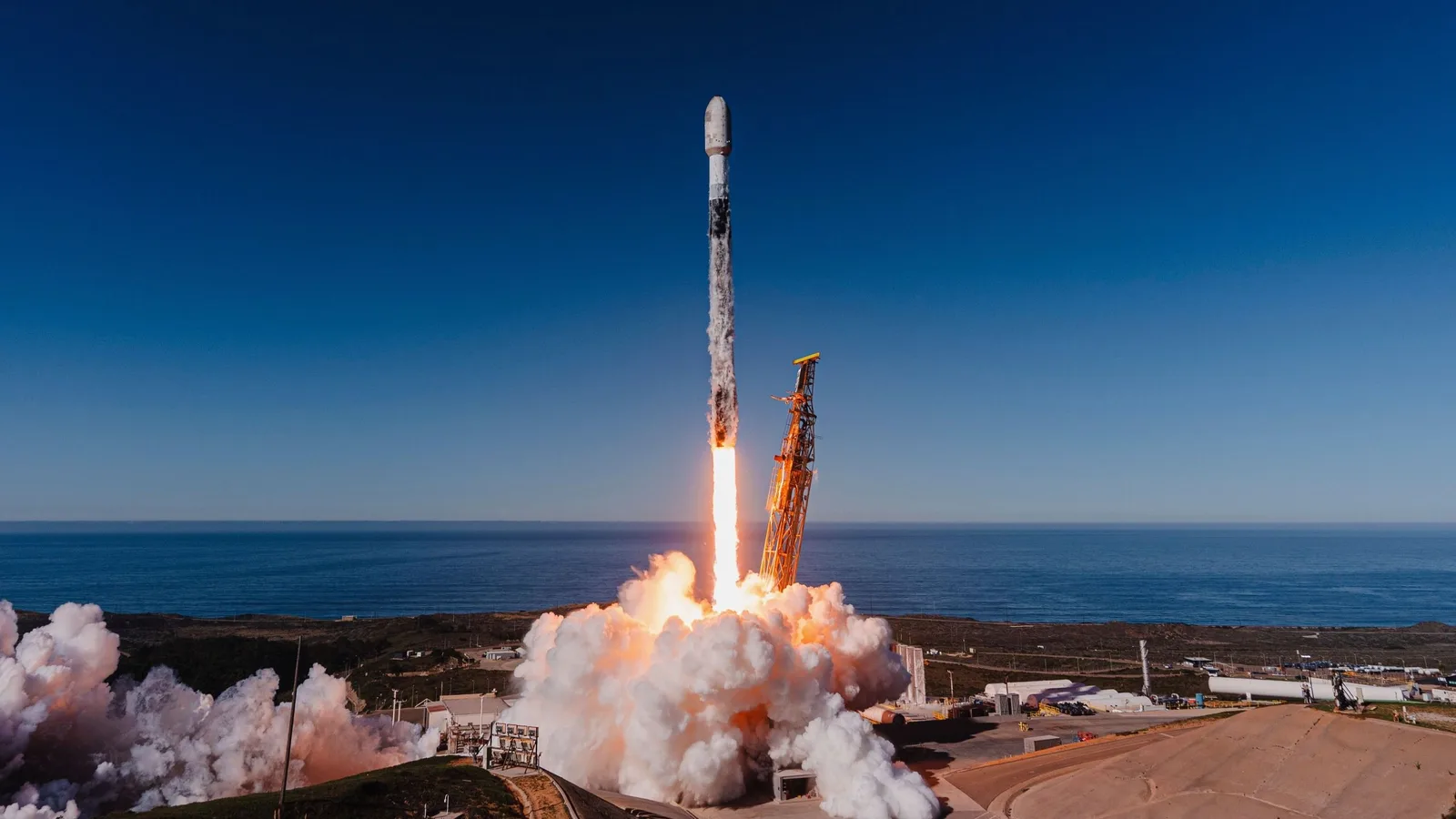
Photo: SpaceX / Space.comSource page
Google’s first Project Suncatcher hardware is in orbit. Cris Tolomia at Quartz reported that a SpaceX Falcon 9 left Vandenberg Space Force Base at 11:18 a.m. local time on Thursday with 130 payloads on Transporter-18. The Google chips ride a Planet Labs satellite. Mike Wall at Space.com had the window opening at 2:18 p.m. Eastern — 11:18 a.m. Pacific — and the booster’s 25th flight coming back to Vandenberg about seven and a half minutes after liftoff. Quartz confirmed both the launch time and the landing. Lora Kolodny at CNBC, filing before the window at 7:20 a.m. Eastern, had a 11:15 a.m. Pacific target. This is the first in-orbit test of Suncatcher, Alphabet’s research program on whether low Earth orbit can host machine-learning infrastructure. It is not a commercial data center.
Ryan Whitwam at Ars, 24 September, described the box as MVP: about the size of a refrigerator, four of Google’s TPU accelerators, solar panels that supply about one kilowatt — enough, the Times told him, for a microwave or a hair dryer. Google did not build the bus. Planet Labs had a spacecraft ready; Google put its chips in it rather than wait for two custom satellites planned for 2027. Gemini will run on the TPUs in roughly 15-minute bursts, then shut down so radiators can catch up. Cooling in vacuum uses a thermal-interface layer and aluminum and copper heat pipes into a radiator. The flight is meant to last a few months.
Travis Beals, senior director of Paradigms of Intelligence at Google, posted the ground-test record the same day as Whitwam. Trillium TPUs survived a proton beam at UC Davis’s Crocker Nuclear Laboratory at a total ionizing dose above a five-year mission. Vibration: the craft at about 10 g, the chips at 50 to 100 g. A pair of satellites in 2027 is still supposed to try short-range, high-bandwidth laser links. Beals’s line is that this is a research moonshot, years from project to product. Alphabet holds a SpaceX stake CNBC put above $82 billion. Gwynne Shotwell said in September the company will deploy “supercompute in space” in 2027. Elon Musk has said orbital training will be the cheapest path in two to three years. Those are SpaceX’s claims. Thursday’s payload is four chips and a heat pipe.