Google Cloud AI Research open-sources Harness², which edits the agent and leaves the model frozen
Harness², Apache-2.0 on GitHub, rewrites prompts, tools, memory and skills around a model whose weights do not change. The method is Propose–Probe–Compose, with no ground-truth verifier. A preprint submitted 9 October, and written up by MarkTechPost on Sunday, reports gains of up to 11.5 points on WorkBuddy-Bench, 4.5 on JobBench and 11.8 percentage points on LAB Partial. The largest WorkBuddy move is GLM-5 under OpenCode, 64.2 to 75.7. The repository says this is not an officially supported Google product.
Deep dive5 minIn-depth
James Okonkwo5 min read
- Agents
- Harness
- Open source
- GLM-5
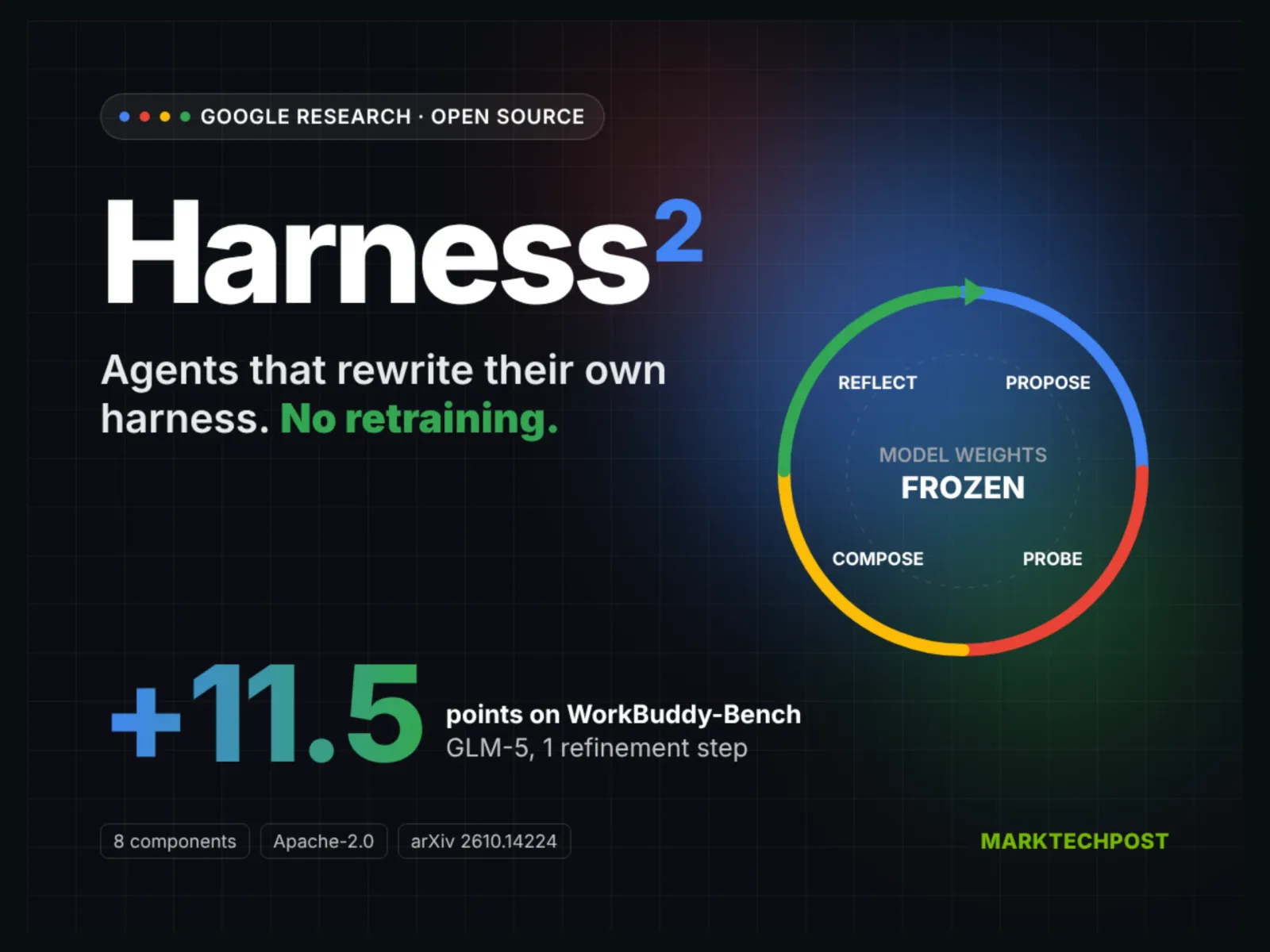
Photo: MarkTechPostSource page
Google Cloud AI Research has open-sourced Harness², a framework that rewrites the files around a language model and does not change the model’s weights. Asif Razzaq at MarkTechPost filed the release on Sunday. The code is in the GitHub repository google-research/harness2, under the Apache-2.0 license. The paper, “Harness²: Recursive Agent Harnessing for an Open World,” was submitted to arXiv on 9 October as 2610.14224. It has not been peer-reviewed. The authors are Ruiyao Xu, Yanfei Chen, Zhongying CuiZhu, Bhavana Dalvi Mishra, Yifei Ming, Han Yu, Rujun Han, Chen-Yu Lee and Tomas Pfister. The affiliation lines on the paper are Google Cloud AI Research and, for Xu, Northwestern University. His corresponding address is a Northwestern email. The README says the project is not an officially supported Google product, and that it is not eligible for Google’s open-source vulnerability rewards program.
A harness, in the paper’s definition, is the system around a frozen model: the prompts, memory, skills, tools and orchestration the model acts through. Harness² exposes eight of those as files. The README lists a system prompt, guardrails, memory, tool guidance, subagents, skills, scripts and plugins. The paper says that set takes the file-level split from earlier agentic harness engineering work and adds one component, a middleware plugin. Each component is mounted as a file in the runtime. The weights stay fixed. The setting the authors want is an open world: tasks that were not in the design set, and no ground-truth label or verifier to say whether an answer is right.
Propose, probe, compose
Task-level recursion is one contrastive step, which the paper calls Propose–Probe–Compose. The agent runs the task once on the base harness. That run is a reference for how the harness behaved, not a score. An editor then proposes two candidates. The invariant candidate targets failures that can show up in more than one domain, such as planning, tool use, context or delegation. The domain candidate targets the knowledge and procedures of the task in front of it. Both run on the same task, under the same model and environment. A composer reads the trajectories and the diffs and keeps only edits the observed behavior supports. It can merge them, take one candidate, or leave the harness as it was. The decision is tied to a contrast between runs, not to a presumed gain on a hidden answer.
A second loop runs after the task. Harnessing-level recursion stores the adopted harness and an EXPERIENCE.md of lessons that the execution contrasts support. The next task still starts from the base harness. The library is what later proposals can reuse. A budget, k, sets how wide or how deep the search goes. In parallel mode the pipeline probes k invariant candidates and k domain candidates, then makes k compositions. In sequential mode it chains k steps, each one seeing the harness and the evidence so far. For k greater than 1, an agentic selector picks among anonymized deliverables. The paper says that selector does not revise the harness. The default editor in the experiments is Claude Opus 4.8, running under OpenCode. The executors are frozen: Gemini 3.5 Flash and GLM-5, each under the off-the-shelf OpenCode harness and under Codex.
One step, four setups
The paper evaluates three benchmarks. WorkBuddy-Bench covers office, web and code deliverables. JobBench is a set of longer professional tasks. Harvey’s Legal Agent Benchmark is reported as Partial, a per-criterion pass rate. Main tables are means over three runs, each with a shuffled task order. The abstract says one contrastive step improves GLM-5 and Gemini 3.5 Flash over their base harnesses in every configuration, with gains of up to 11.5 points on WorkBuddy-Bench, 4.5 points on JobBench and 11.8 percentage points on LAB Partial. Table 2 and the results section put the WorkBuddy 11.5 on GLM-5 under OpenCode, which the paper says reaches 75.7. MarkTechPost’s table, attributed to Tables 1 and 2, gives the base for that cell as 64.2. The same OpenCode row is the LAB move that matches the abstract’s 11.8: Partial pass rate 59.6 to 71.4. JobBench on that row goes from 20.6 to 24.2, a gain the paper states as 3.6.
The other three setups move by less, and one of them barely moves on JobBench. GLM-5 under Codex goes from 64.4 to 75.3 on WorkBuddy, 23.6 to 24.8 on JobBench and 58.1 to 65.9 on LAB Partial. The paper calls the JobBench change 1.2 points. Gemini 3.5 Flash under OpenCode goes from 72.4 to 77.5 on WorkBuddy, 31.5 to 36.0 on JobBench — the 4.5-point gain in the abstract — and 79.9 to 81.9 on LAB Partial. Under Codex the same model goes from 74.5 to 77.5, 33.9 to 35.3 and 71.6 to 75.6. The paper says that after one step GLM-5’s WorkBuddy scores, 75.7 and 75.3, sit above the base Gemini scores of 72.4 and 74.5. On LAB Partial it also says Meta-Harness, an offline method that searches on a training split, still leads for Gemini 3.5 Flash under Codex. Table 1 shows Gemini under OpenCode using fewer WorkBuddy steps after one Harness² pass, 25.4 to 21.9.
Raising the budget adds more. The paper says parallel recursion at k=5 adds a further 2.9 to 3.9 points on WorkBuddy-Bench, 3.0 to 4.2 on JobBench and 2.6 to 6.7 percentage points on LAB Partial, on top of the single step. For Gemini under OpenCode it says that budget lifts the Code domain from 76.5 to 80.8 and Office from 79.5 to 83.4. MarkTechPost lists 80.8 as the WorkBuddy average for that configuration at k=5. A separate test uses the same model as executor and editor, at k=2 under OpenCode. The paper says all five models it tried, from GLM-5 to Claude Opus 5, improve on every benchmark in that setup. It gives Opus 5 gains of 3.3, 5.5 and 3.0 points on WorkBuddy-Bench, JobBench and LAB, and a 13.7-point LAB gain for GLM-5.
What the repository will run
The README targets Linux, Python 3.12 and the uv package manager. A local demo runs both recursion modes with deterministic editors and real Python executions, and it does not need model credentials. Model-backed benchmarks need Node.js 20 or newer, the Google Cloud command-line tools and a Vertex AI project. LAB needs Pandoc and Poppler. WorkBuddy-Bench needs Docker. MarkTechPost’s label for the release is version 0.1.0. The README also says executor network access is unrestricted, that Codex runs with its sandbox disabled, and that public rubrics may be reachable online. It tells anyone running an evaluation to restrict the network first, so a run cannot fetch benchmark answers. Third-party code, the benchmarks and the datasets keep their own upstream licenses.