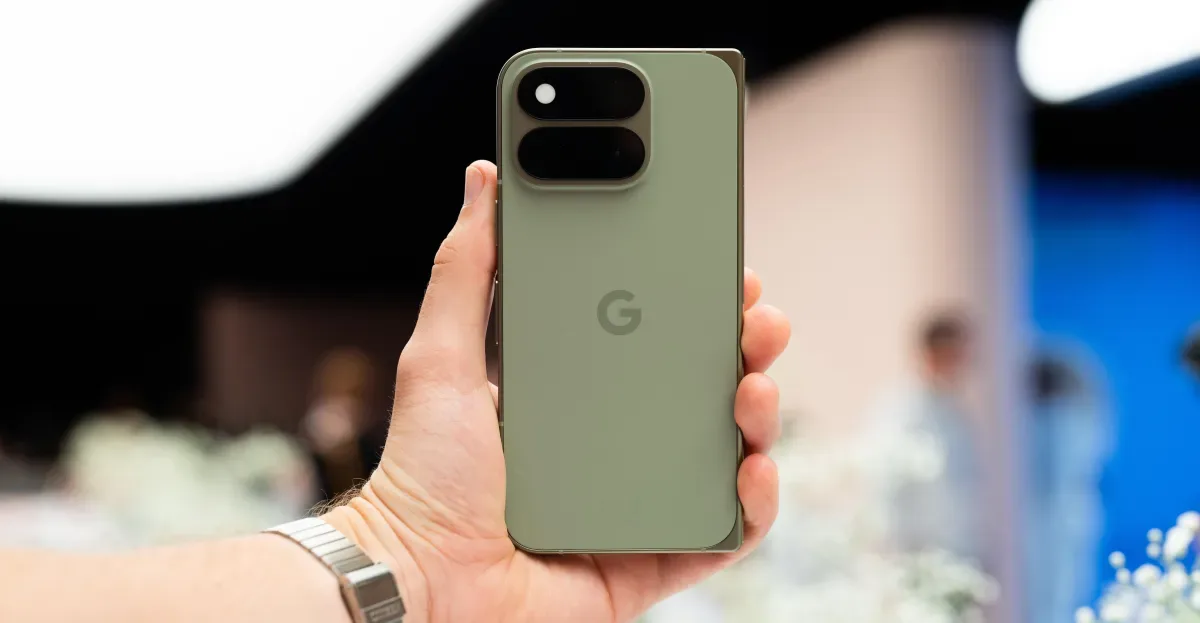
Google Fi says a Pixel on eSIM can switch 5G networks, and it does not name the carriers
Shimul Sood at Android Authority, at 12:30 p.m. Eastern on Tuesday, writes that the phone moves only when the difference is noticeable, and only on Pixel 9 and newer with no other SIM active. The Pixel Drop post’s footnote lists Samsung and Motorola models for the Wi-Fi feature Sood says arrives next week.
Short2 minEasy
Eli Navarro2 min read
- Google Fi
- Pixel
- Samsung
- Motorola
Photo: GoogleSource page
Google Fi is switching supported Pixel phones between two U.S. 5G networks when one of them is clearly better. Shimul Sood’s story at Android Authority is timestamped 12:30 p.m. Eastern on Tuesday. The same day’s Pixel Drop post, by Mayra Fajardo, calls it Google Fi’s super network and says it also uses millions of secure Wi-Fi networks. Sood writes that Google is not saying which carriers are on the other end of the switch. The phone moves only when the difference in quality is noticeable, and the data is priority on both networks, including ultra-wideband.
The limit is in both accounts, in different words. Sood writes that it is Pixel 9 and newer, Google Fi on an eSIM, and no other SIM active. A physical SIM does not qualify. Support for more phones, he writes, is planned for 2027. Fajardo’s footnote says 5G and network switching are not available in every area, and that the feature needs Fi active on the eSIM with any non-Fi SIM disabled, on Pixel 9 devices and newer. A separate footnote says multiple-enabled-profile technology lets one eSIM chip run more than one profile at the same time. The claim that this is the country’s fastest and most expansive coverage is footnoted to Ookla Speedtest Intelligence data for the first half of 2026.
The Wi-Fi half is where the timing differs. Sood writes that Wi-Fi Auto Connect+, which joins supported networks without a password or a sign-in page, is already on supported Pixels and starts rolling out to selected Samsung Galaxy and Motorola phones next week. Google, in his account, says those connections are twice as reliable as cellular alone, with 30 percent lower latency, and that the data does not count against the high-speed allowance on unlimited plans. Fajardo’s footnote already lists a device set: selected places in North America, Europe, Asia, and Brazil, on Pixel 5a and newer, Galaxy Z Fold7 and Flip7 and newer, Galaxy S24 and newer, the 2023 Moto razr+, the 2026 Moto G Stylus 5G, the 2024 Moto Razr and newer, and the 2026 Moto G 5G. Sood also writes that Fi covers more than 200 destinations abroad, and that an assistant in the Fi app, Ask Fi, answers account questions while human support stays available.
The discounts are not printed as one offer. Fajardo’s post says people who already have a Pixel and are not on Fi can get 50 percent off selected unlimited plans for 12 months, ending 1 December 2026. Sood reports a Pixel 11 deal for new customers, up to $899 back, with $500 off immediately and $399 in monthly credits over two years, plus $10 off Unlimited Premium each month for 24 months. For someone bringing an existing Pixel, he writes, the offer is 50 percent off Unlimited Standard or Unlimited Essentials for a year. The Google post does not print the $899 figure.