Gemini Decision 1 prices a thousand closed questions at ten cents a million tokens, and Jev is cheaper on Google’s own table
Min Choi and Felix Yu’s post, dated 11 November, bills input once and output at zero. The table on that post gives Decision 1 five of the seven tests every named rival ran. The cost line on the same table is $0.68 for TypeSafe’s Jev and $0.88 for Gemini.
Feature4 minIn-depth
Priya Shah4 min read
- Gemini
- Decisions
- Agents
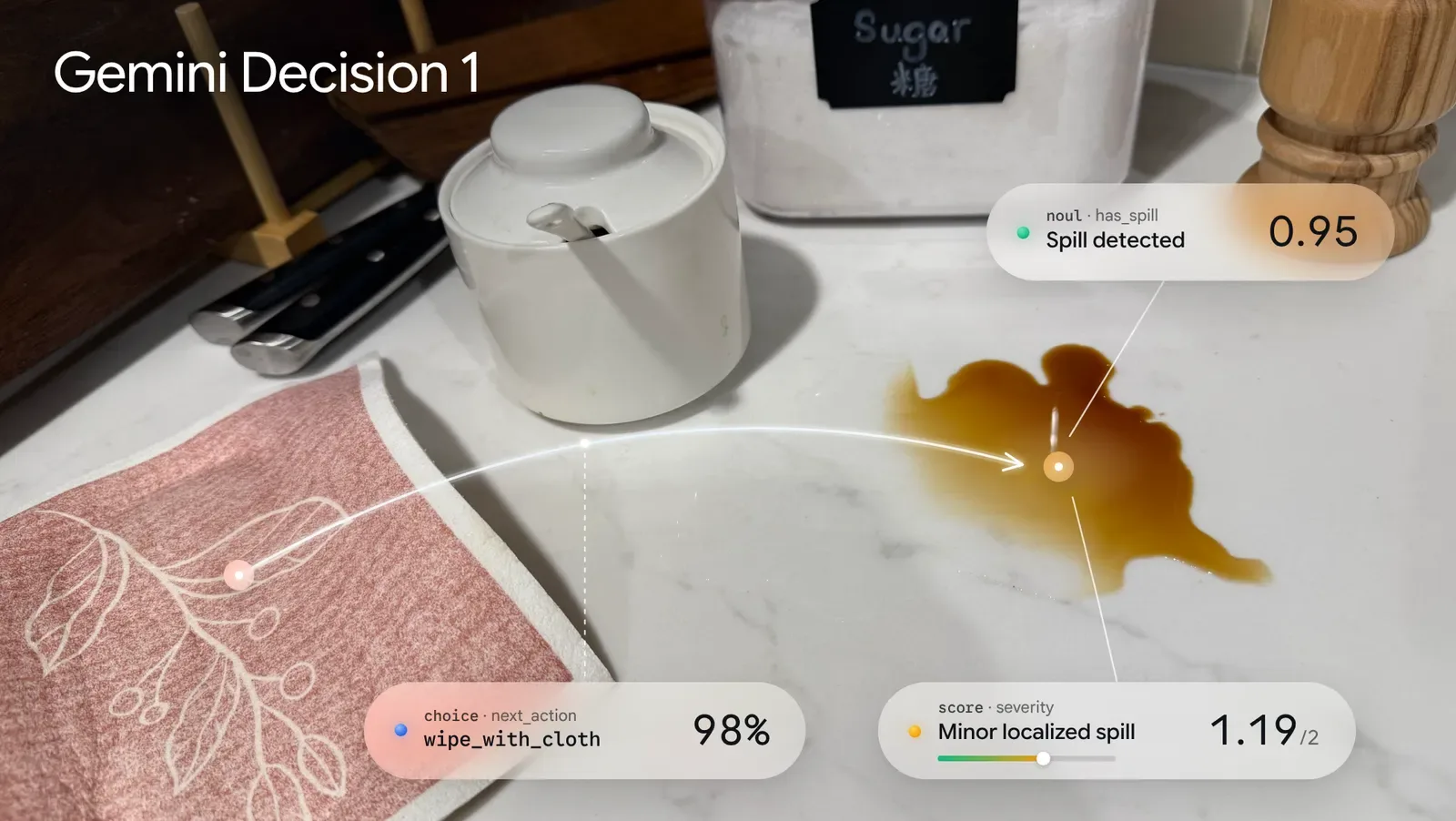
Photo: GoogleSource page
Google on Wednesday opened a model that does not write an answer. Min Choi and Felix Yu, in a DeepMind post dated 11 November, introduced the Gemini Decisions API and Gemini Decision 1, model id gemini-decision-1, in Google AI Studio. A call sends one shared input, text, images, audio, video or a PDF, up to 256K tokens in the post’s wording, and as many as 1,000 questions. The model scores the choices in one pass and returns probabilities and a confidence from 0 to 1. The price on the post is $0.10 per million input tokens and nothing for output. The shared input is billed once. Each question adds only its own instructions and criteria. Carl Franzen’s VentureBeat story is timestamped 3:03 p.m. Pacific.
The three question types are in the post and in the API guide. A noul is a yes or no, and the guide says that probability always falls between 0.01 and 0.99, so a threshold above 0.99 never matches. A choice picks from 2 to 255 named options and returns a probability for each. A score grades an ordered rubric, starting at 0, and returns a weighted score plus a probability at each level. The guide’s context window is 262,144 tokens, which is 256 times 1,024. The post’s “256K” and the guide’s 262,144 are the same ceiling written two ways. Questions are scored independently. The post says a second decision that depends on the first has to be written in code, or sent as another call.
Five of seven on the company’s table, and a cost line that points elsewhere
The post says Decision 1 leads across its suite and has the lowest calibration error. The table on the page is more specific than that sentence. On the seven tests where Gemini, TypeSafe’s Jev 1.14 and GPT-6 Luna all have a number, Decision 1 is ahead on five: JevBench at 92.2 percent against 90.0 and 90.9, Amazon ESCI at 58.7 percent, the New Yorker Caption test at 79.7 percent, PubMedQA at 79.8 percent, and Global-MMLU-Lite at 86.0 percent. Jev is ahead on Mind2Web Multimodal, 86.8 percent to 86.2, and on When2Call, 82.0 percent to 79.9. A footnote says refusals and safety blocks count as incorrect, and that scores are top-1 accuracy unless noted. ESCI is marked as macro-F1. The two media rows, MMAU at 71.8 percent and Video-MME at 69.1 percent, are compared with Gemini 3.5 Flash-Lite, at 67.7 and 63.3, because Jev and Luna are blank there.
The cost row is the line the prose does not lead with. For seven shared evals the table prints $0.88 for Decision 1, $0.68 for Jev, $0.93 for Luna and $4.14 for Flash-Lite through the Interactions API. The post says Decision 1 is nearly five times cheaper than Flash-Lite on that suite. Four dollars and fourteen cents divided by $0.88 is about 4.7, which is the multiple Franzen prints. The same row has Jev cheaper than Decision 1. The post does not say so. Calibration, where lower is better, is 0.0250 for Decision 1, 0.0494 for Jev, 0.0721 for Luna and 0.2104 for Flash-Lite. Franzen calls 0.0250 roughly half of Jev’s figure. Half of 0.0494 is 0.0247.
The latency sentence is also narrower than the product limits. The post says median model compute is 50 to 100 milliseconds, and end-to-end latency is 150 to 250 milliseconds, for inputs up to 16K tokens, nearly flat from 1 to 100 questions. The API allows 1,000 questions and a 262,144-token window. Franzen writes that a team planning to use either limit should time its own files. Simon Willison’s note, timestamped 10:03 p.m. on 11 November, records a separate behaviour on yes-or-no questions. He writes that Jev and OpenAI returned 1.0 or 0.0 on a short video test, and that Gemini returned 0.0498 for a dragon, 0.923 for a robot, 0.083 for France and 0.923 for the United States. Those four figures sit inside the 0.01 to 0.99 band the guide requires. He also writes that the price matches GPT-6 Luna’s decision model, ten cents per million input tokens with output free, and that Jev remains cheaper at 4.2 cents. Jev, he writes, takes text and JSON. Luna takes text and images. Decision 1 takes text, images, audio, video and PDFs.
An outside index the post does not print
Franzen’s account of Artificial Analysis’s Decision Index v2.1 does not reproduce the company’s “leads the suite” line. He writes that the index placed Gemini ninth of 18 models at launch, with a score of 65.98, against 66.23 for Jev 1.14 and 72.62 for Nace’s Drex Max v1.1. GPT-6 Luna, on that index, is at 60.25. The cost column he prints is $345 per million tasks for Gemini, $156 for Jev, $103 for Drex and $339 for Luna. On the index’s When2Call run he has Gemini at 75.2 percent, Jev at 80.8 and Drex at 94.6, which is not the 79.9 and 82.0 on Google’s table. He also writes that OpenAI’s Decisions API became generally available on 22 October, with Luna the only model and a cap of 400 questions, against Google’s 1,000. The Wednesday post does not mention that index, that cap, or Jev’s price.
Inside Google, the post names four uses already running. Gemini Notebook routes a query to a model and a thinking level, and the company says everyday queries in that path are up to 40 percent lower in latency. Stitch uses the API to turn a voice or a tap into a wireframe. CC, from Google Labs, picks an emoji from more than 200 options. Search uses it as a check on adversarial behaviour against its own evals. The post says support in Gemini on Google Cloud is coming, and that the model is also landing in OpenRouter, LangChain, Vercel, LiteLLM and a handful of voice and agent libraries. A no-cost tier is available in AI Studio. The post does not print the free-tier caps.