Google opens Gemini 4 Carbon to paying API customers and Ultra subscribers, and dates the $2 rate to 30 November
Koray Kavukcuoglu’s Tuesday post puts the model on the paid Gemini API and, for Google AI Ultra, in the Gemini app, AI Mode, and Antigravity. The introductory price matches Argon, then doubles. Abner Li quotes a first-place line on a benchmark the post ranks second.
Deep dive6 minIn-depth
Priya Shah6 min read
- Gemini
- Carbon
- Antigravity
- Pricing
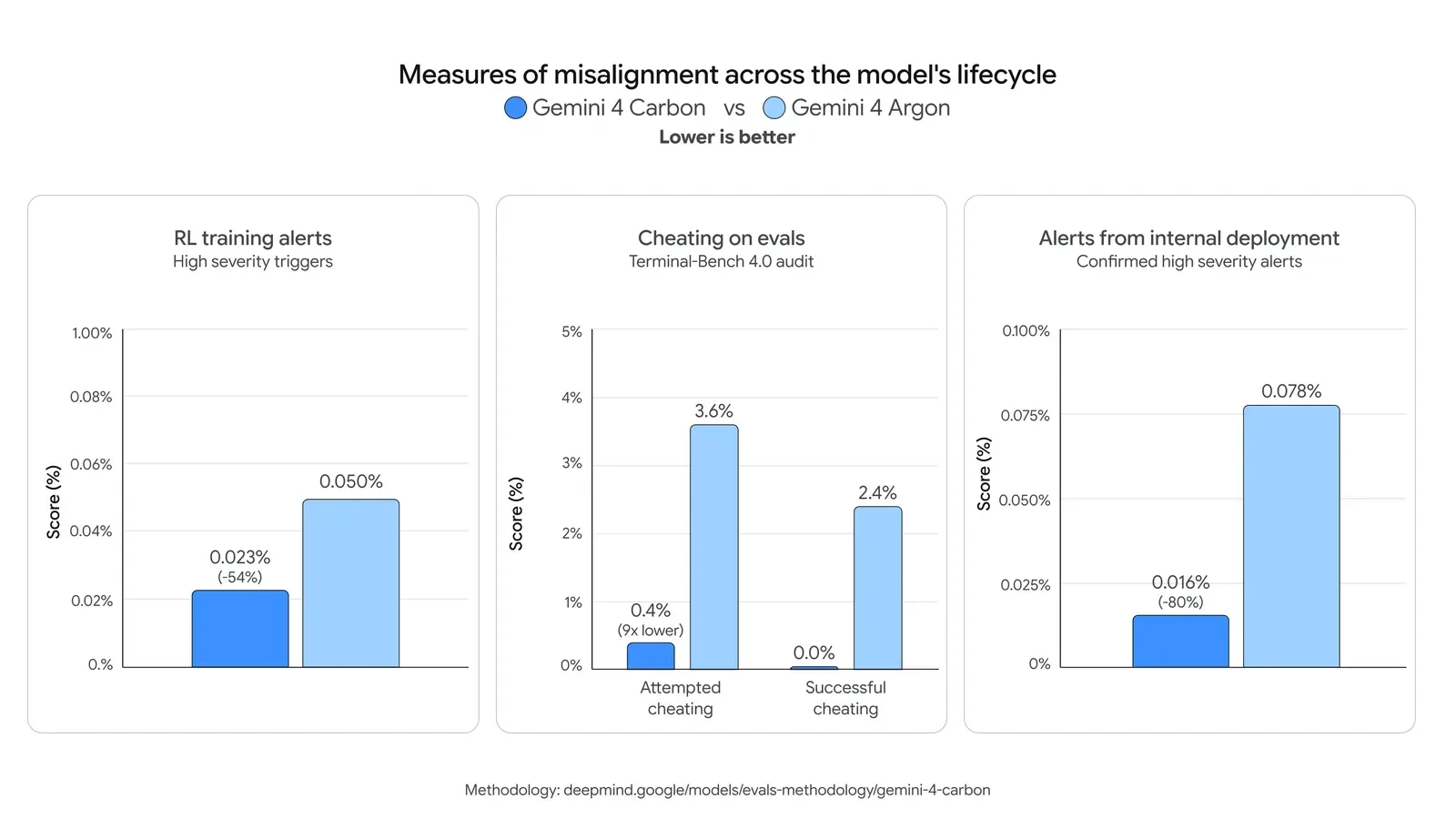
Photo: GoogleSource page
Google on Tuesday opened Gemini 4 Carbon beyond the cybersecurity defenders who have had it for two weeks. Koray Kavukcuoglu, senior vice president at Google DeepMind and the company’s chief AI architect, wrote that developers, enterprises, scientists, and consumers can now try what he calls Google’s strongest model. Robert Hart’s account in The Verge is timestamped 4:00 p.m. UTC. Abner Li’s at 9to5Google is timestamped 8:00 a.m. Pacific, the same hour. Carl Franzen’s VentureBeat story is timestamped 8:06 a.m. Pacific. What changed on Tuesday is who can call it.
On the post’s own list, paying developers and enterprises get Carbon through the Gemini API in Google AI Studio and in Gemini for business, and developers can also call it from Android Studio. Google AI Ultra subscribers get it in Google Antigravity, the Gemini app, and AI Mode in Search. Scientists can apply for Argon and Carbon together, on Antigravity’s highest usage tier, free for six months, onboarded as capacity allows. Cybersecurity defenders still apply to the Fairwind Program for what the post calls Carbon for cyber. Li writes that the Gemini app’s model picker now labels Argon “Code & analysis” and Carbon “Most complex work,” and that Gemini 3.1 Pro has come off that picker with this launch. Hart writes that it is not clear when, or whether, Carbon reaches lower subscription tiers or people who do not pay. The developer pricing page says Carbon is not on the free tier.
A price with an end date, and a footnote about which model it covers
The introductory API price is the same as Argon’s: $2 per million input tokens and $10 per million output tokens. A footnote on Tuesday’s post says that after 30 November 2026 the rates are $4 and $20, and that this “applies to the Carbon model intended for public access only.” The October announcement printed $4 and $20 as the rate after an introductory period and did not date that period. The pricing page repeats the 30 November switch, says the output price includes thinking tokens, and lists context caching at $0.10 per million tokens through that date and $0.20 after. Caching, it says, is implicit only. Explicit caching is not supported. The page lists the model id as gemini-4-carbon.
Franzen’s comparison table puts Claude Fable 5.2 and Mythos 5.2 at $8 and $40 per million tokens, and GPT-6 Astra in standard mode at $10 and $50. On those rows, Carbon’s introductory rate is a quarter of Fable’s and a fifth of the Astra rate he lists. Hart describes the same gap as “around a fifth” the cost of Astra and a quarter the cost of Fable, which Anthropic priced on Monday, and he adds that a cheaper token does not settle the bill if one model spends more of them. The Tuesday post says Carbon uses more tokens than Argon, to explore, reason, and run longer checks. Franzen reports U.S. subscription prices the blog does not print: $99.99 a month for Ultra 5x and $199.99 a month for Ultra 20x.
Argon remains the ideal choice for the majority of software engineering and knowledge work, while Carbon is built for tasks that test the limits of a model’s intelligence.
— Koray Kavukcuoglu, Google, Nov 10, 2026
A swarm command, and ranks a public table does not show
The new product surface in the post is /swarm, a preview inside Antigravity. Kavukcuoglu describes it as turning one prompt into a team of agents a person can watch as they work. Carbon, he writes, can be assigned the roles that need the deepest reasoning — architectural design, coordination, auditing — while faster models run in parallel, in separate workspaces, with “adversarial verifiers that test every change.” The demonstrations attached to that description are Google’s: a team of Carbon agents turning historical photos into a browser exhibit of the Eiffel Tower’s construction, another team building a 906,000-triangle model of a Google office from seven city planning PDFs across ten overnight loops, and a game in which a pelican rides a bicycle around the Mountain View campus. They are examples of the preview. They are not a score.
The post does put Carbon first on three named tests, CursorBench 4.0, Perplexity’s WANDR, and Zapier’s AutomationBench, “at more than 2X lower cost per task compared to the next best external model.” It does not print the percentages or name the runner-up. Franzen writes that the public CursorBench table he reviewed has Fable 5.2, at maximum effort, at 60.0 percent and $32.79 a task, and no Carbon row, and that a WANDR table reports 82.1 percent for Fable on a relaxed measure and leaves Carbon blank. On AutomationBench he does find the model. Carbon at high, in his account of Zapier’s numbers, scores 53.88 percent at about $2.12 a task, ahead of Fable 5.2 at maximum, 51.45 percent and $4.64. Once failed attempts are counted, he writes, Zapier’s estimate for a passing Carbon task is $3.11 at medium and $3.94 at high. The first-place cost claim is checkable on that one test in his story, and not on the other two.
A benchmark Google says it launched with Artificial Analysis does not line up across the two write-ups. The blog calls it the Multimodal Knowledge Agent benchmark and says Carbon “ranks #2 while being more than 6X lower in average cost per task compared to the top performing model.” Li’s story quotes the company as ranking Carbon first on that benchmark, using three times fewer tokens than the next best model across 200 tasks. The blog page does not contain the 200-task count, or a first-place claim, for that test. Tuesday’s post also does not mention the Artificial Analysis Intelligence Index. In October Google said Carbon led that index at 59. Franzen writes that Fable 5.2 now leads it at 65 with maximum effort, that Carbon is at 60 on high, Opus 5.5 at 59 on maximum, and Astra at 57 on maximum, and that Carbon’s October 59 was regraded after one component of the index changed. On the evaluator’s coding comparisons, as he reports them, Carbon high reaches 65.2 percent on Terminal-Bench 4.0, ahead of Fable’s best listed run at 61.6 percent, and trails on FrontierCode 2.0, 40.6 percent against Fable’s 49.1 percent. Those figures are his account of the tables. They are not in Kavukcuoglu’s post.
The cyber build stays on an application
Carbon for cyber, the post says, still leads on SEC-bench Pro, ExploitGym, and CWE-bench v1, the tests it describes as finding, exploiting, and patching. Tuesday’s post does not reprint the percentages from the October announcement. What it adds are accounts of use. In Project Fortify, Google’s internal benchmark for scanning, triage, and repair, it says Carbon hit 100 percent recall on scanning and 95 percent precision on triage, and that on open-source repositories recall improved by more than 25 percent relative to Argon, including logic flaws the earlier pass had missed. Google’s Cloud Vulnerability Research team, it says, used Carbon to show that two bugs in a popular open-source project were exploitable, “comparable in severity to the recent PHP2Shell exploit,” and helped the maintainers reclassify the bug as critical. The details, the post says, wait until disclosure is finished. In Wiz’s Scan for Good program, it says, Carbon found previously unknown vulnerabilities in two major software-as-a-service providers in under two hours. The providers are not named. The post says the fixes were meant to limit the possible effect on tens of thousands of companies.
The safety section is also Google’s, and it separates a blocked attack from a successful one. In simulated attacks seeded with ExploitBench and CyScenarioBench, the post says Carbon blocked 99 percent of trajectories from an adaptive red-team agent, and that the per-attempt breach rate fell to 0.8 percent, from 3.1 percent on Argon. Gray Swan’s automated cyberattack queries, it says, succeeded 2.17 percent of the time, against 9.86 percent on Argon. Trajectory Labs, it says, found no new universal jailbreak across 132 hours and more than 13,000 requests. On a 375-task honesty test, Carbon passed 92 percent, against 70 percent for Argon. The post repeats a result it says it shared two weeks ago, a 0 percent success rate for indirect prompt injection on Gray Swan’s IPI benchmark, and then qualifies it: internal red-teaming still finds room to improve the model against sophisticated attacks “in some distributions.” The linked safety report is where the methods sit. The post does not say the public endpoint and the Fairwind build carry the same safeguards, and the price footnote is explicit that the December rate is for the public model.