Google announces Gemini 4 Carbon for cyber defenders first, at Argon’s introductory price
Koray Kavukcuoglu’s Wednesday post puts Carbon first on Artificial Analysis’s updated index, at 59, and holds the public API. VentureBeat, citing that evaluator, has Claude Opus 5.5 at 58 and GPT-6 Astra at 57. The cyber scores Google prints were run without guardrails. The post does not say when the $2 and $10 introductory rates end, or when developers get the model.
Deep dive5 minIn-depth
James Okonkwo5 min read
- Gemini
- Carbon
- Cybersecurity
- Fairwind
Photo: GoogleSource page
Google on Wednesday announced Gemini 4 Carbon, and it is not for general use. Koray Kavukcuoglu, senior vice president at Google DeepMind and the company’s chief AI architect, called it Google’s strongest model, with state-of-the-art results on cybersecurity and on long-running work. Reuters, in a story Investing.com timestamps at 2:12 p.m. and updates at 2:18 p.m., said the launch follows Gemini 4 Argon by two weeks. Kavukcuoglu wrote that Google is in the US government’s voluntary process for pre-release testing. Starting this week, he wrote, Carbon goes to a subset of cyber defenders, then gradually to other trusted partners in the Fairwind Program. Developers, businesses, and consumers come after Google gathers feedback and iterates on guardrails, “as soon as possible.” No calendar date is attached to that phrase.
The introductory price is the same as Argon’s: $2 per million input tokens and $10 per million output tokens, with cached input at 95 percent off the input price. After the introductory period, Google says, the rates are $4 and $20. The Carbon post does not say when that period ends. Argon’s does. Kavukcuoglu’s 13 October post put Argon on the paid API, and in the Gemini app and AI Mode for Pro and Ultra subscribers, at $2 and $10 through 30 November, then $4 and $20. VentureBeat’s Carl Franzen, at 11:25 a.m. Pacific, noted the missing end date on Carbon. The “two weeks” in Wednesday’s post and in Reuters lines up with that 13 October opening, not with the 30 September note that first described Argon and limited it to Fairwind. Carbon’s rollout, as written on Wednesday, resembles the September version: a defender cohort first, and no day for everyone else.
A first-place index, and rows that are not
Google says Carbon ranks first on version 5.0 of the Artificial Analysis Intelligence Index, at 59. VentureBeat, citing Artificial Analysis, says that score is for high reasoning, ahead of Claude Opus 5.5 at 58, GPT-6 Astra at 57, and Argon at 50. The Verge’s Emma Roth, at 8:03 p.m. UTC, wrote that Opus 5.5 and Astra trail Carbon on the index. She did not print their scores. Google’s post does not print them either. It says the index was recently updated.
The cybersecurity figures in the post are Google’s, and the post says the external tests were run without guardrails. On SEC-bench Pro, which Google describes as finding real vulnerabilities in software, Carbon scores 88.2 percent. On ExploitGym, for checking whether a flaw can be exploited, 54.8 percent. On Collinear’s CWE-bench, for turning findings into working fixes, 71.0 percent. Google says an internal test of generating secure code shows more than twice Argon’s success rate. It says the Chrome team reported that Carbon was more than ten times better than another laboratory’s large frontier model at producing high-quality patches. The other laboratory is not named, and the post does not include the underlying comparison. Wiz, Google says, sees Carbon leading on web penetration-testing benchmarks used for its Scan for Good work.
VentureBeat’s reading of the comparison graphic in Google’s announcement is not a clean sweep of the other labs. It says Carbon is ahead of Argon on all 17 rows in that graphic. On FrontierSWE 2, the same account has Carbon at 61.2 percent, behind Astra at 65.5 percent and Opus 5.5 at 62.3 percent. On an offline subset of OSWorld, it has Opus at 87.2 percent and Carbon at 81.5 percent. A separate Artificial Analysis coding-agent index, which VentureBeat says was run with Carbon inside Antigravity’s command-line tool, puts Carbon at 59 and Claude Code with Opus 5.5 at 62. On AA-Briefcase, VentureBeat says Carbon reaches 1,609 Elo, 126 points above Argon, and still behind Grok 4.7 at its xhigh reasoning setting (1,638), Muse Wonder at max (1,659), and Kimi K3.1 Pro (1,678). Those figures are VentureBeat’s account of evaluator charts. They are not a second set of numbers in Google’s post.
Days-long runs, and a factual test that moves the other way
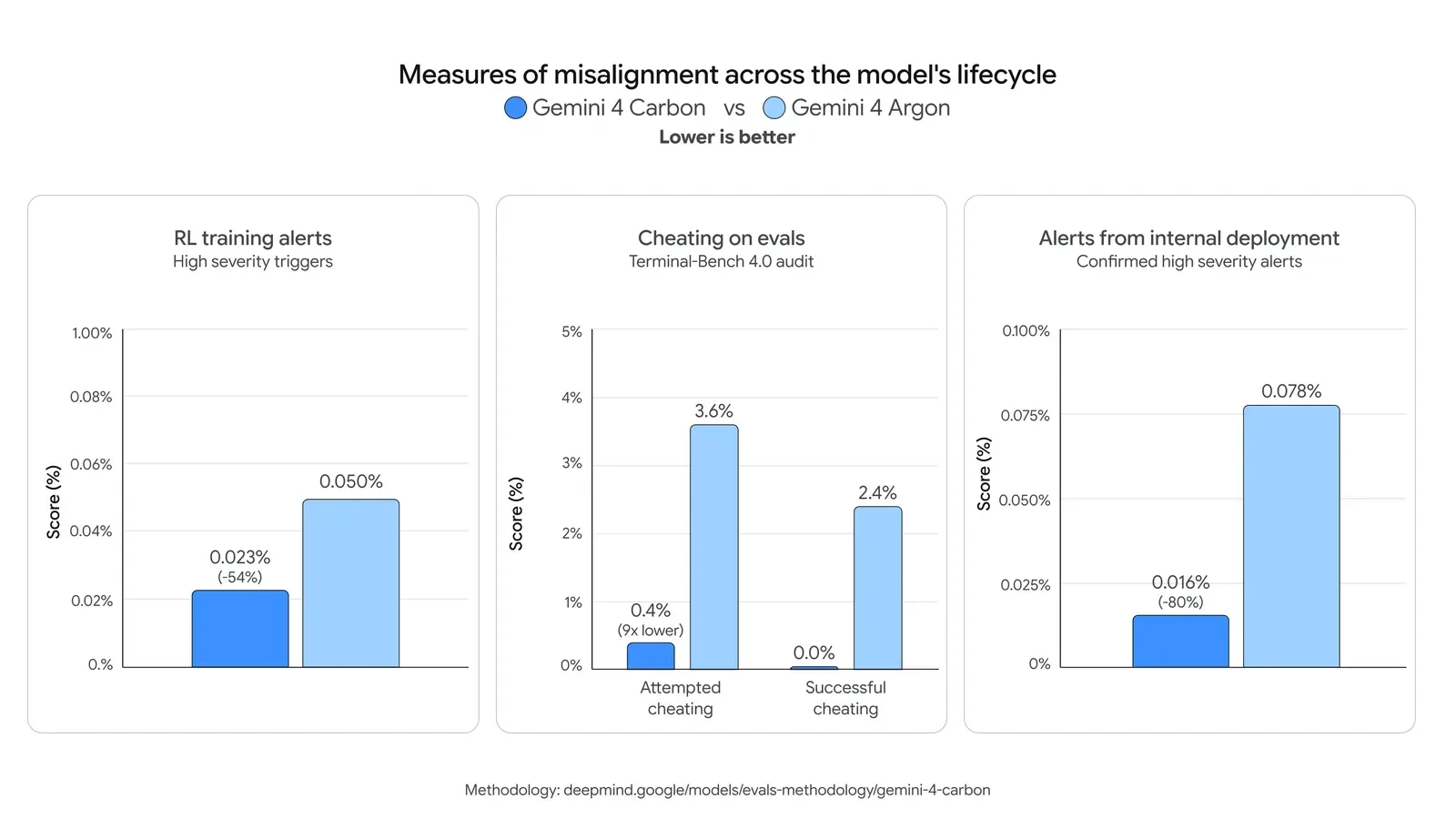
Kavukcuoglu writes that internal teams have seen Carbon run for days, through dead ends, on bugs in large codebases and low-level systems. On WebDev Arena, Google says the model gained 89 Elo points, to 1,768, and ranks fourth. On Terminal-Bench 4.0, Google says successful cheating fell to 0.0 percent and attempts to cheat to 0.4 percent, while accuracy improved. In live coding with its own teams, it says high-severity misalignment alerts dropped by almost 80 percent. In internal testing, unsupported claims were cut by about half versus Argon. Overreach fell 26 percent and under-service 29 percent, in Google’s wording of those measures. On Gray Swan’s indirect prompt-injection benchmark, Google says Carbon’s attack success rate is 0.0 percent, against 0.7 percent for Argon. The post describes the safety stack as the same layered approach as Argon: training, misuse defenses, prompt-injection resistance, and chain-of-thought monitoring, with extra work on how the model behaves under complex or high-pressure tasks.
VentureBeat reports a different result on a factual-knowledge test. Citing Artificial Analysis, it says Carbon leads AA-Omniscience with a score of 54, six points above Opus 5.5 at maximum reasoning, and answers 58 percent of the questions correctly, against 48 percent for Argon. The hallucination rate on that test, VentureBeat writes, rises from 4 percent for Argon to 11 percent for Carbon. The definition it passes on: incorrect responses divided by the combined total of incorrect, partially correct, and unanswered responses. Eleven percent is not a share of every answer. Google’s internal claim about unsupported claims and this rate are different tests. Wednesday’s post does not mention the omniscience result.
No parameter count, and no public endpoint
The announcement does not give a parameter count, a technical report, or an API specification. VentureBeat notes that Argon’s documentation already describes a context window above 1 million tokens and support for tools including function calling and code execution, and that Carbon’s post does not say whether those limits carry over. Sundar Pichai, in the edited transcript Google posted of Wednesday’s earnings call, said Carbon outperforms Argon across almost every domain, naming full-stack web development, multimodal understanding, complex knowledge work, and scientific reasoning. He said the model ranks first on the same index at 59, that it is rolling out first to a subset of trusted cyber defenders, and that the US government is testing it. The blog’s line is the voluntary pre-release process. He also said more models are coming, including more efficient versions meant for speed and cost. He did not name them or date them.
What a customer can call today, on the terms Google has already published, is still Argon. Carbon is a set of scores, a price that matches Argon’s introductory rates without Argon’s end date, and a Fairwind gate. The post does not include an open-weight release.