On Claude Code’s own codebase, merged pull requests more than doubled and reverts fell over 40%
Addy Osmani, Morgan Westlee Lunt and Qing Wang, on 15 October: from June to September, merged pull requests on Claude Code more than doubled, and the share that had to be reverted fell by more than 40 percent. The post gives no base rate. A separate figure, for Anthropic’s monorepo, is about 2,500 changes a day in May and more than 30,000 in September. Code Review, the public version, is generally available on Team and Enterprise. It comments. It does not approve.
Feature5 minIn-depth
James Okonkwo5 min read
- Claude Code
- Code review
- Anthropic
- GitHub
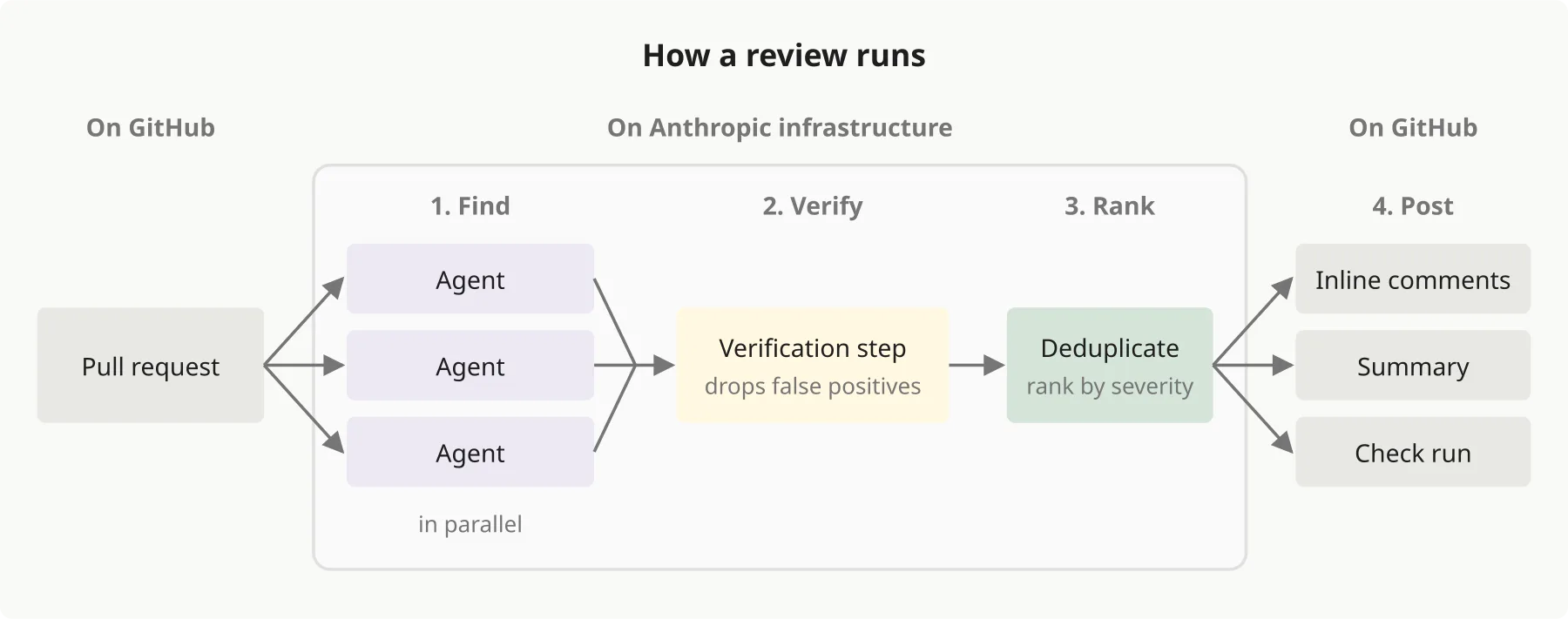
Photo: AnthropicSource page
The team that builds Claude Code says it merged more than twice as many pull requests from June to September, and that the share of those merges it had to revert fell by more than 40 percent. The post, “How the Claude Code team does code review,” is dated 15 October and signed by Addy Osmani, Morgan Westlee Lunt and Qing Wang. It does not give the number of pull requests in either month, and it does not give the revert rate it started from. A fall of more than 40 percent in the share is the claim. The level of that share is not. The same post says Claude writes about 90 percent of Claude Code’s own code, a figure the authors say they have given before.
A second count in the post is easy to mix up with the first. In Anthropic’s monorepo, changes landing per day went from about 2,500 in May to more than 30,000 in September. Claude Code, the authors write, lives in its own repository, separate from that monorepo. The doubled merges and the revert figure are about Claude Code’s codebase: the command-line tool, the desktop and web apps, and the mobile apps. The 30,000 is about the rest of the company. The post’s stated goal for the Claude Code repos is that most pull requests merge with at most one human in the loop, and that the human can be the author, without a rise in reverts or incidents. The measures it says it tracks are human approvals per pull request, human comments, and how long a change waits on a person. Reverts and incidents are the guardrail.
Six checks, then a person if the change is risky
Most of the review, the post says, now happens before a pull request exists. Claude is given something it can run — tests, a build, a screenshot against a design — and a subagent reads the diff with fresh context. Boris Cherny, who created Claude Code, is quoted as calling that verification probably the most important thing for getting good results, and as estimating that it makes the final result two to three times better. On the pull request itself, every change gets a Claude review before a person looks. The public version of that step, Code Review for Claude Code, is generally available on Team and Enterprise plans. A local command, /code-review, runs a lighter pass on any plan.
When the research preview launched, the share of internal pull requests that received substantive review comments went from 16 percent to 54 percent. Most pull requests over 1,000 lines get findings. Most small ones come back clean. Admins set each repository to Quick, Standard or Deep. Several agents look for bugs at once. A separate group votes, and a finding is posted only if enough of them agree it is real. Comments that are only about style, diagnostics or cleanup are dropped. What remains is tagged Important, Nit or Pre-existing. Every finding has to be fixed or resolved with a reason. A security review can block the merge on its own: a pull request cannot merge while a bug-review or security-review finding is still open. Ordinary lint, types, tests and a build still run. The template asks how the change was tested and how to undo it.
Human approval depends on the change, not on who wrote it. A classifier picks a risk tier, and a second classifier can demand another person even when the tier does not. Low-risk changes — docs, copy, internal-only features, additive work behind a flag — need no human approval once the automated review and the security checks are green. Ordinary product changes need one person. The highest-risk code, and a small set of paths, need two. Only authors on a trusted list, mostly the team that owns the repo, get the lighter path. Everyone else needs a second person. An agent’s approval never counts as a person’s. The person who directed the agent counts as a reviewer, the same as if they had typed the code. An approval covers one commit. A later push the system cannot vouch for has to be approved again.
What the product will and will not do
Anthropic’s general-availability note says most reviews now finish about three times faster than in the preview, from about 20 minutes to 6 to 10. Eligible Enterprise organizations can claim at least $10,000 in Code Review credits by 15 January 2027. The credits expire 30 days after they are claimed. The docs describe four stages on Anthropic’s infrastructure: several agents read the diff and the surrounding code, a verification step drops false positives, the remaining findings are deduplicated and ranked, and the review posts inline comments, a summary and a check run. The check run does not fail the pull request. “A review never approves or blocks the pull request, so the decision to merge stays with your team.” Code Review is not available to organizations with zero data retention or a HIPAA configuration, and not yet to those using customer-managed encryption keys. It reads the repository. It does not build or run the code, and it does not push commits.
The internal story the engineering post tells is about review that would not stop. One command-line pull request went through more than fifty rounds of review and fixes overnight before its author halted it. A git blame of what the reviewer kept flagging found that about 59 percent of it was code that had been there since the reviewer’s first pass. The team now caps rounds at three, re-reviews only the new diff after the first passes, and asks the author to fix a class of bug rather than one line. The public product is the narrower thing. It posts findings on a GitHub pull request. On the Claude Code repositories, the authors write, owners can already let some low-risk changes merge on automated checks alone. That is a rule inside one codebase. It is not what Code Review does for a customer.