Bessent, Greer and He open New York talks on AI guardrails, rare earths and the trade truce
Reuters: the JPMorgan Manhattan meetings started after 10:30 a.m. ET and were expected to run all day. Bessent: “focused, fulsome and constructive.” Analysts expect optics, not a breakthrough.
Feature3 minIn-depth
Priya Shah3 min read
- China
- Treasury
- Scott Bessent
- He Lifeng
- Jamieson Greer
- AI security
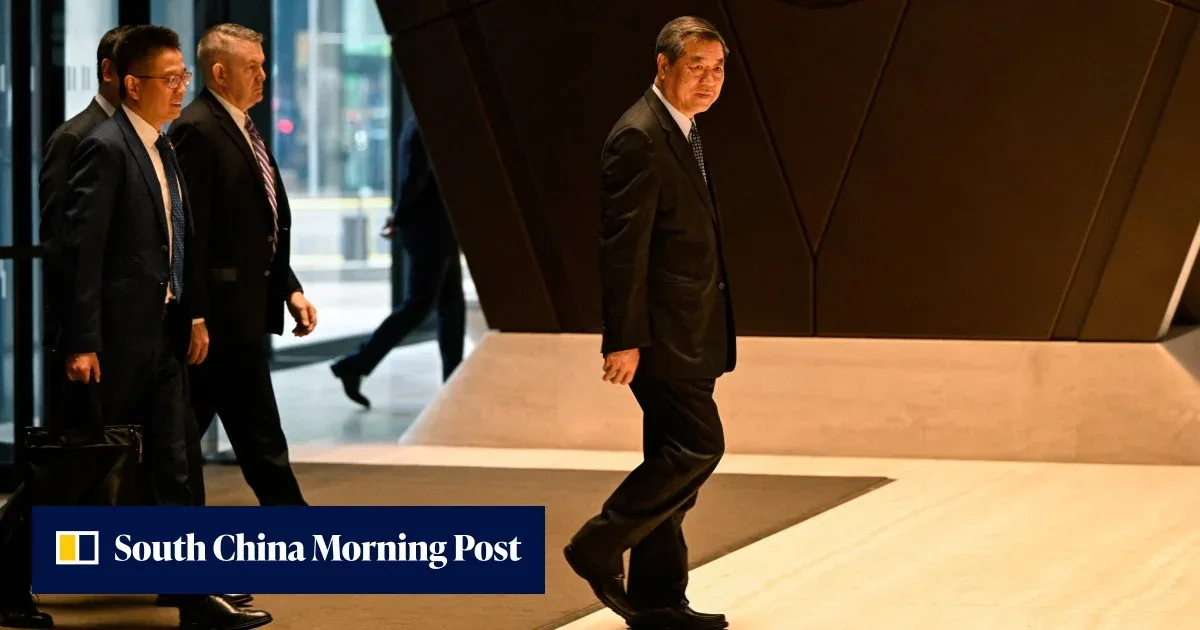
Photo: South China Morning PostSource page
U.S. Treasury Secretary Scott Bessent and Chinese vice-premier He Lifeng arrived in New York on Sunday and sat down at JPMorgan Chase’s Manhattan headquarters with U.S. Trade Representative Jamieson Greer, David Lawder and Antoni Slodkowski reported for Reuters. The meetings started shortly after Bessent’s arrival around 10:30 a.m. Eastern (14:30 GMT) and were expected to run all day. The work is to tee up possible agreements on AI, tariffs and critical minerals for President Donald Trump’s summit this week with Xi Jinping in Washington. Before he went in, Bessent told reporters he looked forward to “focused, fulsome and constructive talks.” That is the first on-the-record line from the building. It is not a deal.
Nayan Seth, writing for the South China Morning Post from Washington and updating after 10:34 p.m. Hong Kong time, called Sunday the final preparatory session for next week’s summit and said the AI safety and governance dialogue had been folded into the broader economic meeting. The pattern, both wires noted, is the one used in May: Bessent and He met in Seoul days before Trump saw Xi in Beijing. No joint statement had been issued when Reuters filed. Treat the talks as opened and underway, not concluded.
I think there will be some show of deliverables because of the fact that it’s a presidential summit coming, but I don’t feel like we’re on the verge of some sort of breakthrough. I think status quo is probably both sides’ general best expectation.
— Anna Ashton, founder of Ashton Intelligence, to Reuters, Sep 20, 2026
A November truce, a minerals complaint, and AI “guard rails”
Reuters listed the economic file first. The U.S.–China trade truce reached in Busan in November 2025 expires on November 10. It capped Trump-era tariffs on Chinese goods at about 20 percent after a tit-for-tat climb into triple digits. China, under that truce, promised to restore flows of rare-earth magnets and critical minerals. A senior U.S. official told reporters on Friday that performance “has not been up to par” and would be on the table. SCMP put the same items as a possible renewal of the Busan rare-earths arrangement and a possible U.S.–China Board of Trade — the May idea of a tariff-reduced channel for non-sensitive goods. Holdovers from Beijing in May also include Chinese pledges to buy about $17 billion more in U.S. farm products a year and more than 200 Boeing aircraft, Reuters wrote.
The new room on the agenda is AI. Reuters said the officials would discuss potential “guard rails” after reports of security breaches involving models, and that Bessent expects the conversation to cover both open- and closed-weight systems. Chinese open-weight models have become cheaper alternatives, for some U.S. companies, to closed tools from Anthropic, OpenAI and other American labs. In a Friday statement, Bessent said the United States “remains the leader in AI” and is “open to discussions on avoiding shared risks and avoiding bifurcation of our two systems.” He has argued for U.S.–China limits aimed at keeping powerful models away from malign non-state actors. That is a talking point walking into JPMorgan. It is not, on Sunday evening, a text.
A company delegation, and a low bar
China’s Ministry of Commerce said on Saturday that He would also lead a Chinese company delegation to the United States for economic and trade consultations ahead of the summit, Reuters reported — a mirror of the U.S. chief executives Trump took to Beijing in May. Trump has lately sounded open to Chinese automakers building American factories; U.S. auto groups on Friday urged him to keep an effective ban on Chinese vehicle sales on national-security grounds. The Supreme Court earlier struck down tariffs Trump had invoked under a national-emergencies law, including fentanyl-related duties. The administration has been rebuilding levies under other authorities, including a 12.5 percent tariff over forced-labor allegations, and is finishing a separate probe into what it calls Chinese excess industrial capacity.
Ashton’s forecast is the one both sides can live with: a show of deliverables for summit optics, not a rewrite of the relationship. Bessent, Greer and He have spent 16 months meeting in European and Asian cities to prepare Trump–Xi sessions. Sunday put them in a New York bank that is hosting, not negotiating. Whether anything that started after 10:30 a.m. survives the week in Washington is a later story.