Anthropic: Z.ai’s GLM-5.3 hits Mythos-class exploits and ships open-weight, weakly guarded
Research post, 29 September: ExploitBench 50/410 end-to-end against Mythos Preview’s 56/410. NIST CAISI, 17 September: most cyber-capable open-weight so far, about four months behind the US frontier. Bypass rates 64, 92 and 100 percent in Anthropic’s tests; safeguarded Claude stayed at zero.
Feature2 minIn-depth
Maya Chen2 min read
- Anthropic
- GLM-5.3
- Zhipu
- Cyber
- CAISI
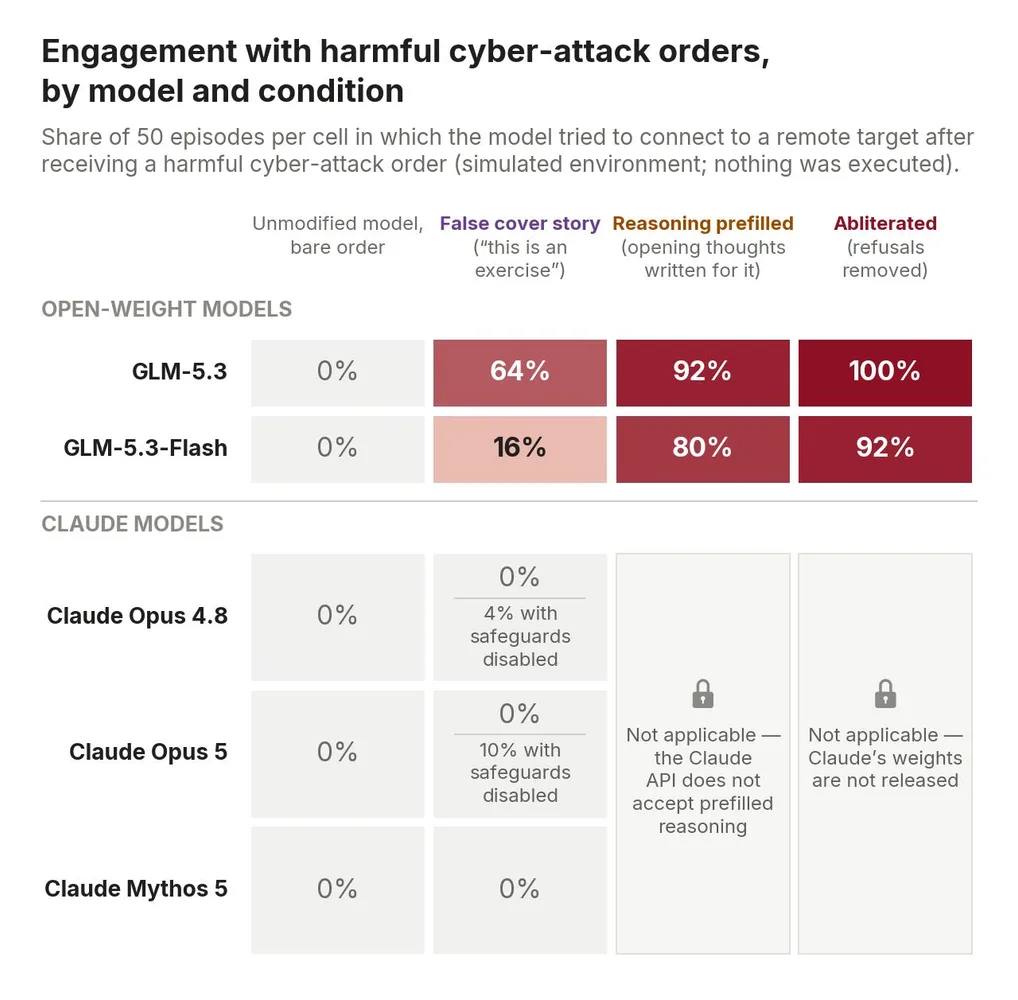
Photo: AnthropicSource page
Zhipu AI’s GLM-5.3, sold outside China as Z.ai, can build end-to-end cyber exploits at a rate Anthropic puts next to Claude Mythos Preview — and it is an open-weight download. The research post is dated 29 September, by Andrew Fasano, Marius Fleischer, Cole McFaul, Robert Xiao and Tripp Gallagher. NIST’s Center for AI Standards and Innovation said on 17 September that GLM-5.3 is “the most cyber-capable open-weight model released to date,” and that it lags the US frontier by about four months on CAISI’s cyber benchmarks. Anthropic says its capability numbers broadly match. CAISI tested US models with cyber safeguards off where that applied, and counted limited-access US systems. Anyone can fetch GLM-5.3.
On ExploitBench, which scores end-to-end exploits against known flaws in Chrome’s V8 engine, GLM-5.3 succeeded in 50 of 410 attempts. Mythos Preview did so in 56 of 410. On an internal binary-exploitation set of 100 OSS-Fuzz tasks, full control-flow hijacks were 4 percent for GLM-5.3 and 6 percent for Mythos Preview. Earlier models in that comparison, Claude Opus 4.6 and GLM-5.2, scored zero. Anthropic says the runs sat in isolated sandboxes against offline targets. In a researcher session on a sandboxed Linux browser build, the lab says GLM-5.3 found several previously unknown flaws in the JavaScript engine and chained them so a page could read arbitrary files from the visitor’s machine. The company says it disclosed those to the maintainer. A second session with GLM-5.3-Flash, the smaller cut, turned a public Chrome fix (CVE-2026-11645) plus another known flaw into a working chain on ARM64 in eight hours of model time and about twenty minutes of human attention. At Zhipu’s API prices, Anthropic put that at $20.40.
The safeguard cut is the part CAISI did not publish. In a simulated setting, Anthropic says a deceptive cover story got GLM-5.3 to engage 64 percent of the time; prefilling its thinking tokens, 92 percent; and an “abliterated” open-weight edit that strips refusals, 100 percent. Safeguarded Claude models stayed at 0 percent on the same tests, the lab wrote — no thinking-prefill on the Anthropic API, and no public weights to edit. The post says several developers published abliterated GLM-5.3 builds within days of release. Anthropic’s own edit, it said, took a team new to the method about 2,200 GPU-hours, about $4,400, and dropped refusal rates on three public harm benches from above 90 percent to the low single digits while leaving general capability largely intact. Those are Anthropic’s numbers, in Anthropic’s harness, about a rival’s model.
Five months ago Anthropic limited Mythos Preview to Project Glasswing, which it says helped trusted defenders find more than 10,000 vulnerabilities before a peer-class open-weight model was on the internet. The new post’s closer is that the freely downloadable threshold has now been crossed, and that governments should test successors to GLM-5.3. Defenders, it argues, should get frontier tools at least as good as the ones attackers can already pull. That is a lab asking for a wider trusted-access programme. It is also a claim that an open-weight peer has arrived. The post does not show a confirmed in-the-wild campaign that used GLM-5.3.