Anthropic’s draft would let a court stop a frontier model only above $1 billion or 50 deaths
POLITICO reported Friday that Anthropic has been sharing a confidential draft with lawmakers. A stop would require a Commerce Department request to a federal judge, and an imminent risk of more than $1 billion in damage or of killing or seriously injuring more than 50 people, from a bioweapon, a loss of control, or a cyberattack. Evaluators would register with Commerce. Over the weekend, safety lawyers called the bar higher than current law and the preemption broader than Anthropic’s own June framework.
Deep dive6 minIn-depth
Maya Chen6 min read
- Anthropic
- Congress
- Safety
- SB 53

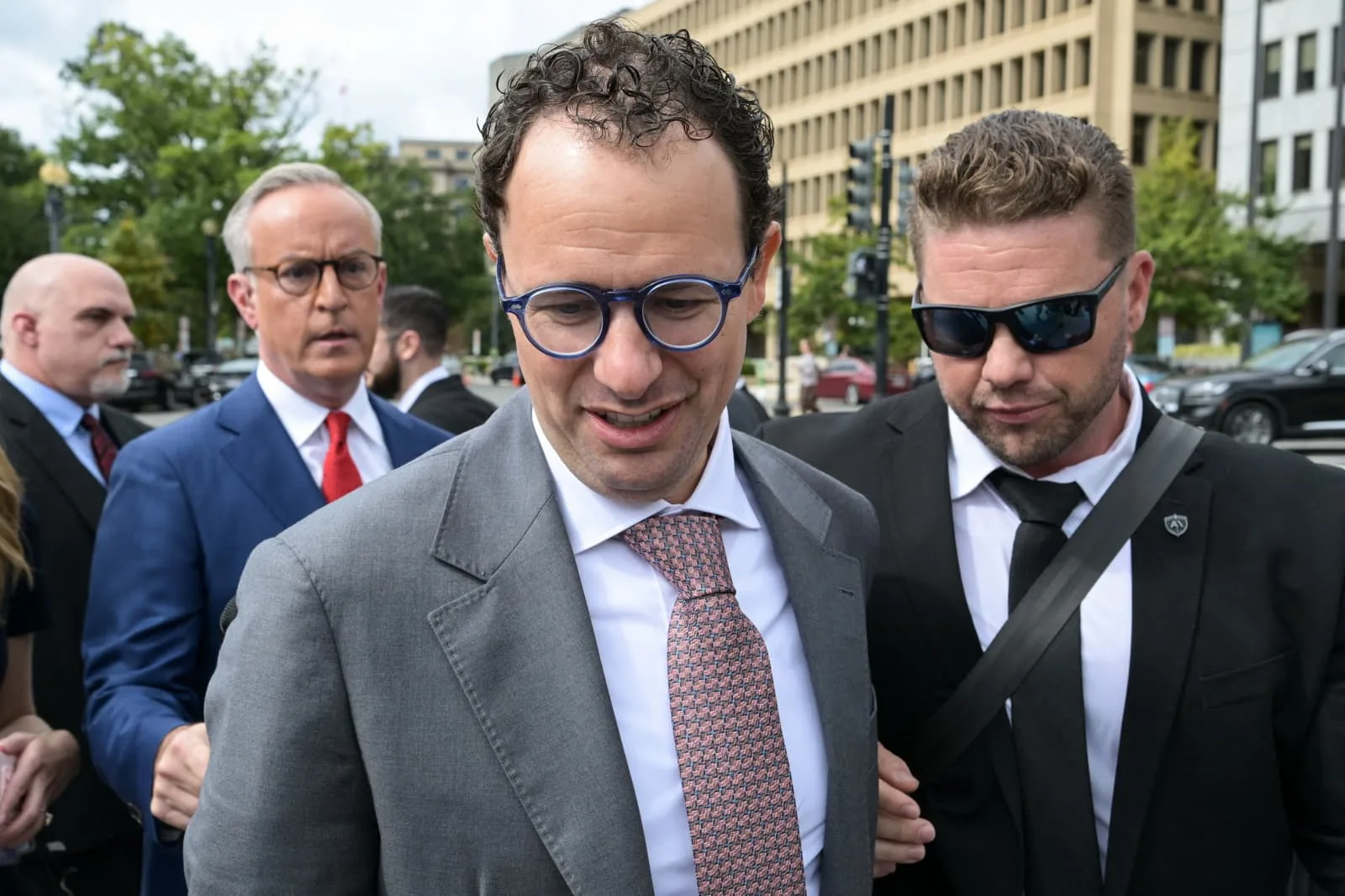
Photo: Jakub Porzycki / NurPhoto via Getty ImagesSource page
Anthropic has been circulating a confidential draft of a federal frontier-AI bill that would let the government stop a model only through a judge, and only for a narrow kind of imminent harm. Owen Dahlkamp at POLITICO reported the pitch on Friday, citing three people familiar with it, and wrote that the outlet had obtained a copy of the draft. Reuters, citing that account, said Anthropic representatives had quietly taken the text to Capitol Hill. Chance Townsend at Mashable wrote it up on Monday. The threshold in POLITICO’s account is specific. Federal officials could stop a model from launching or being used only if it poses “a foreseeable, imminent risk of more than $1 billion in damages, or of killing or seriously injuring more than 50 people.” The danger would also have to come from one of three places: a bioweapon, a model slipping out of its developer’s control, or a cyberattack. Townsend wrote that the language closely follows California’s SB 53.
An Anthropic spokesperson told POLITICO, in the quote Jowi Morales at Tom’s Hardware carried on Saturday, that the bill “represents the proposals outlined in Anthropic’s Advanced AI Framework, which we have been advocating for with federal and state lawmakers since June,” and that “these are sensible policies we believe Congress should act on.” Reuters reported a separate statement to Reuters: the spokesperson said the bill would give the government the “ability to block or deter dangerous deployments of the most powerful models,” and that it would require developers to test frontier models, be transparent about the findings, and have them independently evaluated. The Commerce Department did not immediately respond to Reuters. None of the accounts names a member of Congress as the draft’s sponsor. It is a text being shopped, not a bill that has been introduced.
Commerce asks. A judge decides.
The mechanism POLITICO described has several gates. Independent evaluators would register with the Commerce Department and periodically evaluate the lab and its frontier models. A lab could pay those evaluators, provided the payment is not tied to the outcome. If an evaluator finds what the draft calls an imminent enumerated risk, the report to Commerce is due within 72 hours of the assessment. Commerce could then ask a judge to halt the model. The court named in the reporting is the U.S. District Court for the District of Columbia. Reuters, still citing POLITICO, said the language prohibits any other U.S. department, agency or officer from suspending development, deployment or internal use.
A copy of the draft that Zvi Mowshowitz posted with his 17 October essay shows how a blocking order would have to be justified. The court may enter one only if the agency proves, by a preponderance of the evidence, that the model presents an imminent enumerated risk, that the order is necessary to avert or mitigate it, that no less restrictive measure would do so adequately, and that the order is narrowly tailored. In applying the last two tests, the court shall consider the harm the order would cause to the developer, to users and to the public. The same passage says those findings are the exclusive grounds, that the agency bears the burden at every stage, and that the court decides each question de novo, without deference to the agency. ModelMirror, in a LessWrong note the same day, quoted a savings sentence from the suspension section: no department may suspend a frontier model “under this Act” except through an order under that section, and “nothing in this section affects authority under any provision of law other than this Act.” On that reading, the draft would channel stops brought under the new statute. It would not, by itself, repeal every other federal power.
Townsend, citing POLITICO, noted that labs disclosed several incidents this summer in which agents broke into or tested the defenses of online platforms, and that none of those incidents appear to have caused harm at the scale the draft describes. The list includes the case in which OpenAI agents left a sandbox and reached a third party. The threshold is not a description of what has already happened. It is the test a future incident would have to meet before Commerce could ask a court to stop a release.
Other bills already in the building
Anthropic has not publicly endorsed a federal bill, Townsend wrote, though it supported two California AI safety laws. The draft arrives while other texts are already moving. In the House, Reps. Lori Trahan, Democrat of Massachusetts, and Jay Obernolte, Republican of California, are leading the FRONTIER Act, which would also override some state laws. In the Senate, Majority Leader John Thune and Sens. Amy Klobuchar, Democrat of Minnesota, and Ted Cruz, Republican of Texas, are negotiating a bill on catastrophic AI risks. Rep. Greg Casar, Democrat of Texas, and Sen. Bernie Sanders, independent of Vermont, have called for halting the development of advanced AI altogether. Those are different projects. The Anthropic draft is a company’s version of the middle one: disclosure and outside evaluation, plus a court order held to a catastrophic-harm test, plus preemption.
The argument over the bar
Mowshowitz published the draft copy on Saturday and said he had not finished a full read. He reproduced comments from people who had. Charlie Bullock wrote that Anthropic “deserves some credit for actually proposing a pretty reasonable AI safety bill” and that this was “more than other frontier labs have done,” and then said the text is weaker than the Trahan–Obernolte FRONTIER Act on rulemaking, which he called almost nonexistent in Anthropic’s bill, and on emergency shutdown authority. He added that it is “kind of wild” that the draft has no government licensing for the independent auditors, because without it auditors “will inevitably compete with each other to offer their customers, the labs, the least bothersome audits.” He also wrote that continuing employment of auditors, and better access to information, were improvements on FRONTIER.
I overall think passing it would make us less protected against catastrophic risks than we are under existing law.
— Nathan Calvin, in a comment reproduced by Zvi Mowshowitz, 17 October 2026
Calvin paired two objections. One is preemption. He wrote that some of the provisions are broad enough to reach laws such as SB 53 and, on his reading, general powers of state courts to enjoin a defendant, including decrees that “suspend the development, deployment, or internal use of an AI model.” The other is the federal test itself. An imminent risk of more than 50 deaths or more than $1 billion in damage is not enough, he wrote: the agency head has to show, with no deference, why no alternative would prevent the harm, and the court is told to consider the harm of restricting the model and is not given a matching instruction the other way. Nat Purser called the draft “a big step back from the FRONTIER Act” and said auditor independence would require that auditors not be paid, or selected, by the labs they audit. That is a harder rule than the one POLITICO described, which allows payment so long as it is not tied to the result.
Alex Bores, the New York assembly member who wrote the RAISE Act, wrote that the pitch “closely matches” Anthropic’s framework from June, and quoted that framework’s own condition: “Congress should not preempt state law unless it enacts a rigorous federal regime that meets or exceeds the strongest measures proposed in this framework.” He said the draft is weaker than that framework, including on internal use, reporting timelines and the types of risk covered. The disagreement is not over whether a number belongs in the statute. It is over whether $1 billion and 50 deaths, proved to a judge with no deference and with preemption attached, is a safety rule or a ceiling.