Anthropic, OpenAI, Hugging Face and Alibaba give four agent projects to the Linux Foundation
San Jose, Thursday: the Agentic AI Foundation said it is taking Agent Skills from Anthropic, Open Responses from OpenAI, OpenEnv from Hugging Face and OpenSandbox from Alibaba. That brings the foundation to 10 projects, from three at its launch in December 2025. Anthropic says more than 70 products, including ChatGPT, Cursor, GitHub Copilot and VS Code, already load skills, and that 1 million skills have been published.
Feature3 minIn-depth
Eli Navarro3 min read
- Agents
- Anthropic
- OpenAI
- Linux Foundation
- Alibaba
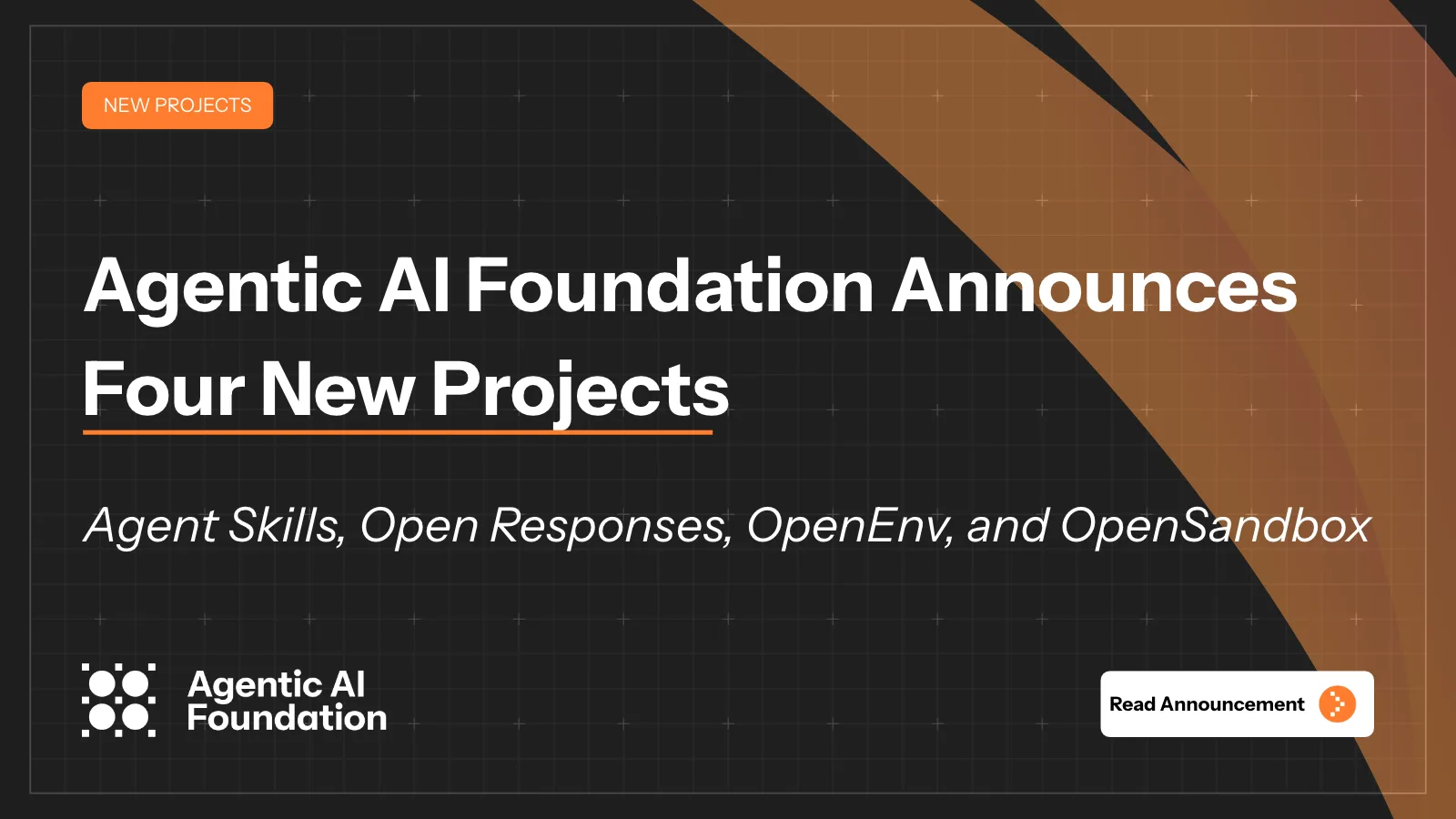
Photo: Agentic AI FoundationSource page
The Agentic AI Foundation on Thursday took in four projects at once. A Linux Foundation release datelined San Jose, 22 October, says Anthropic contributed Agent Skills, OpenAI contributed Open Responses, Hugging Face contributed OpenEnv, and Alibaba contributed OpenSandbox. The foundation said the additions bring it to 10 hosted projects in its first year, up from the three it launched with in December 2025. The release says the announcement coincides with AGNTCon and MCPCon North America, which it lists for 22 and 23 October at the San Jose McEnery Convention Center. The four are described as covering different layers: how an agent gains a skill, how an application talks to models from more than one provider, how agents are trained, and where an agent is allowed to run.
They join six projects the foundation already lists: the Agent2Agent protocol, Agent Router, agentgateway, AGENTS.md, goose, and the Model Context Protocol. Manik Surtani, the foundation’s chief technology officer and a co-founder, said that a year ago it launched with three projects, and that “today we host 10.” He said the four new ones cover different parts of the stack, “from how agents gain capabilities to where they run,” and that four companies chose to put them under neutral governance. That is the foundation’s account of what changed hands. The release does not say any of the four is finished, funded, or required for a product that already uses a private version of the same idea.
A folder, a schema, a training gym, a sandbox
Agent Skills is the one with a public count. Anthropic’s own post, also dated 22 October, says a skill is a folder with a SKILL.md file that teaches an agent a task, plus any scripts or reference files it needs. The company says it built skills while working on Claude Code, published them as an open standard in December 2025, and is now donating the name, the logo, the GitHub organization and the agentskills.io domain. More than 70 agent products have integrated the standard, Anthropic wrote, including ChatGPT, Cursor, GitHub Copilot and VS Code. It says 1 million skills have been published and nearly 280 million have been installed. Engineers from Anthropic, Google, OpenAI and other companies will maintain the standard as individuals, with David Soria Parra and Mahesh Murag as lead maintainers. Anthropic says it has proposed a roadmap of versioned releases, a formal proposal process, and security guidance for people who write and install skills. Those are proposals. The post does not say the foundation has adopted them.
Today, we’re donating Agent Skills to the AAIF to ensure that anyone building with skills can shape what’s next.
— David Soria Parra, Anthropic, in the Linux Foundation release, Oct 22, 2026
Open Responses is a specification, based on OpenAI’s Responses API, for calling models from more than one provider. The Linux Foundation release says it defines a shared schema, consistent streaming events and extensible tooling, so a request can be described once and run across providers with less translation. Steve Coffey, a member of technical staff at OpenAI, said the project was joining the foundation “to further our mission of helping developers build great products on today’s language models through simple, clean, and unified interfaces.” A technical charter published at openresponses.org says it was adopted on 21 October 2026, the day before the announcement. The charter’s mission statement matches the release: a shared schema for calling language models, streaming results and composing agent workflows. It does not list which providers already accept the schema.
OpenEnv and OpenSandbox are the execution and training pieces. The release calls OpenEnv an open framework for reinforcement-learning environments, built as a containerized service that exposes an agent interface, MCP, and the Gym protocol training libraries already use. Ben Burtenshaw, a machine-learning engineer at Hugging Face, said the committee behind it is sharing work built and used at Hugging Face, Microsoft, Reflection, Meta-PyTorch, Fleet, Mercor, RadixArk, Modal and Prime Intellect. OpenSandbox, from Alibaba, is described as a sandbox platform with multi-language SDKs, a unified API, and Docker and Kubernetes runtimes, for coding agents, GUI agents, evaluation, code execution and reinforcement-learning training. Xiaobin Xu, Alibaba’s head of development infrastructure, said the project was created at Alibaba and that the company does not want its future “defined by a single company.” The release does not publish a security review of the sandbox, or a count of who is running it.