Gross’s committee says the Lean code proves a Yang-Mills existence result, and says it did not check the prose
The 10 November assessment says a clean rebuild passed, the mass gap is not proved, and the authors used Astra to read the code. Jacklin Kwan at Science still describes a 1,147-page manuscript as unreleased. Joseph Howlett at Scientific American describes the proof as out.
Feature4 minIn-depth
James Okonkwo4 min read
- OpenAI
- Yang-Mills
- Lean
- Mathematics
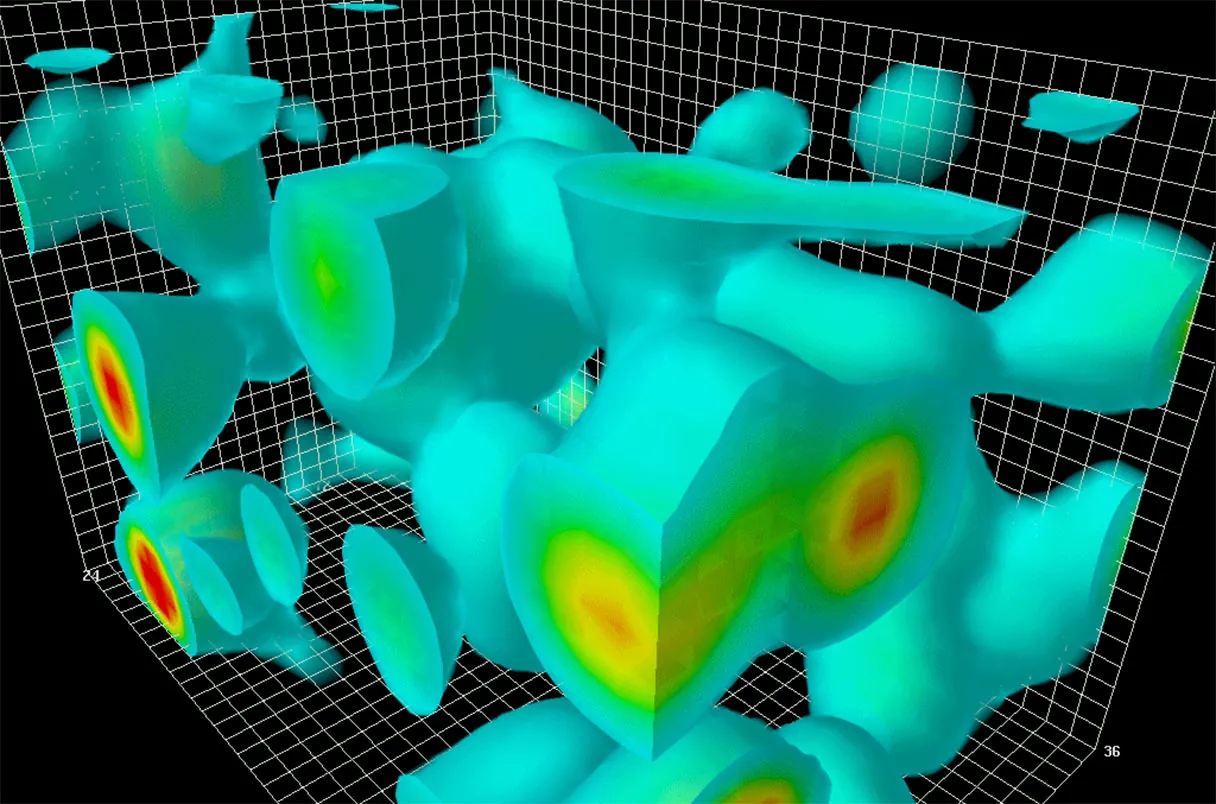
Photo: Derek Leinweber / Wikimedia Commons, via ScienceSource page
The committee David Gross chairs published its first assessment of OpenAI’s Yang-Mills Lean code on Tuesday, 10 November. The document says a clean rebuild, an axiom audit, and a Comparator check passed. In the committee’s judgment, the submission proves that a relativistic quantum field theory satisfying the Wightman axioms can be constructed as a scaling limit of four-dimensional Wilson lattice gauge theory, for any simple compact gauge group. The same paragraph says the submission does not prove that the infinite-volume limit is unique, and does not prove a mass gap. Joseph Howlett’s story in Scientific American is dated Wednesday. Jacklin Kwan’s in Science reports the same Tuesday release.
A statement dated 9 November, posted by the Kavli Institute for Theoretical Physics, said the release would come the next day and named two repositories: the Lean code OpenAI submitted to the group on 28 October, and a validation that “proves the existence of pure Yang-Mills theory according to the problem statements which are standard in physics and mathematics.” The signatories are Michael R. Douglas, Gross as chair, Arthur Jaffe, Igor R. Klebanov and Nikita Nekrasov. The assessment thanks Ron Nissim and Fred Rajasekaran. It also draws a line the 9 November note does not. “This assessment uses the Lean sources submitted by OpenAI on Oct 28, 2026,” it says, and “does not draw on the separate informal proof manuscript.”
What the two write-ups do with that manuscript
Kwan describes the informal proof as a 1,147-page document OpenAI did not release, and the Tuesday validation as a check of a formalized version in Lean, a language that tests a mathematical argument against a set of axioms. A passed Lean check, she writes, is a sign of logical consistency. It does not mean the still-unreleased proof is correct. Howlett writes that on the night of 10 November the committee posted a document explaining how the proof works, alongside an affirmation of the formal verification, and that “the proof and its Lean code” are now out for scrutiny. The assessment’s own limit is narrower than that sentence. The file it says it checked is the Lean submission. The prose manuscript is the file it says it did not use.
We used OpenAI’s Astra to assist with the digestion of the supplied Lean code. We do not claim to fully understand the proof yet.
— Yang-Mills group assessment, Nov 10, 2026
The assessment says the group’s only connection to OpenAI, besides accepting the submissions, is that use of Astra, and that it has no present connection to the Clay Mathematics Institute. Howlett quotes Scott Armstrong, a mathematician at New York University, welcoming the Lean release and hoping labs will share results widely, because “this review can be done more efficiently and quickly in the open.” Kwan writes that an advisory group on mathematics and artificial intelligence, hosted at the Institute for Advanced Study, has called for the immediate release of the full proof. She also writes that Martin Hairer, at the Swiss Federal Institute of Technology Lausanne, questions the choice of Gross to lead the committee, because Gross had earlier dismissed work to put theories such as Yang-Mills on rigorous foundations as “useless” and “ugly.” Those two words are in Kwan’s account of Hairer. They are not in the assessment.
The half of the prize problem the file does not touch
The assessment sets the construction against the four requirements in the Jaffe-Witten statement of the Millennium Prize problem. It says the submission builds continuum correlation functions as a scaling limit of Wilson lattice gauge theory at a fixed physical volume, then uses compactness to reach an infinite-volume limit that is not shown to be unique. Component theories from that limit are said to satisfy the Osterwalder-Schrader axioms, and the Osterwalder-Schrader reconstruction, also proved in the submission, produces a theory satisfying the Wightman axioms. On the fourth requirement, a positive mass gap, the assessment is flat: “The construction provides no evidence for or against a mass gap in the theory.” It says OpenAI’s construction does not certify the full Jaffe-Witten problem.
Kwan’s physicists treat that gap as the part that would change the interpretation of particles, not the part that was checked on Tuesday. David Tong, at the University of Cambridge, tells her the Yang-Mills theory already describes what accelerators see, and that a rigorous account might still be missing something about how protons and neutrons get their mass and why quarks are not found alone. She writes that OpenAI and a separate collaboration, Levent Alpöge at Anthropic with Ethan Sussman at Northwestern, both claim the existence result and not the mass gap. Sussman and Alpöge have put their working process on GitHub, she writes, and Sussman expects a human-readable manuscript within weeks. Sussman’s line in her story is that he would rather invite other researchers into the work than present hundreds of pages of generated mathematics as a finished product. The committee’s document is the finished object it was willing to sign on Tuesday: a Lean submission, checked, with the mass gap left open.