OpenAI tells Fortune the stand-alone robotics team is gone, and that GPT-6 Astra is what changed the plan
Wen Shao’s story, at 12:05 p.m. Eastern on Friday, is a confirmation the company gave when asked. Research reports to Mark Chen. Applied robotics and hardware report to Greg Brockman. Booth 208 at CoRL in Austin was empty. Altman’s public target for a humanoid demonstration is still 2027.
Feature4 minIn-depth
Priya Shah4 min read
- OpenAI
- Robotics
- GPT-6 Astra
- Agents
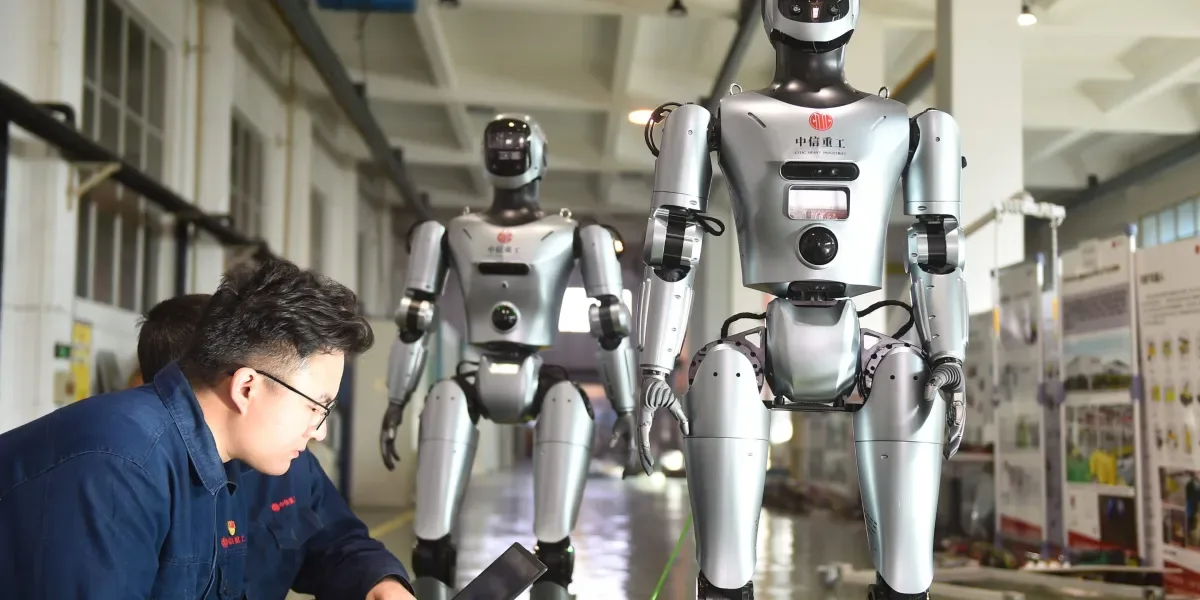
Photo: Huang Zhengwei / VCG via Getty Images, via FortuneSource page
OpenAI has disbanded its stand-alone robotics team and moved the researchers onto other teams. Wen Shao at Fortune, in a story published at 12:05 p.m. Eastern on Friday, writes that the company confirmed the change when asked. A spokesperson said robotics remains a core part of the company’s long-term vision, and described the move as a sign of commitment rather than a retreat. The research team now reports to chief research officer Mark Chen, inside the main research organization. The applied robotics and hardware teams report to president Greg Brockman, inside the larger Applied organization. The spokesperson said the company is still committed to bringing general-purpose robots into the world. Chief executive Sam Altman’s stated target for a first public demonstration of a humanoid robot is 2027. Fortune does not print a new date.
Booth 208, registered and empty
The timing is visible on a conference floor. The change came recently enough that OpenAI had already registered a booth at CoRL, a robotics conference in Austin this week. The conference app and the floor plan marked the spot. When Fortune went to booth 208, it was empty, and OpenAI’s logo was not there. An update on the story, dated 13 November, says the piece was changed to clarify the status of the OpenAI robotics researchers who were at the conference. The clarified account is that a few former members of the stand-alone team were around the booth. They had no display and no demonstration, and they still drew a crowd. Fortune does not name them.
This is the second time the company has taken a robotics group apart. It wound an earlier team down in 2020. Cofounder Wojciech Zaremba later cited limited robot data, and a view that other methods were a more efficient path to the human-like systems the lab was founded to build. The path it took was large language models trained on text, which Fortune credits with ChatGPT in late 2022. OpenAI rebuilt a stand-alone robotics team in 2024 and announced a partnership with Figure to develop models for humanoid robots. That partnership ended in February 2025, when Figure said it would build its own robot models. The company has said it is developing its own humanoid. Friday’s confirmation does not say that project has stopped.
Sora was the assumption in January
The reason the spokesperson gave Fortune is a change of method inside the year. At the start of 2026, researchers assumed the way to make progress on robotics was to build on models such as Sora. Sora is a video model, and generating realistic video requires some implicit grasp of how physical objects move. Since then, the spokesperson said, general-purpose frontier models, including GPT-6 Astra, have shown they can be applied directly to robotics. That finding is what motivated the company to break up the stand-alone team and put the researchers onto teams that work on the general models. Fortune writes that researchers have seen surprising performance when Astra is connected to a robot and used, without a separate robotics model, to perform some tasks. It also describes experiments in which researchers gave Astra camera images, robot information, and a control interface that let the model command actions. In an Nvidia study, Fortune writes, an Astra-powered agent reached a 74.8 percent success rate on a simulated manipulation benchmark, against 51.0 percent for the best specialized robotic models on that leaderboard. The simulation commands a robot in software, not a machine on a floor. Fortune does not name the benchmark.
There may be different starting points for how to grow intelligence.
— Pete Florence, cofounder of Generalist, to Fortune
Florence told Fortune it was unclear that any model that exists now would be the one that dominates robotics over a long period. Guanya Shi, an assistant professor at Carnegie Mellon University’s Robotics Institute, read the reorganization as a signal that OpenAI sees robotics as “no longer a special problem,” and instead as something a general model can take on the way the same frontier models now sit under coding tools or tools for legal and financial work. He also told Fortune that better spatial and reasoning ability already lets general models handle tasks that used to need dedicated training: a bottle in a different place, a change in lighting, the order of steps, or which step failed. He still sees a use for smaller specialized models that run on the robot itself. A large language model, he said, is powerful, slow, and hosted in the cloud, so the robot needs a network connection the whole time. Russ Tedrake, an MIT professor and the cofounder and chief executive of Walden Robotics, told Fortune that robotics companies still have something the labs do not: robots already working in real places, including factory floors, and the data from that work. Better foundation models make that site-specific data more useful, he said, because the robots can learn from it faster.
Fortune places the staffing change next to a cost argument it does not attribute to a named OpenAI executive. It says the company is under pressure to limit costs and to concentrate on a few products. Last year, it writes, Altman told the company to abandon “side quests,” and the company has dropped efforts, including Sora, to move computing toward work it sees as more central and more likely to make money. The loss figure in that paragraph is reported, not a new filing: Fortune says operating losses reportedly totaled $10.9 billion in the most recent quarter, as the company tries to close a funding round and prepares for a possible listing in early 2027. The sentence OpenAI did give Fortune, about the team, is the method. It said it was moving the researchers because it now believes that is the fastest way to build general-purpose robots.