Images 2.6 adds GIFs in ChatGPT, and the API splits into Flare and Sunburst
OpenAI’s Wednesday post says people now create 4 billion images a week across ChatGPT, Codex, and the API, and that Images 2.6 is 50 percent faster. At low quality, Flare can return an image in about six seconds. The developer docs price image output at $30 per million tokens for both new model ids.
Feature2 minIn-depth
James Okonkwo2 min read
- OpenAI
- ChatGPT
- Images
- API
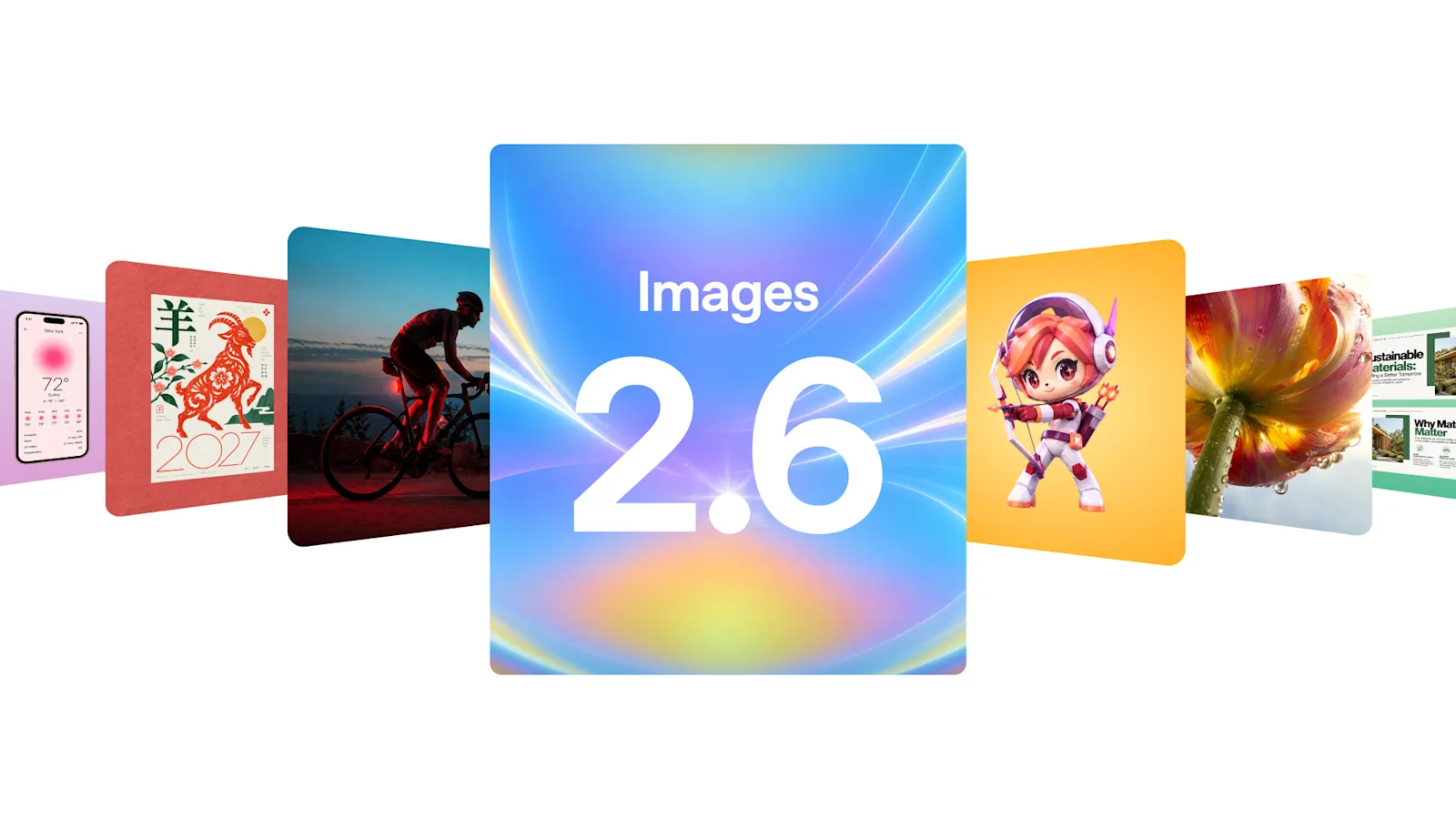
Photo: OpenAISource page
OpenAI put Images 2.6 into ChatGPT, Codex, and the API on Wednesday. The post, dated 4 November, says the release generates images 50 percent faster than before, and that it can turn a still into a GIF: a looping animation of a character, a product, or a storyboard frame. It also says people now create 4 billion images a week across those three surfaces, which it averages to more than half a billion images a day. The release is live, the post says, on desktop, mobile, and the web, in every ChatGPT and Codex subscription tier.
In the API the release is two model ids. GPT-Image-2.6 Flare is the one OpenAI points at speed. When quality is set to low, the post says, Flare can generate an image in as little as six seconds, and it also improves layout on posters and product shots. GPT-Image-2.6 Sunburst is the one for detail. At medium or high quality, OpenAI says, it holds characters, products, and brand details more steadily across an edit. The announcement names two customers. OpenArt’s examples in the post are sprite sheets for looping GIFs. Town, described as a startup building an AI work assistant, used the API to try animated characters in work software. Figma Weave is adding the model inside what Itay Schiff, its creative director, calls a reusable workflow.
GIFs are the native language of social media, and GPT-Image-2.6 lets every OpenArt creator speak it fluently from a single prompt.
— Coco Mao, chief executive and co-founder of OpenArt, in OpenAI’s Images 2.6 post, 4 November 2026
Two knobs, and a price per million tokens
The API prompting guide separates two controls that the announcement treats as a pair. Quality is how much visual detail the model renders, and the guide’s settings are auto, low, medium, high, xhigh, and max. Complexity is how much planning the model does before it draws. The choices are low, medium, and high, and both Flare and Sunburst use high if the caller leaves the field off. OpenAI says low complexity is the setting it recommends for most edits, with quality chosen separately. Markup, already in ChatGPT, comes to the API as a transparent overlay that marks where an edit should land. Generations can come back as PNG, JPEG, WebP, SVG, or GIF. SVG is the vector file. The guide says JPEG and WebP are the formats that take a compression setting, and that a caller should omit input_fidelity on edits because Images 2.6 does not use it.
The model pages price Flare and Sunburst the same way, by the token. Text going in is $5 per million tokens, and cached text input is $1.25. Image input is $8 per million, cached image input is $2, and image output is $30 per million. Neither page lists a per-image sticker price. The announcement tells readers to look up pricing and points at a system card for the safety evaluations. It does not summarize that card. The same prompting guide, in sections kept for older integrations, says gpt-image-1 was shut down on 23 October 2026, and that gpt-image-1.5 is scheduled to shut down on 1 December 2026.