Nvidia introduces GR00T 2 at the robot-learning conference in Austin
Sasa Docca’s post, timestamped 2:00 p.m. UTC on Monday, calls GR00T 2 an open world-action model built on Cosmos. Nvidia says it finished 40 of 50 tasks at least once with no task-specific demonstrations, and that one demonstration per task produced a 71 percent average success rate across those 50. Isaac Lab 3.0 is in the same release.
Short2 minEasy
Eli Navarro2 min read
- Nvidia
- Robotics
- GR00T
- CoRL
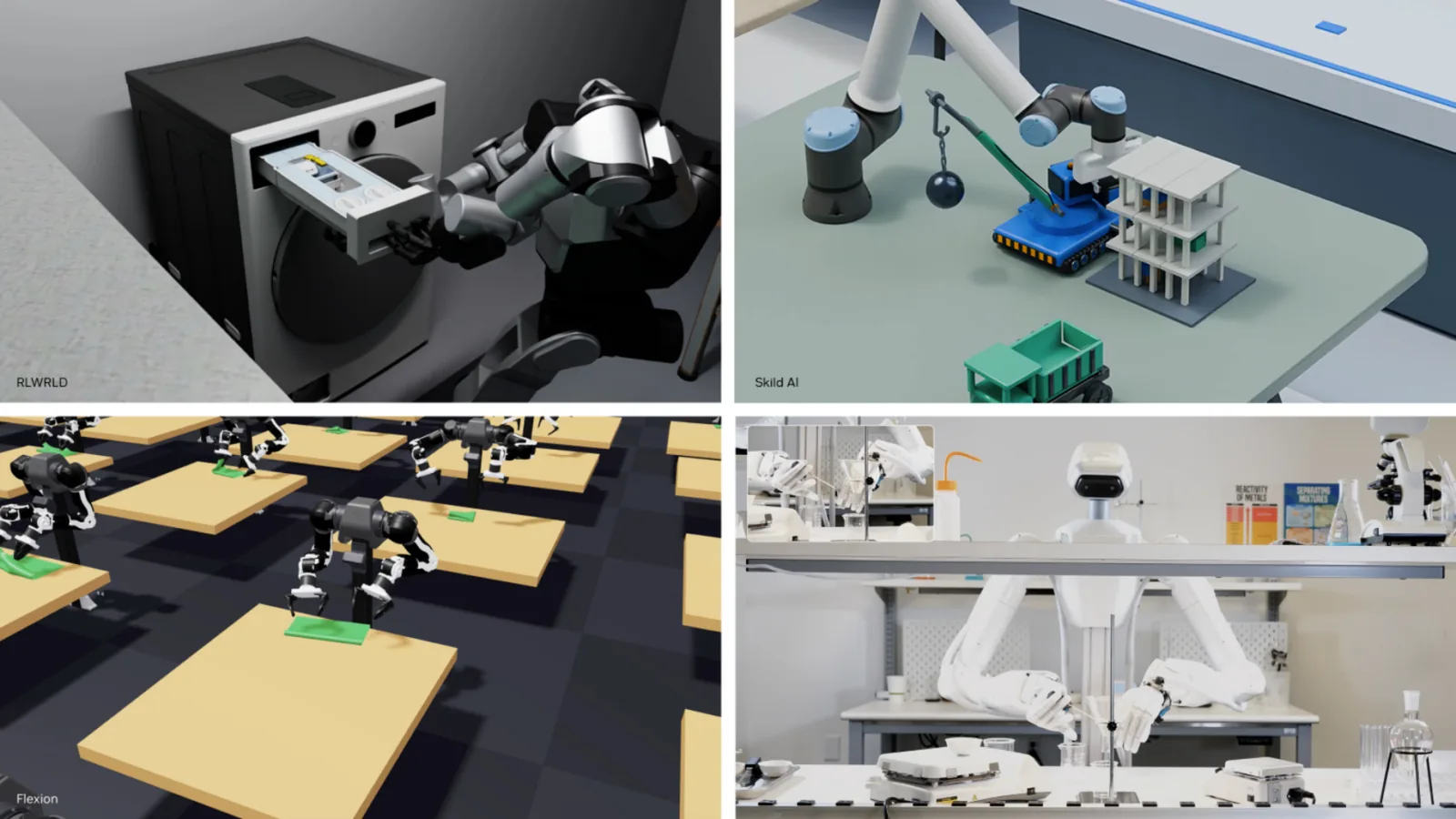
Photo: NVIDIASource page
Nvidia on Monday introduced GR00T 2 at the Conference on Robot Learning in Austin. Sasa Docca’s post on the company blog is timestamped 2:00 p.m. UTC. She calls GR00T 2 an open frontier world-action model built on Nvidia’s Cosmos, trained on robot and human data, including 100,000 hours of Nvidia’s open-source human egocentric video. The skills she lists are dexterous manipulation rather than walking: aligning gears, connecting cables, assembling small parts.
The performance lines are Nvidia’s, and they are about a set of 50 tasks. Without task-specific demonstrations, the model completed 40 of the 50 at least once. With one demonstration per task, Nvidia says average success across the 50 was 71 percent, and with five demonstrations, 95 percent. The post also says agents can call GR00T 2’s API and supporting tools to run skills in sequence and recover from errors. It says the model ranks among the top three in every vision-language-action and world-action category on RoboCasa365, RoboLab, RoboDojo, and MolmoSpaces, with more than one first-place result. It does not print the other names on those boards.
The companies named as trying it are Nexuni, on robotic laundry; Foxconn, on factory automation for server manufacturing; and Siemens, which Nvidia says is evaluating it on industrial work. MicroAGI, the post says, is using a reinforcement-learned version to swap Ethernet cables with a YAM arm. The same post releases Isaac Lab 3.0, the open robot-learning framework. Nvidia says that on a vision-based dexterous-manipulation benchmark, Isaac Lab 3.0 with the Newton physics engine reached up to 2.5 times the training throughput of Isaac Lab 2.3 with PhysX. Newton is what the post credits for simulating cables, cloth, and hands with many joints.
To me, agentic robotics is the most exciting technological development since the internet in 1995.
— Ken Goldberg, professor of robotics at UC Berkeley, in Nvidia’s post
Goldberg is a lead on two projects in the same post, the VABAR benchmark and a framework called Graph-as-Policy, which uses agents to connect individual skills into robot programs and tests those programs in Nvidia’s simulation before an engineer reviews them. The GR00T 2 numbers and the Isaac Lab throughput figure are the measurements Docca’s post actually states. The conference is this week. The post does not give a download link’s version number, or a date by which the weights are on a public hub.