Microsoft’s quarterly filing records $10 billion in revenue from OpenAI
The 10-Q for the quarter ended 30 September, filed on 28 October, puts that figure in a related-party note, including revenue-sharing payments. It is not a product line. Accounts receivable from OpenAI were $7.2 billion, up from $6.0 billion in June. The same filing lists an approximate 24 percent stake, and a separate $272 million gain on the investment. It does not say how much of the $10 billion is Azure.
Short3 minIn-depth
Priya Shah3 min read
- Microsoft
- OpenAI
- Azure
- Earnings
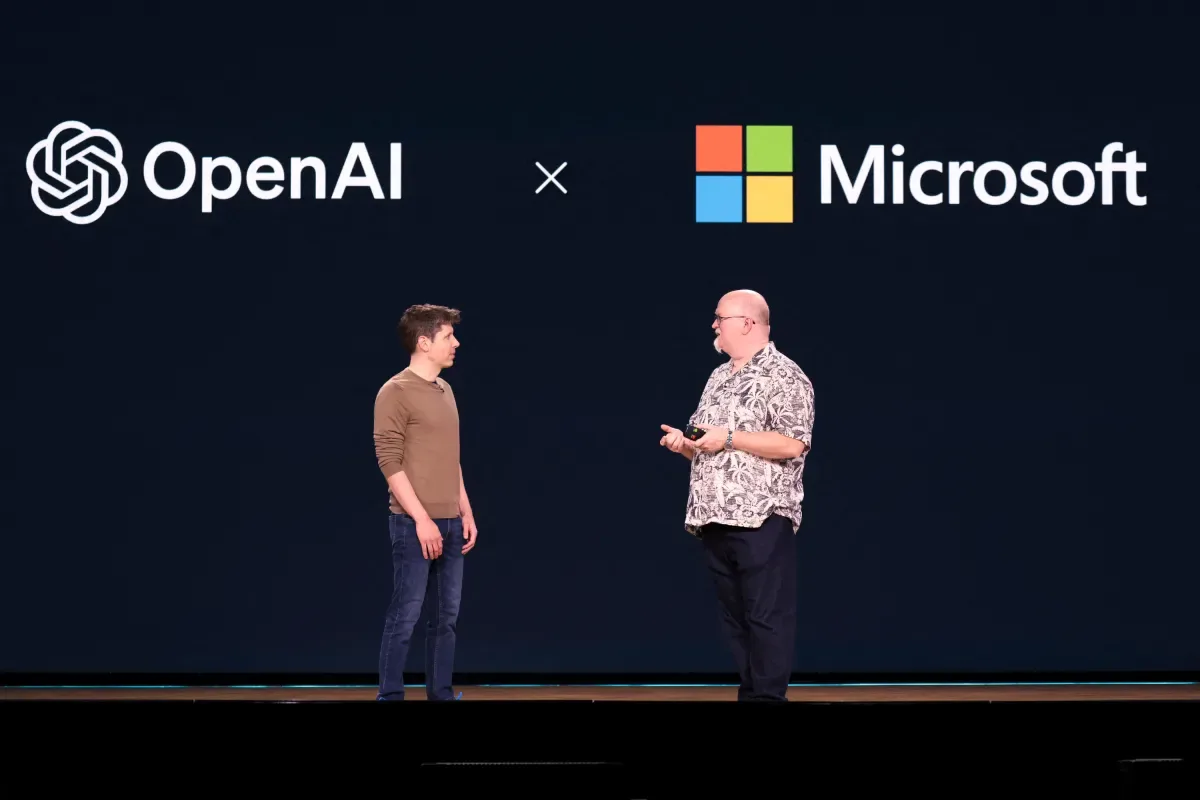
Photo: Jason Redmond / AFP / Getty Images, via TechCrunchSource page
Microsoft recorded $10.0 billion of revenue from commercial arrangements with OpenAI in the quarter ended 30 September, including revenue-sharing payments. The figure is in the Form 10-Q the company filed on 28 October, in the note that treats OpenAI as a related party because Microsoft accounts for the stake under the equity method. The same note says the stake is an approximate 24 percent interest on an as-converted basis. Accounts receivable from OpenAI were $7.2 billion at 30 September, against $6.0 billion at 30 June. Funding commitments related to the investment are $13.0 billion, of which $12.0 billion had been funded. TechCrunch’s Rebecca Bellan, at 2:34 p.m. Pacific, wrote that the receivable is money owed for past transactions, not more revenue, and that the $10 billion is nearly 11 percent of the quarter’s revenue.
That revenue, in the filing’s income statement, is $92,279 million, up 19 percent from $77,673 million a year earlier. Net income was $36,629 million. Diluted earnings were $4.92 a share, against $3.72. The $10 billion is not one of the product lines underneath the total. Those lines include Azure at $33,165 million, Microsoft 365 cloud at $27,778 million, search and advertising at $6,554 million, and Xbox at $5,379 million. The OpenAI note does not say how much of the $10 billion sits inside Azure, how much is a revenue-share payment, or how much is something else. Bellan wrote that TechCrunch had asked and did not yet have the split. A reader can see that $10 billion is larger than the quarter’s Xbox revenue and larger than search and advertising. That is a comparison of a related-party total with two labeled lines. It is not a statement that the $10 billion is extra on top of Azure.
The investment’s own gain is a different number, and it is small next to the revenue. Other income included $272 million of net gains from investments in OpenAI for the quarter, against $4.1 billion of net losses a year earlier. Microsoft says the current-year gain increased net income by $207 million and diluted earnings by $0.03. The year-earlier loss decreased net income by $3.1 billion and earnings by $0.41. The company also publishes non-GAAP figures that strip those gains and losses out. The $10 billion of revenue is not in that adjustment.
Bellan wrote that revenue from OpenAI for the full 2026 fiscal year was $24.1 billion, and that four quarters at the latest pace would be $40 billion a year. She noted that Microsoft’s financial year begins in July, so the September quarter is the first of fiscal 2027. The second figure is that multiplication. It is not guidance in the 10-Q. She also wrote that the disclosed stake had been about 25 percent in June, down from roughly 27 percent after a recapitalization in October 2025, and that Microsoft did not specify the cause of the dilution. The filing states the approximate 24 percent. It does not narrate the change. On the revenue share itself, she wrote that OpenAI is reported to send Microsoft 20 percent of revenue under an earlier investment of more than $13 billion, that neither company has publicly confirmed that percentage, and that an April 2026 agreement keeps a revenue share in place through 2030, subject to a cap, while allowing OpenAI to use other clouds. She dated an additional $250 billion Azure purchase commitment to an October 2025 agreement. Those terms are her account of the partnership. The new fact in the quarterly report is the $10 billion, the receivable, the funded amount, and the 24 percent.