DeepMind’s AlphaGenome Atlas maps every one-letter DNA change — 9 billion of them
The 1-petabyte catalogue is free for academic use. An AVI score ranks variants. Broad researchers used it on an unsolved epilepsy case; it is not a diagnosis.
Feature1 minIn-depth
Priya Shah1 min read
- DeepMind
- AlphaGenome
- Biology
- Science
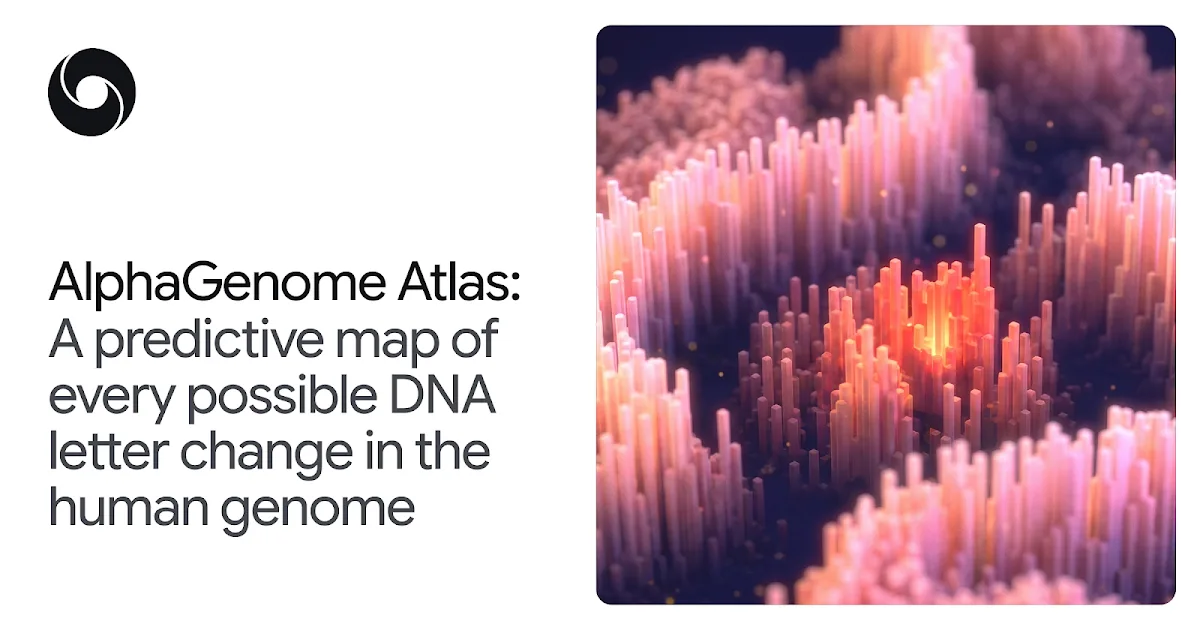
Photo: Google DeepMindSource page
Google DeepMind published AlphaGenome Atlas on September 8: precomputed predictions for about 9 billion single-nucleotide variants — every possible one-letter substitution in the human reference genome — plus more than 100 million observed short insertions and deletions, Nature reported. The dataset is about 1 petabyte, more than 30 times the size of the AlphaFold protein-structure database. Academic and other non-commercial researchers can search it through a website, the AlphaGenome API, or a skill in Google Antigravity. Commercial use is slated for Google Cloud later.
A single number, the AlphaGenome Variant Impact score, or AVI, is meant to make that pile usable. DeepMind says it combines AlphaGenome’s regulatory predictions with AlphaMissense, the lab’s protein-impact model, and works on both the 2 percent of the genome that codes for proteins and the 98 percent that does not. The Decoder wrote that a small network folds those signals together with conservation features — 18 inputs against more than 150 in the older CADD benchmark. Each score can be broken into contributions from splicing, chromatin accessibility, expression and the like.
Collaborators have already put numbers on it. Laura Covill and Anne O’Donnell-Luria at the Broad Institute used AVI to reopen an unsolved rare-disease case and flagged a variant in DNM1, a gene tied to epileptic encephalopathy; AlphaGenome predicted a bad splice that lengthened the protein, and lab screens backed that mechanism. Gareth Hawkes at the University of Exeter applied the atlas to more than 54,000 UK Biobank genomes and reported 22 percent more non-coding associations, including regulatory hits near PLA2G7 and EGLN1. Nature’s news piece is careful: the atlas ranks hypotheses. It does not replace a clinical test.